
Moses Lake man applies ultrasound to livestock
CHERYL SCHWEIZER | Hagadone News Network | UPDATED 10 years, 1 month AGO
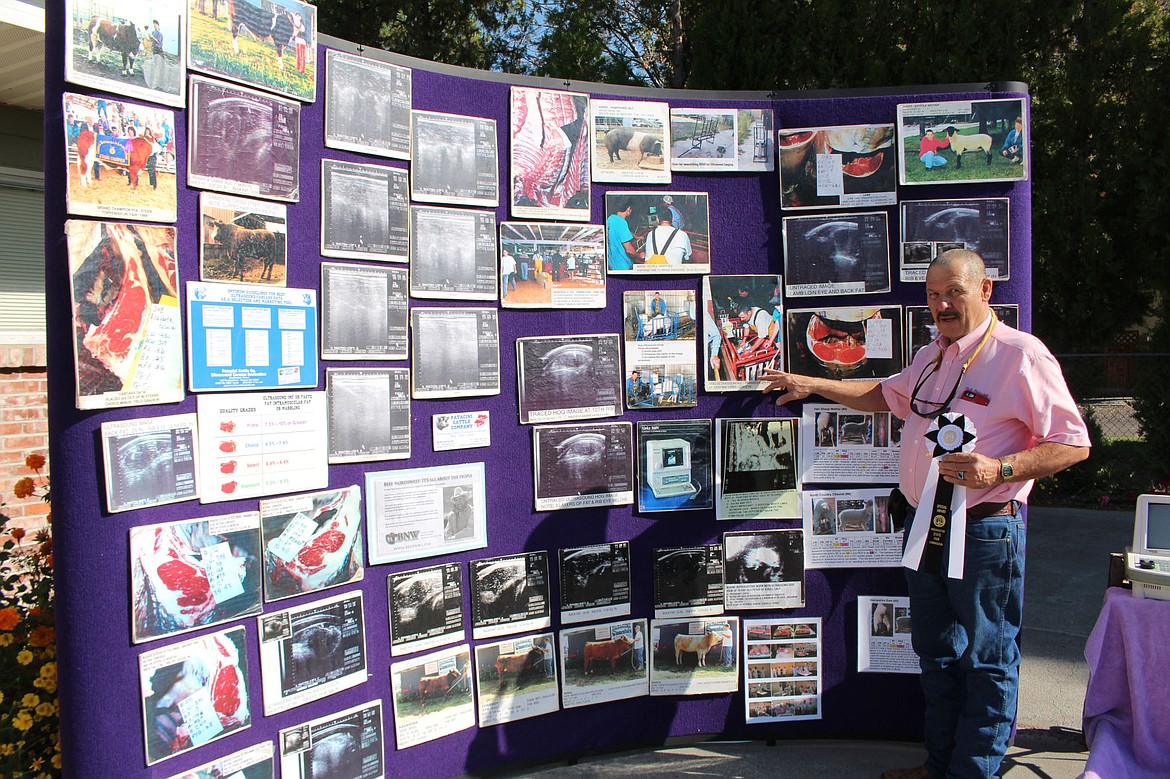
Bob Patacini uses ultrasound to evaluate livestock, and his work with livestock exhibitors earned him a state award.
Senior Reporter Cheryl Schweizer is a journalist with more than 30 years of experience serving small communities in the Pacific Northwest. She began her post-high-school education at Treasure Valley Community College and enerned her journalism degree at Oregon State University. After working for multiple publications, she has settled down at the Columbia Basin Herald and has been a staple of the newsroom for more than a decade. Schweizer’s dedication to her communities and profession has earned her the nickname “The Baroness of Bylines.” She covers a variety of beats including health, business and various municipalities. | September 5, 2016 6:00 AM
MOSES LAKE — The interesting thing about technology is that its applications turn up in unexpected places – at least they’re unexpected to begin with. But really, in the end those applications aren't so surprising.
Bob Patacini is one of a handful of people nationwide who can take ultrasound technology and turn it in a direction that seems – at first – to be totally unlikely.
His business impressed Washington Department of Agriculture evaluators at the Junior Sheep Exposition held in July, so much so they gave him a special ribbon and the exposition a special cash award.
Patacini took the technology most commonly associated with human medicine and turned it to the evaluation of animals. He’s one of seven people nationwide certified to use ultrasound to evaluate sheep, pigs and cattle. He’s been evaluating livestock with ultrasound since 1994, he said.
“We can evaluate beef, sheep and swine for what they call fat and muscle definition,” he said. That’s important to ranchers and farmers who are trying to find the best animals for their breeding programs. It’s also important to exhibitors, including a lot of kids, who raise animals to show and sell at various fairs.
After all, a livestock producer is not interested in killing his breeding stock to find out if they have the necessary characteristics. The ultrasound allows producers and exhibitors to see what’s actually underneath the animal’s skin at any given moment. “I’m analyzing the end product live,” Patacini said.
The ultrasound wand is placed along the animal’s ribs. To the trained eye it shows the animal’s muscles and how fat is distributed among the muscle fibers. (There’s back fat, or “waste fat,” and intramuscular fat, intermixed with the muscle, which is “taste fat,” Patacini said.)
“It’s a selection tool, a marketing tool and a ranking tool,” Patacini said. “We can measure things. We can measure these animals.”
For 4-H and FFA exhibitors, the ultrasound evaluation provides a way for kids to learn more about their animals, Patacini said. They learn “the how-tos and the whys,” and the characteristics of a quality animal, he said. "Tremendously useful tool."
A native of Montana, Patacini said he’s been interested in the difference between animals evaluated on the hoof at fairs, and what’s revealed when the carcass is evaluated. With the information provided to participants with the ultrasound, there’s a more consistent result, he said.
The animal has to hold still for 10 seconds for maximum effectiveness, Patacini said. He built his own chute for swine and uses existing chutes for cattle. Sheep usually stand still if they’re on a lead, he said.
It was at the sheep exposition that Patacini and his business caught the attention of the WSDA evaluators. He received a “Black and White” ribbon, awarded by the WSDA. It “has absolutely no criteria in how it’s awarded,” wrote Paul Nimmo. WSDA Fairs Commissioner. “The award can be presented to a fair board, individual, exhibit, project, anything or anyone that is viewed as making a positive impact on the fair being evaluated.”
Nemmo wrote that Patacini’s efforts went beyond the service he had been hired to provide. Each exhibitor “not only had a mentor willing to share the ‘how-tos’ and ‘why-fors’ through the process, but an educator as well,” he wrote.
The award was a “validation of what I do,” Patacini said. It’s a “pleasure to work with livestock people and 4-H and FFA members to measure and evaluate their livestock.”
ARTICLES BY CHERYL SCHWEIZER
Warden man injured in tractor-trailer collision with train
BRUCE — A Warden man was transported to an out-of-area hospital after the tractor-trailer he was driving was hit by a train near Bruce at about noon Tuesday. "The extent of the driver's injuries is not known at this time," wrote Adams County Sheriff Dale Wagner in a media release. "Preliminary information indicates the semi-truck was traveling above the speed limit and failed to obey posted requiring traffic to yield at the railroad crossing. The train was traveling at a slow speed," Wagner said. "He was moving. He wasn't stuck on the tracks," he said in an earlier interview.
Othello man arrested for Moses Lake attempted burglary
MOSES LAKE — An Othello man jumped into Moses Lake in an unsuccessful attempt to avoid Moses Lake Police Department officers last Friday. An MLPD media release issued Wednesday said Fernando Lira, 36, was booked into the Grant County Jail on suspicion of second-degree burglary in connection with the incident. Lira allegedly attempted to burglarize a business in the 600 block of East Broadway Friday morning. The business owner discovered him and chased him off the property, the release said.
Higher revenues, expenses projected in preliminary Moses Lake city budget
MOSES LAKE — While Moses Lake city officials have reduced expenses and revenues are projected to increase by about 7.9% in the city's preliminary budget, proposed expenditures are projected to go up by about 9.5%. Assistant City Manager James Richmond emphasized the preliminary budget presented earlier this month is not cast in stone. "The projected figures are not finalized. They are requests from departments based on projected 2027 operational costs. Largely, the figures are based on guidance from the city council during the financial sustainability plan analysis," Richmond wrote in answer to questions from the Columbia Basin Herald.