
THE FRONT ROW WITH MARK NELKE: Thursday, Sept. 29, 2016
Coeur d'Alene Press | UPDATED 9 years, 6 months AGO
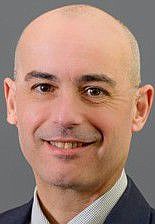
<p>Bill Chaves</p>
The red turf.
The national championship in football, and repeated FCS playoff appearances under coach Beau Baldwin.
A recent NCAA tournament appearance in men’s basketball under coach Jim Hayford.
All have helped Eastern Washington University’s athletic program muscle its way into the conversation, in a region where most of the attention had gone to Washington State football, to Gonzaga men’s basketball, some to the University of Idaho, and even some to Boise State football, and University of Montana athletics.
Just ask Bill Chaves, 50, athletic director at Eastern since 2007, when he takes to the road wearing his EWU gear.
“Even if it was just the logo, the EWU with the eagle, with nothing on it, people recognize it, no matter where you are,” Chaves said the other day, after a visit to Coeur d’Alene to speak to the North Idaho College Booster Club.
“If you were talking to coach Baldwin, he would probably say to you, the turf has allowed him an introduction into recruits without having to introduce the institution,” Chaves said. “They know who we are. That’s almost half the battle, when you’re recruiting from an FCS standpoint. Seventy percent of our (football) roster is Washington athletes, but, the other 30 percent is coming from California — or at least 20 percent — so it’s awesome that they know us down there.”
CHAVES, ON other topics:
On the red turf, which was installed in 2010: Chaves was in Boise in the summer of 2008, walking on the blue turf at Bronco Stadium with a friend of his in Boise, when he noticed, in the middle of summer with little else happening on campus, people were taking pictures of themselves on the blue turf.
At the time, Eastern’s grass field was like many others in the area — when the weather turned, field conditions worsened. So the school was thinking of installing artificial turf.
“It took me walking on it to realize, ‘this (red turf) might not be a bad idea, Chaves said.
And now that it’s here ... “It is one of the hallmarks of the institution,” he said. “Many folks want to be on the turf. You find high schools want to be there, too, which is kind of neat.”
On the possibility of Eastern Washington playing Boise State in football: “We would certainly consider that, no question,” Chaves said. “I’ve reached out a couple of times (to BSU) during my time here, and it’s like a jigsaw puzzle — sometimes it just doesn’t work. If that was our ‘guarantee’ game for the year, and it would work scheduling wise, we certainly would play them.”
Like Idaho, Eastern looks for one “money game” per year to help balance its modest budget. The Eagles are booked for the next four years -- Texas Tech in 2017, Washington State in ‘18, Washington in ‘19 and Florida in 2020.
“At some point, chances are we will potentially reach out (to Boise State again) and at least take the temperature,” he said.
Florida is paying EWU $750,000 to come to Gainesville in 2020.
Chaves said in general, Eastern receives between $350,000 and $600,000 for money games, with games within driving distance usually paying less (by comparison, an FBS school like Idaho can fetch $1 million or more for money games).
“We’ve gotten into the realm where we play the Power-5 schools because they give you a little more, so instead of potentially playing two (in a season), we can play one,” Chaves said. “That’s been our philosphy the last five years.”
When Idaho joins the Big Sky in football in 2018, and the conference increases from 13 to 14 football-playing schools: For at least the first two years, the Big Sky plans to stay with eight conference games in football, Chaves said.
“There’s a conversation moving forward, starting in 2020, that potentially we could go to nine games,” Chaves said, “but we have not officially voted on it.”
As for splitting the Big Sky into two divisions for football -- something FBS conferences have done, so they can create a (lucrative) conference championship game, “for whatever reason, there’s not been a lot of appetite for that (in the Big Sky),” Chaves said. “If one division was more dominant than the other, it may impact the ability for certain teams to make the playoffs.”
In FCS, as many as three Big Sky teams often make the 24-team FCS playoffs. In FBS, only four teams make the College Football Playoff, for a chance at the national title. So the need to create a champion in an FBS conference is greater that in FCS, where teams just need to make the playoffs to have a shot at the national title.
On growing Eastern’s athletic facilities: Chaves said the Eags have greatly improved the infrastructure — locker rooms, weight rooms, athletic training, etc. EWU’s press box was upgraded years ago, with nine suites built. And they’ve increased seating where they could. But there’s more to be done at Roos Field.
“We’ve got to figure out, for sure, additional premium seating,” Chaves said. “Whether it be club seating (outdoor seating, with the option to move out of the elements and under cover), or additional suites.”
He said perhaps 150 fans can be accommodated in the nine suites. Between more suites and club seating, Chaves would like to get to 500 fans being accommodated.
Roos Field has roughly 8,600 permanent seats and with other, “manufactured” seating, the capacity improves to around 9,500.
“Ideally, for us, if we could get between 12 and 15 (thousand), and that includes additional premium seating ... that’s probably our sweet spot,” Chaves said.
On recruiting athletes from North Idaho: Scholarships to Eastern for Washington residents are less expensive, because of in-state tuition. Everyone else, even those just over that imaginary line between Idaho and Washington, is subjected to out-of-state tuition.
“Someone from Idaho is no different from someone in California,” Chaves said. “Even though it’s right around the corner, the amount of dollars and cents we’re going to invest in that student-athlete is no different than if they’re from L.A., Phoenix or Coeur d’Alene.”
On the impact of Idaho in the Big Sky already in basketball: “It gives us another opponent that is attractive on our schedule,” Chaves said. “I think they (longtime fans) love the fact there’s a regional rivalry. When it’s 90 minutes away ... all of our sports are going to re-form a great rivalry with Idaho (the two were Big Sky foes for roughly a decade before Idaho left the Big Sky in 1996). Across the board, they were incredibly competitive the minute they stepped through the door of the Big Sky.”
Two years ago, when Idaho returned to the Big Sky in hoops, Eastern’s men beat the Vandals three times, all in hard-fought games, the last one in the conference tournament. Last season, Idaho sent the Eags home from the conference tourney.
“It’s healthy for the league,” Chaves said. “As much as I’d like to think we have very competitive games with Montana, and Montana State, let’s face facts — the rivalry is Montana and Montana State. This gives us a chance to have a rivalry with someone right around the corner.”
On playing the EWU-Montana football game at Albi Stadium in Spokane, something that happened quite often in the earlier days of Eastern in the Big Sky: Most recently, EWU “hosted” Montana at Albi in 1998, 2000 and 2002.
The 2002 game drew 17,142. The 2000 game attracted 15,678.
Chaves would rather keep the game in Cheney. When the teams played at Roos Field in 2014, the Eagles found room to squeeze in 11,339.
“At the end of the day, my thought process was, I wanted every game at home to be like a Montana. ... and we’ve kinda of gotten to that point,” he said. “We’ve had 15 straight sellouts in the regular season. We play Montana here this year, and it won’t feel much different than our other home games. It used to, but not so much anymore. And once we installed the red turf, our guys want to play on the red turf.”
“Because you could put more people in an Albi, doesn’t necessarily mean the environment’s going to be better for you,” Chaves added.
Besides, more seating at Albi means more potential seating for Griz fans, negating EWU’s “home” advantage.
Chaves said in the earlier days of EWU-Montana games in Cheney, “initially, half the stadium was Griz fans. Now, between 15 and 25 percent (at Roos) are Griz fans. We’ve reduced it tremendously, and that’s the mark of a program and a fan base that’s growing.”
By conference rule, visiting teams are allotted 150 tickets. Chaves said Eastern usually ends up “consigning” another 350 or so tickets to Montana. The rest of the Griz fans are on their own, free to find their tickets in other ways.
“I get the monetary end of it (playing at Albi), but there’s an environment end to it,” Chaves said.
On Baldwin, the EWU football coach, who is 76-31 in his ninth season in Cheney, with the one national title and five playoff appearances, and the constant talk at the end of each successful season of him potentially moving on to a bigger school: “I want the best for him. Period. End of story,” Chaves said. “He’s very committed to Eastern, Spokane and the state of Washington. If something were to occur because he’s very good at what he does, it would happen because it’s the right move.
“At this point, he’s happy, obviously the program’s in good shape. I think it’ll take a pretty good opportunity for him, but at the same token, I think he’s just a great football coach. I think he could succeed at any level. ... If ‘XYZ’ school came and offered a seven-figure contract, that is not something Eastern could entertain (EWU pays him a base salary of around $225,000, among the top third among coaches salaries in the Big Sky, Chaves said). At the end of the day, you would be extremely excited for him.
“I think he appreciates where he’s at, and he’s seen other FCS coaches go to the FBS and he’s savvy enough to know he would want to go to a situation that would give him at least a chance (to succeed) ... he knows what he has, but he’s a competitor — at some point, you want to continue to challenge yourself.”
On where EWU is as an athletic department, and where it’s headed: “I think we’re very realistic as to the reason why we exist -- it’s to make sure that we put Eastern Washington University on the map,” Chaves said. “That’s why, in some ways, you have an athletic department, because good, bad or indifferent, the culture we’re in likes sports. it’s a good way to connect our alums, future students and anybody else to Eastern.”
As an example, Chaves and Eastern just have to look a few miles east on Interstate 90, to what men’s basketball success has done for Gonzaga University.
“It’s worked out OK for them,” he said.
Mark Nelke is sports editor of The Press. He can be reached at 664-8176, Ext. 2019, or via email at [email protected]. Follow him on Twitter@CdAPressSports.