
Business leaders hope to set legislative agenda
Keith Cousins Staff Writer | Hagadone News Network | UPDATED 9 years, 6 months AGO
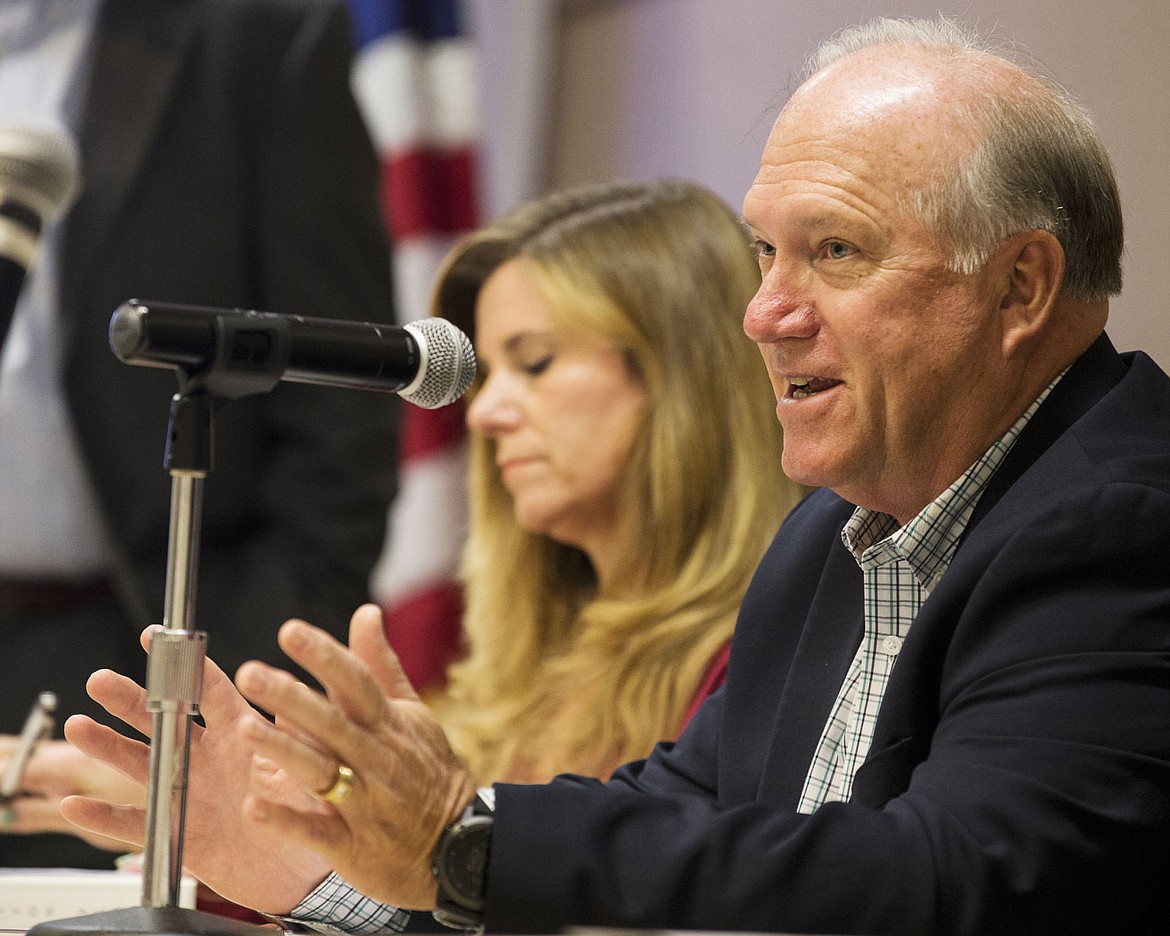
<p>Jim Coleman with the Idaho Transportation Board answers questions about the status and improvement of state and local infrastructure during a legislative forum on Thursday at the Best Western Plus Coeur d'Alene Inn. Topics included CTE, transportation Issues, healthcare, and tax regulations.</p>
COEUR d'ALENE — Business leaders from throughout Kootenai County attended an annual forum sponsored by four local chambers of commerce to discuss legislative priorities.
The four-hour forum, held at the Best Western Cd’A Inn Thursday, was split into a series of panel discussions and question and answer sessions on four topics — career technical education, transportation, healthcare, and taxes. Although several current and hopeful state legislators were in attendance, Coeur d'Alene Chamber of Commerce President and CEO Steve Wilson said the forum was not about hearing from elected officials, and all about gathering input from attendees that will be used to help develop policy positions for next year's legislative session.
"It's time for business to discuss the issues," Wilson said.
Representatives of the state board of education, North Idaho College, and the timber industry were on hand at the meeting to discuss the importance of continued support for career and technical education programs. Dwight Johnson, the head of professional-technical education for the Idaho State Board of Education, told attendees there is a misconception about technical education: that it should only be pursued if a student is not fit for a four-year degree.
"This ignores the reality of the high-paying, in-demand jobs that this training leads to," Johnson added, while stating the goal of state-level efforts is to connect education directly with employment.
Marie Price, director of workforce and community education at NIC, began her portion of the panel discussion by providing the audience with a study from the Idaho Department of Labor as to which career fields will see an increased need for trained employees. The areas, such as health care and manufacturing, all necessitate the need for a workforce with career and technical training, she added.
To illustrate Price's point, Betty Munis, of the Idaho Forest Products Commission, gave the audience real-world examples of how career and technical training has led to high-paying jobs in the forestry field. But, Munis added, there is a need for additional support to ensure interested students are getting the right hands-on experience before entering the workforce.
"Our industry has continued to advance technologically," Munis said. "It's vitally important they are training on state-of-the-art technology."
Mark Browning, who will soon transition from working at NIC to the College of Western Idaho, asked the panel what attendees can do to not only fill the multitude of job openings requiring career and technical training, but making sure those who want to receive such training aren't stuck on wait-lists as well.
"We need to do two things," Johnson replied. "The first is we need to expand the capacity of our secondary and post-secondary institutions. The second is to promote more career advisement at the elementary level to capture those who are becoming interested in these fields."
Local officials were on hand from the Idaho Transportation Department to discuss with chamber members the need for more funding to be directed toward infrastructure both locally and statewide. Jim Coleman, who represents District 1 on the ITD Board of Directors, told attendees his agency's priorities are to maintain existing roads — and they cannot address needed improvements, such as widening Interstate 90 to six lanes, because of current funding levels.
Rep. Luke Malek, R-Coeur d'Alene, asked the panel how much would be needed in state funding to address local infrastructure concerns. It was noted that last legislative session a transportation task force, appointed by Gov. Butch Otter, recommended the state Legislature approve an additional $260 million in funding to maintain and improve the state's transportation infrastructure. However, the Legislature's appropriation fell well short of the recommended amount.
Coleman said locally, the transportation department would need an annual increase of approximately $20 million to properly maintain the current system.
"To expand and meet current needs, it would probably be about $40 million more a year," Coleman added. "And a gas tax increase is the only way we can do it."
Attendees were also given an update on the 78,000 residents who fall into Idaho's Medicaid Gap, meaning they make too much money to apply for Medicaid coverage, but don't make enough to qualify for subsidies through the health care exchange. Mike Baker, the CEO of Heritage Health, told attendees the current system is messy and, after years of attempting a fix at the state-level, there is still uncertainty as to a solution.
"We need to get the right people to the table with innovative ideas that can change the model," Baker said. "It's so frustrating to see what's happening. It's leading to disastrous consequences that we see in our clinic every single day."
ARTICLES BY KEITH COUSINS STAFF WRITER

The Doctor is in
OSBURN — An unusual career path, with twists and turns all over the globe, eventually led Dr. David Lawhorn to the Silver Valley.
What this strike means to the local economy
WALLACE — The strike at the Lucky Friday mine is more economic bad news in a county that doesn’t need any more, said regional economist Sam Wolkenhauer.

Looking to the past
MULLAN — Like its modern counterpart, the last strike at the Lucky Friday Mine near Mullan in 1981 began with a secret ballot and nearly unanimous support from miners to take to the picket lines.