
Risks at the rails
Coeur d'Alene Press | UPDATED 8 years, 8 months AGO

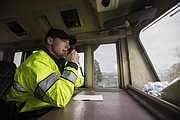
LOREN BENOIT/Press Train engineer Todd Babington sounds the horn as he approaches a train crossing Wednesday morning in Post Falls. Union Pacific Railroad, Idaho Operation Lifesaver and local law enforcement agencies conducted a rail safety emphasis project Wednesday morning to nab violators and to help change driver behavior and raise awareness for train crossing safety.
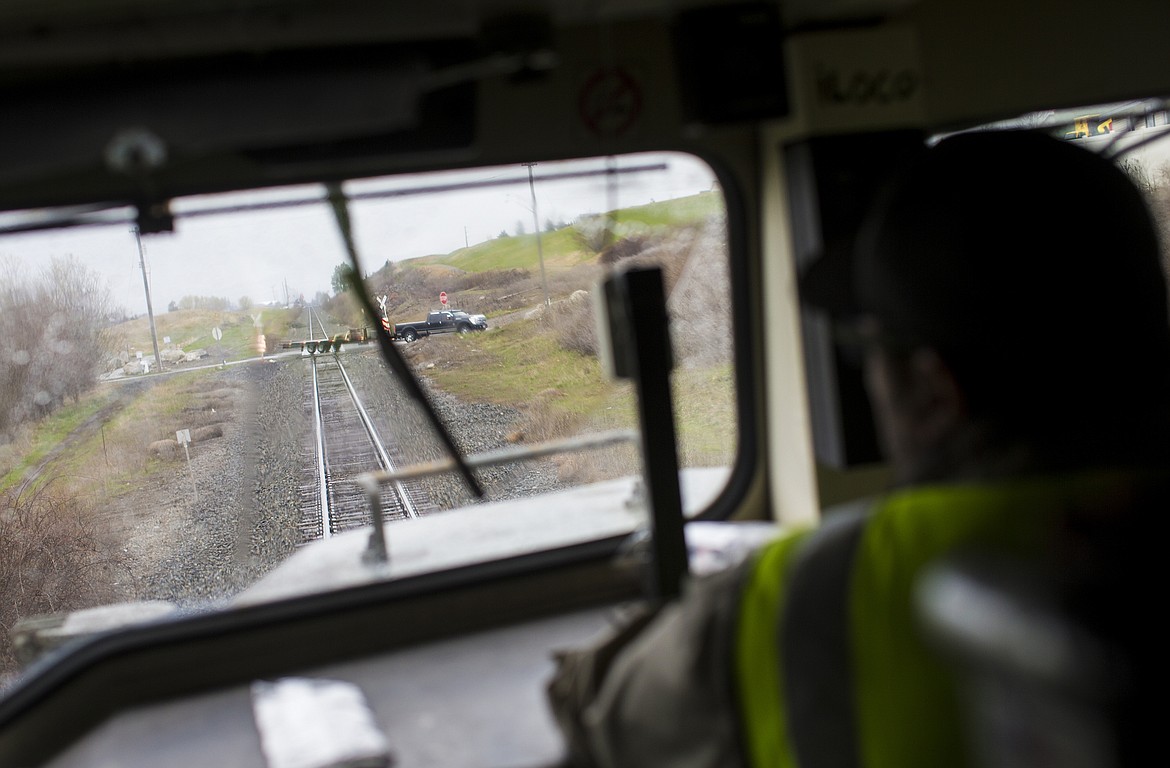
LOREN BENOIT/PressWith a distance of less than 300 feet away, a truck hauling a trailer pushes its luck by crossing the tracks at the Prairie Avenue crossing in Post Falls as a train nears the intersection. Freight trains traveling 55 miles per hour take more than a mile to stop, which is why drivers are urged to stop in designated areas when railroad signals, flashers and gates indicate a train is approaching.
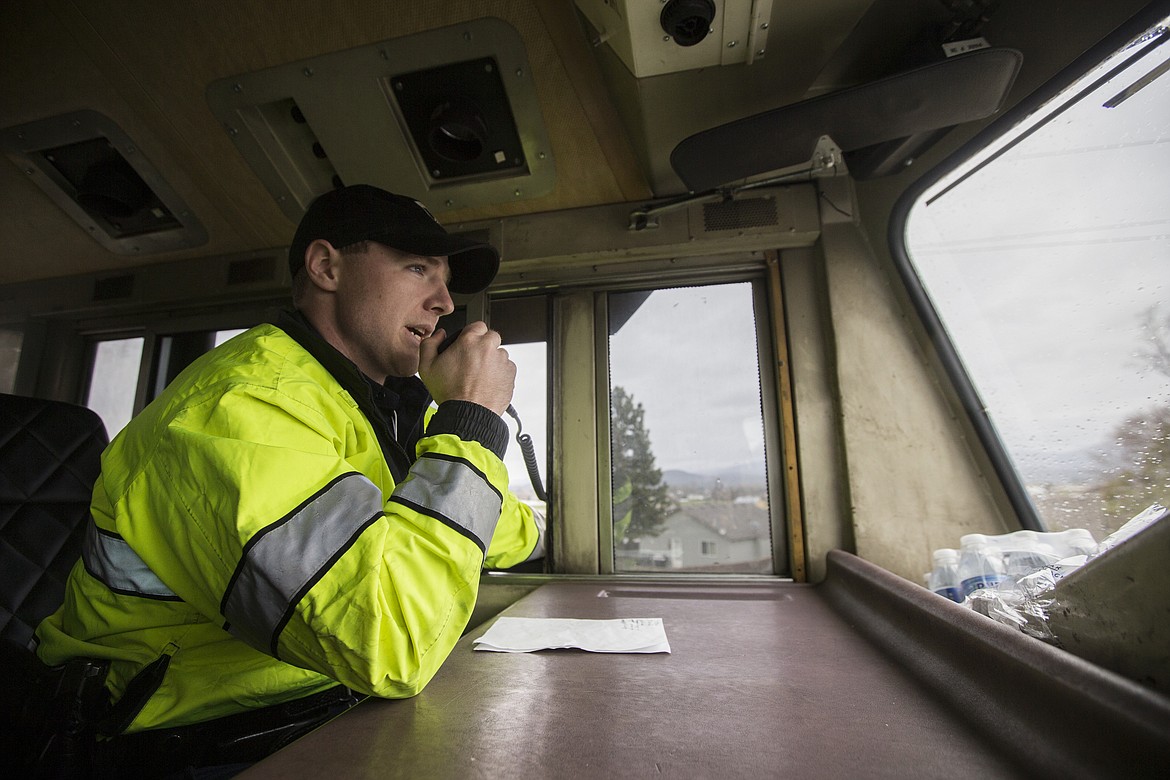
LOREN BENOIT/Press From the front seat in a train, Seth Green with Idaho State Police relays to fellow law enforcement personnel to pull over a driver who didn't stop at a train intersection in Post Falls.
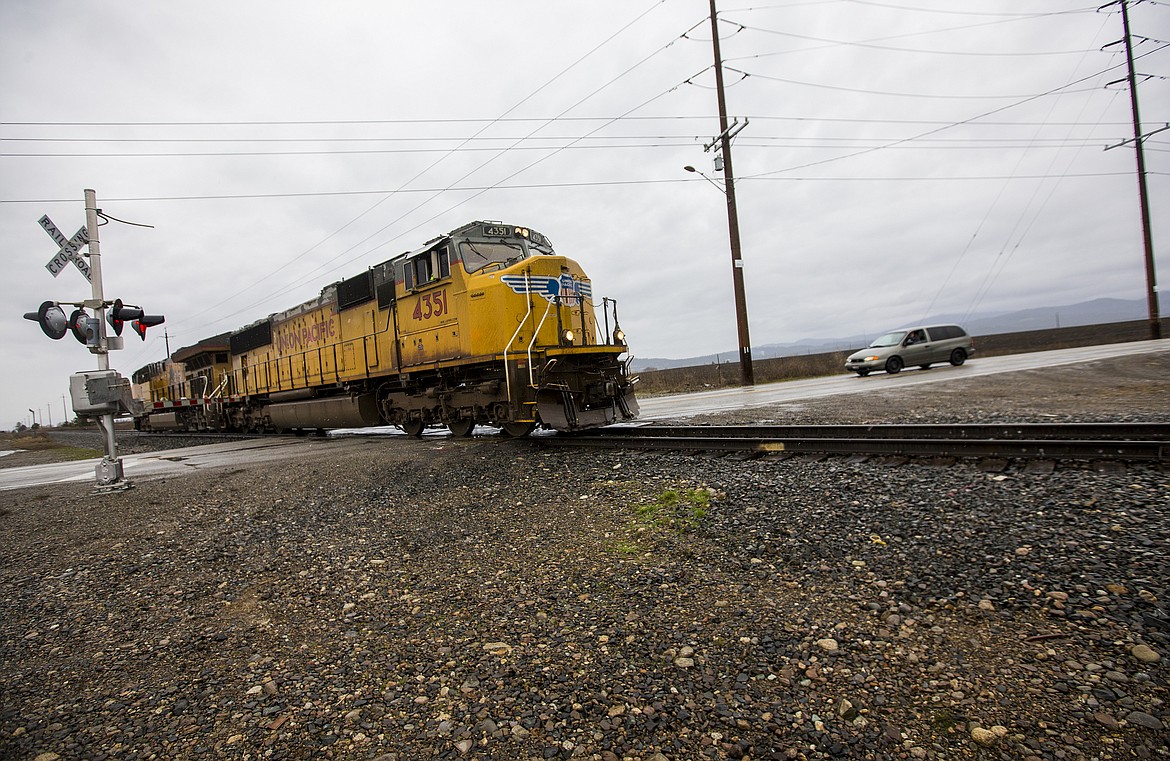
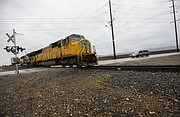
LOREN BENOIT/PressA Union Pacific train makes its way through the Greensferry Road crossing Wednesday morning in Post Falls.
By BRIAN WALKER
Staff Writer
POST FALLS — Those aboard the Union Pacific locomotive gasped as a motorist was visibly tempted to dart across the intersection just ahead of the oncoming train.
At the last second, with the conductor still laying on the horn, the driver opted to stay put, drawing a collective sigh of relief.
"Did you guys feel that?" Travis Campbell, Idaho Operation Lifesaver coordinator, told reporters during Wednesday's Officer-on-a-Train safety education program and railroad crossing emphasis patrol in Post Falls.
"That's what these guys (aboard locomotives) experience all the time. You pray that the drivers will see you and stop."
The scary moment occurred at the Spokane Street crossing — the same one where Post Falls High student Mikelli Villasenor was killed as a passenger in February and classmate and driver Jacob Brockus was injured.
Dicey scenarios occurred time and time again during Wednesday’s emphasis patrol as the engine approached six different intersections on the Rathdrum Prairie, infamously known as one of the state's top hotbeds for vehicle-train collisions.
One driver pulled up so close to the tracks that a crossing gate came down on top of the vehicle, prompting a deputy participating in the emphasis patrol to jump out of his vehicle and race to the rescue.
A truck driver pulling a trailer stopped initially, but even after the engine's horn had been sounded, proceeded through the intersection about 300 feet from the oncoming train.
Another driver appeared to put herself in an uncomfortable position as she backed up at the intersection with the engine approaching.
"The perfect day for us would be no tickets and no violations," Campbell said. "Unfortunately, we don't see that kind of behavior."
Idaho State Police Sgt. Jonelle Greear said law enforcement pulled over 140 drivers in eight hours. She didn't immediately have the breakdown of those issued a $90 ticket versus those warned.
An emphasis last fall in Post Falls drew 90 total violations.
"We had more (on Wednesday), but we also had more officers working," she said.
Greear said drivers being distracted or not wanting to wait are obvious reasons behind collisions, but routes being routine are another.
"People may go through on a regular basis and rarely see a train, but there are actually quite a few that go through," she said. "You can't mess with a train."
Justin Jacobs, UP spokesman, said five to 10 trains travel through the Rathdrum Prairie per day. BNSF Railway also has a system there.
Idaho State Police Trooper Seth Green said he's well aware of drivers' risky decisions at railroad crossings from being on patrol, but observing them from the locomotive that crossed multiple intersections was eye-opening.
"It blows my mind," he said. "It's pretty brutal."
At one intersection as the train approached, there were violations by three drivers. As Green reported them to law enforcement pulling drivers over, he realized there were only two patrol units near the crossing.
"So take your pick," he told the officers on the street.
Campbell said he's amazed how some people have a short memory when it comes to railroad crossing safety.
"Some motorists will be pulled over in the morning and again in the afternoon," he said.
Officer on a Train is a collaboration between Union Pacific Railroad, Idaho State Police, Idaho Operation Lifesaver and city and county law enforcement.
Jacobs said the intent is to change motorists' behavior and ultimately save lives.
"The whole point is to make people more cognizant about safety around railroad tracks," Jacobs said. "When you see tracks, think train. We want to make sure that people will go home to their families. Saving a minute (at a railroad crossing) is not worth risking your life."
While crossing violations were the focus of the emphasis patrol, other activities came up during the program that required officers' attention. Drugs were found inside one vehicle that was pulled over and a bicyclist trespassed onto the railroad's right of way.
"Railroad property is private," Campbell said. "It is dangerous to be on it."
Campbell said many people don't realize it can take more than a mile for the average train to stop. He also put into perspective the force when a locomotive and vehicle collide.
"The average train weighs 6,000 tons," he said. "That's the same force when a car hits a can of soda."
Pullout:
Look, listen and live
The following railroad crossing safety tips and information are provided by Idaho Operation Lifesaver and Union Pacific Railroad:
- Always expect a train and look both ways before crossing the tracks.
- Do not attempt to beat approaching trains.
- Do not stop your vehicle on the tracks.
- Avoid distractions such as loud music, texting or talking on cell phones when crossing the tracks.
- Trains have the right of way.
- Anytime is train time. Trains have no set schedule. They come from either direction.
- The gates mean wait. If the gates are down and/or the lights are flashing, you must wait.
- Signs are posted at every public highway-rail crossing with a number for the crossing and an emergency contact number for the railroad.
- Trains can’t stop quickly. A fully loaded train traveling 55 mph can take more than a mile to stop.
- Nationwide, about every three hours, a person or vehicle is hit by a train.