
Jobs Plus: Next 30 years could be even healthier
Coeur d'Alene Press | UPDATED 9 years, 5 months AGO
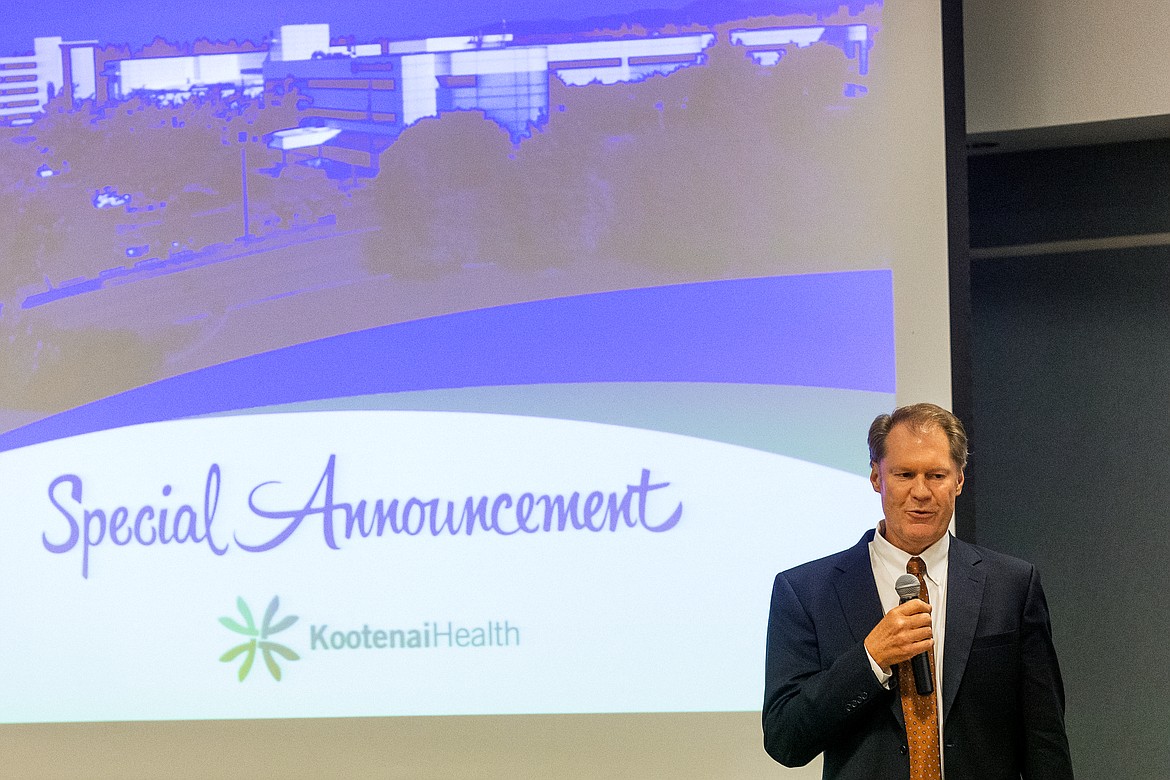
Jon Ness leaned forward. With a gleam in his eye, he pulled a sheet of paper from the folder in front of him. His was the look of a card dealer who knows he's drawing an ace for himself — maybe because every card in this deck is an ace.
“We have data,” he said, laying his card on the conference room table.
Danny Klocko and Kim Anderson, two of Ness's lieutenants, sat there expectantly, smiles barely suppressed.
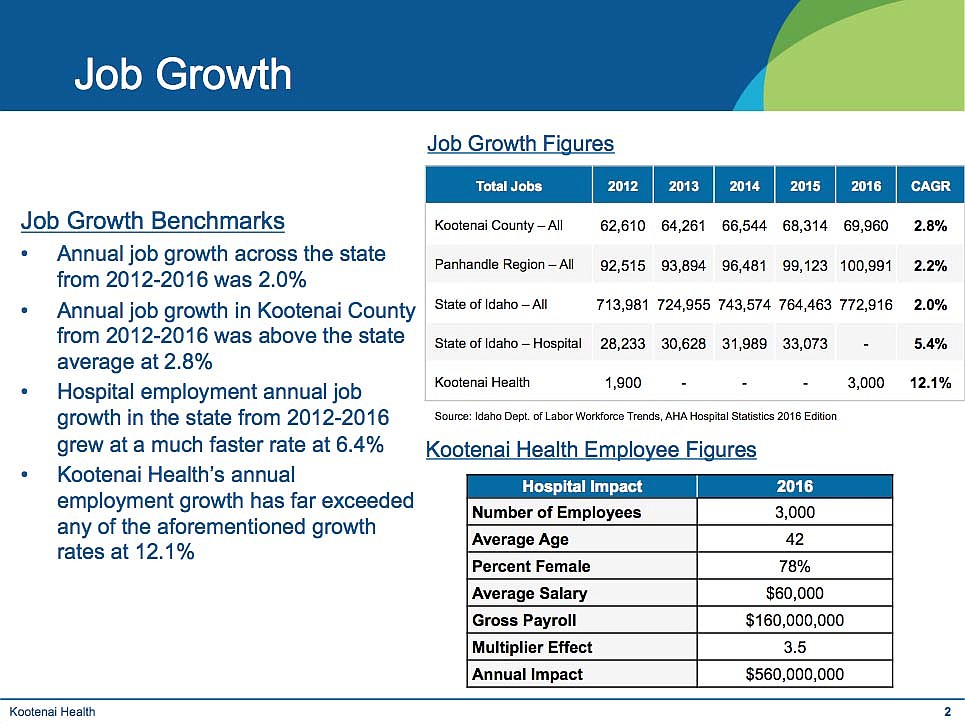
The sheet of paper produced by Ness, CEO of Kootenai Health, showed how the hospital has gone from 1,900 employees just five years ago to 3,000 now.
Its gross annual payroll has ballooned to $160 million. With a 3.5 multiplier effect illustrating how far those payroll dollars really go in creating and supporting other jobs, Kootenai Health's full financial impact is over half a billion dollars a year: $560 million.
But those impressive numbers are big and impersonal, so Ness pointed to three others, smaller but packing powerful punches:
• The average age of Kootenai Health employees is 42. These are prime-of-life performers, firmly rooted, tax-paying, child-rearing Kootenai County residents.
• The average salary is a shade over $61,000. Kootenai County's economic development agency, Jobs Plus, is moving mountains to attract $16.50-an-hour jobs with benefits. Kootenai Health's average is $29.35 an hour — and that figure doesn't even include physicians' pay.
• Seventy-eight percent of Kootenai Health employees are females, a statistic that, like a royal flush, seemed to make Ness almost giddy.
“This is where Mom works,” he said.
• • •
The leaders of Jobs Plus know where Mom works.
More to the point, they're laying a foundation for future growth largely on where Mom works and how many other businesses might branch from that job-generating tree.
Celebrating its first 30 years in existence, Jobs Plus is launching its next 30 years with a subtle name change and a broader vision building off the region's health care industry.
The name change, according to Jobs Plus President Gynii Abracosa Gilliam, is more of a flip than a startling switch.
“We've always had the Coeur d'Alene Area Economic Development Corporation almost as another name after Jobs Plus,” Gilliam said. “We've mainly just flipped it around. Jobs Plus sounds like we're an employment agency. We're not an employment agency; we're the local EDC.”
And so it is: Coeur d'Alene Area Economic Development Corporation/Jobs Plus. Emphasis on Coeur d'Alene, not Jobs Plus.
“Coeur d'Alene, the name, is already pretty well known, thanks to Duane Hagadone and our chambers of commerce,” Gilliam said. “It's known not just in the United States but globally.”
Giving a hat-tip to the Floating Green among other landmarks, Gilliam said Coeur d'Alene is a name to “take advantage of. Since we are marketing our region, let's get to that known quantity.”
Fair enough. Armed with a slightly new name, the CDAEDC/Jobs Plus is preparing to do battle on a much larger battlefield. And they can thank Kootenai Health, among others.
An august group
Gilliam said a group of about 60 to 65 business, education and other economic development leaders has recognized the importance health care plays locally and are meeting regularly to forge a health care initiative. According to Gilliam, the local health care industry contributes about 12 percent to the Gross Regional Product — a massive chunk of production, taxes and payroll dollars.
With the launch of Washington State University's medical school in Spokane, giving that community two medical schools now, Kootenai County is going to feel the pleasant aftershocks of a positive health care earthquake from the other side of the state line, Gilliam predicted.
“Usually when you get that number of [medical school] students, you start building a life biosciences cluster,” she said. “It just happens across the nation over a 15- or 20-year period. Both WSU and UDub [University of Washington] are very focused on R&D [research and development] anyway.”
To envision the potential, Gilliam recalls formation of the massive, globally respected Research Triangle Park in North Carolina — “but ours would be a way smaller version of that,” she acknowledged.
Still, health care-related R&D and possibly other offshoots and peripheral businesses blossoming in Kootenai County could be big for our community. Spokane might be home base with its med schools, but Gilliam believes it'll be good to live next door.
“Yes, it's happening in Spokane, but just as we are part of that supply chain for Boeing [with numerous aerospace-related manufacturers here], we're going to become part of the supply chain to the R&D activity that's happening. Because of this strength from Kootenai Health and its partnership with the Mayo Clinic, a lot of it could potentially happen in our space.”
In August 2014, Kootenai Health became one of just 30 Mayo Clinic Care Network affiliates in the U.S. — and the first in the entire Pacific Northwest. The partnership allows KH to provide advanced medical information and technology for its medical staff, which in turns allows patients to receive world-class care close to home.
Studies shed light
Gilliam said the group of 60 or so still is in early stages of discussion and brainstorming, but based on two studies — one thanks to Avista Corp. and the other still to be done with a grant from Idaho National Laboratory — a pathway is beginning to emerge.
The study by Avista showed three life bioscience opportunities that might fit Kootenai County's strengths: Informatics, diagnostics and pharmacology. Gilliam said of those three, informatics — information science — might hold the greatest potential.
“We're homing in on informatics,” she said. Paraphrasing local industry experts, she added: “Everything in the hospital has an IT element to it, and everything in the hospital has a cybersecurity element to it.”
Moving forward, cybersecurity — the field of protecting electronic data — just might become Kootenai County's code word for an infusion of great jobs.
The state's two largest universities are investing in advanced cybersecurity programs, and INL is gaining prestige as perhaps the national laboratory leader in cybersecurity expertise. The local group of economic development leaders sees health care as perhaps the beginning but nowhere near the end of how far a leading cybersecurity sector here might go.
“This program started out as the health care initiative, but we also know that if we focus on cybersecurity and informatics, it'll cut across all industries,” Gilliam said.
For example, Gilliam used aerospace suppliers as an example. She named several local businesses that create products for Boeing and connect electronically with that huge company. Hackers breaching systems at one of the local suppliers could conceivably attack Boeing through that conduit, which puts a premium on maximum security for all involved.
There's another benefit of the cybersecurity-informatics-health care focus, Gilliam concluded.
“As we get into these things we can ask, ‘What can we do that helps everybody be healthier?' Let's use the system, let's use the data ... to improve health. That could start up businesses, too.”
Other engines
Known as a solid base for manufacturing, Kootenai County won't shed that reputation in the years ahead, Gilliam said. It contributes about 10 percent to the Gross Regional Product.
“We are not moving away from manufacturing,” she said. “This is the Catch-22: We are adding this [health care initiative] to our workload, which totally spreads this team very, very thin every once in awhile. Manufacturing is still one of the strengths of our area ... and we're not about to lose that.
“Our goal is still to keep this area diverse in employment, make sure we have the tax base we need, the living wage we need. We're rebalancing, would be the way to put it.”
Gilliam said another area of growth ahead is maybe not as exciting as keeping North Korea from knocking out North Idaho's power grid, but is key to job diversification and good wages with benefits: warehousing and distribution.
“I think we're going to see more and more of that,” she said, noting Transamerican (4wheelparts.com), Orgill, Inc. and Odom distributors have all expanded or located new operations here in just the two years Gilliam has overseen the CDAEDC/Jobs Plus. “It's the Amazon model of getting everything to you the next day.”
On the more immediate horizon — perhaps as early as this fall — Gilliam said the group is emulating a program started in eastern Idaho that locally is being referred to as the High School Road Show. She said that initiative will target ninth- to 12th-graders and their parents, showing them how many great options there are to continue educations that lead to good jobs in tomorrow's economy.
“Business needs labor — talent, workforce, whatever you want to call it,” she said. “Where we need to be is where they are: ninth through 12th grade. We want to show them that four-year degrees, master's, certifications, apprenticeships, stackable credits — they're all good choices.”
• • •
Back where Mom works, Jon Ness is thrilled to see economic development leaders looking at health care in a new light.
A rather dazzling new light.
“Should health care be a growth sector associated with Jobs Plus initiatives? Our view is, absolutely,” he said. “Health care is not any longer just a service. It's a growth sector in our local economy.”
One that averages $61,000 a year with benefits, no less.
Ness and Klocko, the hospital's human resources VP, pointed at almost unlimited potential.
“When you include all of the ancillary businesses, like research and manufacturing health care-related products, all of that is part of what a whole medical corridor could look like,” Klocko said.
Ness added to the list.
“Information technology associated with dictation companies, electronic health records, the medical records storage industry, health care analytics where they're analyzing data — there's a whole industry associated with that,” he said. “Then there's device manufacturing companies, medical devices for all of us who need things like new hips and knees. There's clinical research and medical research companies that want to be associated with health care organizations.”
While the visions of Kootenai Health's leaders and economic development proponents all seem to be merging, a fair question to ask is: Why here? Ness has the answer.
“It's our demographics,” he said. “In our region, population is what drives the health-care industry.”
Ness noted that from 2010 to 2015, the five-county population including Kootenai grew by 5.4 percent. “Not much,” he said.
“But the population for people who are 65 years and older — the Medicare population — grew by 24.1 percent. There's your growth in the health care sector because our community is really unique. We're a working community, we are a seasonal and tourist community and we are becoming a retirement community.
“That is the trifecta for health care growth.”
Ness isn't hogging credit for his organization, by the way.
“There's all the other good health care in our community,” he said. “It's certainly not just one organization; it's the whole industry.”
• • •
The story of the Jobs Plus really started with Bob Potter, its first president hired in 1987 then serving for 16 productive years, so it's only fitting for this series to end with him.
Gilliam spoke recently of a small business she termed “high probability” to move here and create about 10 jobs, with more likely to follow.
While 10 good jobs — some of them engineering, she said — would be welcome, that's not the real scoop.
“Twenty or more years ago, Bob Potter was working on the owner,” Gilliam said. “Back then the owner couldn't move his business because he was at the peak of what he was doing, but he stayed in touch with Potter. He's at a point now where he's easing off on that company and ramping up another one. He calls me up and says, ‘It might be time to move up there now!'
“That shows you how long the economic development process can take. But at the same time I think it's so cool.
“Bob is no longer with us, but he's still recruiting.”