
Grant PUD discusses fiber options
CHERYL SCHWEIZER | Hagadone News Network | UPDATED 8 years, 7 months AGO
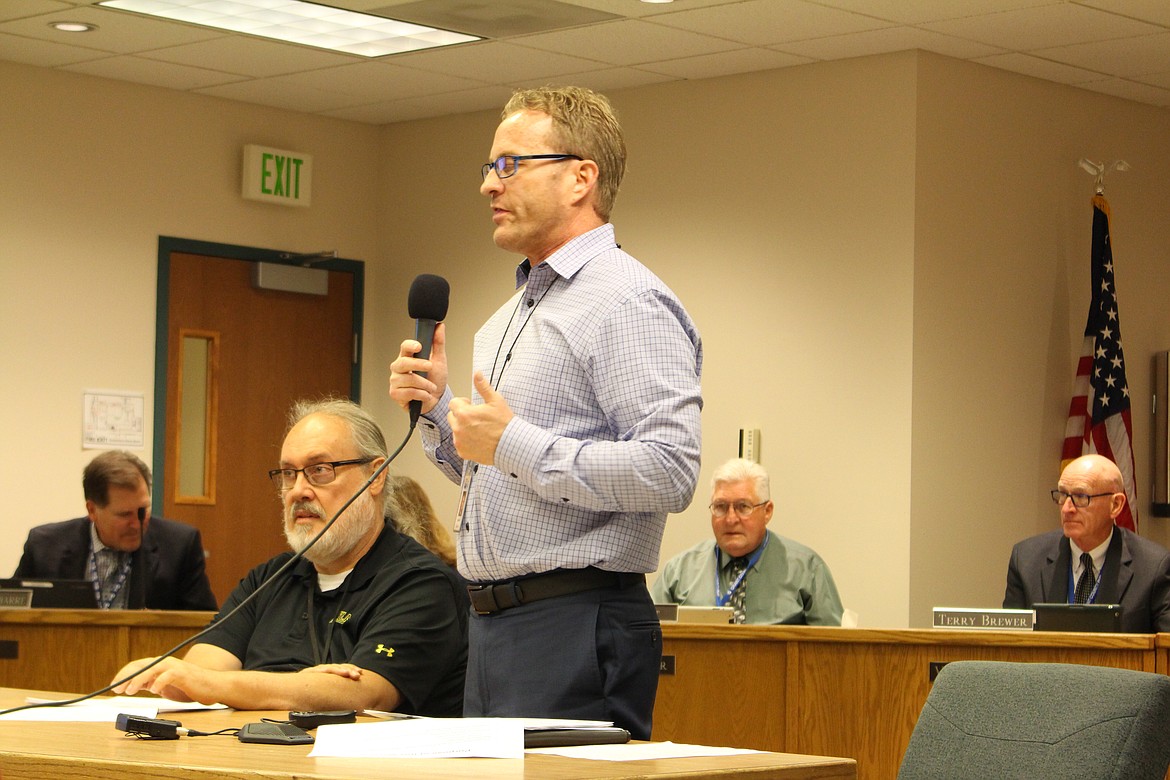
Cheryl Schweizer/Columbia Basin Herald Andrew Munro (standing) and Doug Dawson detailed some tentative options for the Grant County PUD fiber program at a public meeting Tuesday.
Senior Reporter Cheryl Schweizer is a journalist with more than 30 years of experience serving small communities in the Pacific Northwest. She began her post-high-school education at Treasure Valley Community College and enerned her journalism degree at Oregon State University. After working for multiple publications, she has settled down at the Columbia Basin Herald and has been a staple of the newsroom for more than a decade. Schweizer’s dedication to her communities and profession has earned her the nickname “The Baroness of Bylines.” She covers a variety of beats including health, business and various municipalities. | April 26, 2017 3:00 AM
EPHRATA — Grant County PUD commissioners will have to decide how – or if – to continue the expansion of the PUD’s fiber network. Utility district officials laid out the options under consideration during a public meeting Tuesday that attracted a full crowd to the commission meeting room in Ephrata.
Utility district commissioners asked for a review of the system in 2016, to determine what the system actually cost, what it would cost to finish and the impact that might have on electrical rates.
The PUD started working on the fiber system in 2000, and by 2016 it had cost about $256 million, said Andrew Munro of the PUD. Some fiber was installed as part of the PUD’s own operations, and Munro was asked if that cost was included in the $256 million. Munro said the cost of what’s called the PUD backbone wasn’t included.
The $256 million does include the cost of building the existing fiber system, keeping it running and paying the financing costs, minus the revenue it has generated. The study estimated electric system customers had to pay 8 to 9 percent more in electrical rates over those 16 years to pay for the fiber system.
Currently the system covers about 70 percent of Grant County, said Doug Dawson, a consultant who worked on the study. The main question under consideration is what to do about the remaining 30 percent.
Dawson said the usage rate for PUD fiber isn’t as high as it is in other areas of the country. Part of the reason for that, in his opinion, is the PUD is prohibited from selling directly to customers – it must sell to companies that in turn sell to retail customers. Commissioners already have decided to raise rates charged to internet service providers, or ISPs, by $3 per month.
Utility district officials also have to decide what a “sustainable broadband” system looks like, Munro said. One possible definition is that the build-out has to pay for itself, plus cover the costs of financing.
Getting to the remaining 30 percent of the county is going to be expensive, Munro said. The study came up with three tentative options for commissioners and PUD customers to consider.
The first would be leave the system as it is and only add customers within the existing area. That’s the cheapest option, but it leaves open the question of fairness, Munro said. The customers who don’t have fiber helped pay for the customers that have it.
The second option would be “partnership expansion,” where the system is expanded without any help from the electric system. In that case, fiber would only go to those places where the ISPs and customers would help pay the cost.
The third option would be to continue building the system, with the goal of finishing in 10 years. In that case, depending on the number of people who use it, there would be a surcharge on electrical rates, estimated between 2.7 to 4.6 percent.
Another public meeting is scheduled at 6 p.m. Thursday at the George Community Hall. In addition, a phone survey of PUD customers is planned, and a customer survey is available online Thursday. The results of the public meetings, surveys and other information will be presented to the commissioners sometime during the summer, with a goal of June or July.
Cheryl Schweizer can be reached via email at [email protected].
ARTICLES BY CHERYL SCHWEIZER
More park improvements planned for Royal City in ‘26
ROYAL CITY — Lions Park in Royal City now has a soccer field, so city officials will be working on the next phase of improvements in 2026. The first phase of upgrades to Apple Avenue also is scheduled for 2026, and both are among the projects reflected in the city’s 2026 budget. The budget was approved by Royal City City Council members Tuesday.
Sleep Diagnostic Center physician pleads guilty to Medicaid fraud
Charges involve charging Apple Health for recalled, altered CPAP devices
BREWSTER — A Brewster physician who operates a sleep diagnostic clinic in Moses Lake and Wenatchee will be sentenced March 24 as part of a Wednesday plea deal on Medicaid fraud charges.
Qualifying irrigation-only wells approved by Moses Lake council
MOSES LAKE — Public agencies and semi-public organizations will be allowed to drill individual wells to water fields and other publicly accessible green spaces under the terms of an ordinance approved by the Moses Lake City Council at the last meeting of 2025. Council members have been discussing the ordinance for about three months, following a meeting with Moses Lake School District officials.