
Five-month stalemate
Coeur d'Alene Press | UPDATED 8 years, 4 months AGO
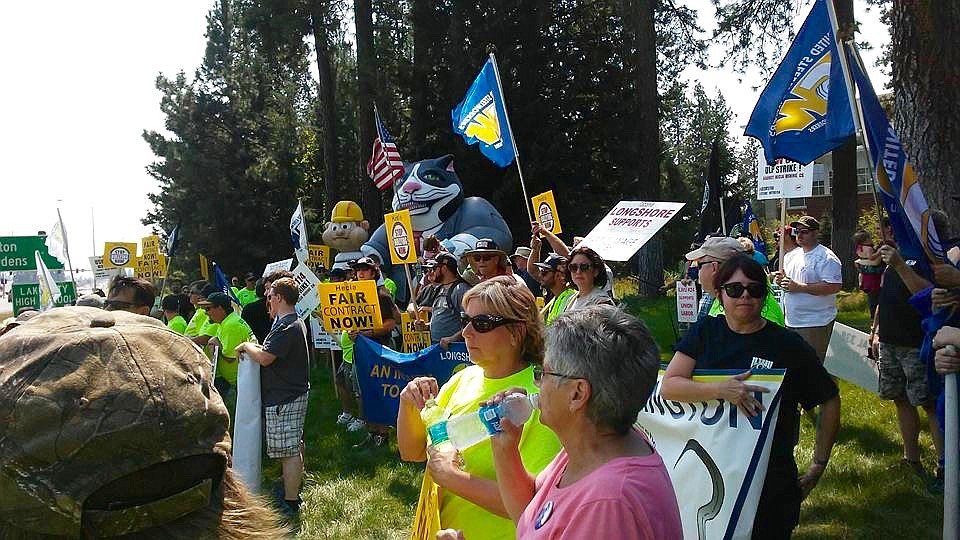
Photo courtesy of USW 5114’S FACEBOOK PAGE USW 5114 miners and supporters hold a rally outside Hecla Mining Co. headquarters in Coeur d’Alene on Aug. 2.
By CHANSE WATSON
Hagadone News Network
MULLAN — It has been five months since the miners of United Steelworkers (USW) Union local 5114 chapter took to the picket line outside the Lucky Friday Mine in Mullan.
Since the miners voted nearly unanimously for a strike on March 12 over what they claim to be unfair labor practices by Hecla Mining Co., the two sides have essentially been locked in an economic cold war. Aside from rumor and speculation, there has been little sign an end is near.
Slivers of hope cropped up in mid-June when news came out the two sides had agreed to sit down in July.
This was the first time the two sides had met since March 14, just two days after the strike began.
That meeting yielded no agreement, but the two sides agreed to meet again on Aug. 3.
RALLY FIRST
The day before that meeting, miners held a rally in Coeur d’Alene outside Hecla’s headquarters to show strength.
The meeting then failed to produce an agreement, but it did highlight the main issue keeping the two sides apart: the job selection system.
Being five months into this expensive game of chicken, simply identifying the main area of disagreement represents a significant step, both sides said.
The company and union have been in disagreement on almost every aspect of what the miners’ new contract should look like after their previous one expired on May 1, 2016.
Everything from hours of work and health plans to recall rights and profit-sharing plans have been points of contention.
Though there has been no evidence to suggest an agreement has been reached on any of the aforementioned issues, narrowing down the main issue is progress.
Phil Epler, USW 5114 president, said the mood at the recent meeting at Mullan City Hall was “optimistic.”
Luke Russell, Hecla’s vice president of External Affairs, said the meeting was “informative to both sides” and “the primary focus of the discussion was on the dispute over the job progression system.”
Another meeting is scheduled today.
THE BIG DEAL
To understand why this issue has taken center stage, one must first understand the two systems Hecla and USW 5114 insist upon at the Lucky Friday.
USW 5114 and the miners want to keep the “bid system” that has been used in the past. Under this system, the miners essentially have the power to manage personnel in the mine. Senior miners have the ability to decide which stope they work in and who they work with in that stope.
If a miner wishes to change jobs or locations, the decision falls to the senior miners, not management.
The same situation applies if a miner wants to stay in his current job or location. The decision comes down to the senior miners.
This bid system is only present in the mine and does not apply to mill or maintenance workers.
UNION’S ARGUMENT
USW 5114 stands by the bid system by essentially taking the “if it isn’t broken, don’t fix it” approach.
Rick Norman, a 36-year veteran Lucky Friday miner, explained in a letter to the editor why USW 5114 believes this system works.
“Our bid system has reached and exceeded production and safety goals time and time again,” he said, “and it will do the same thing in the future.”
The union backs this “record-breaking system” by citing increased production numbers over the years, which have occurred under the current system.
In addition to this point, it also says the bid system keeps miners safe.
USW 5114’s argument is the experienced/veteran miners, not management, are more knowledgeable when it comes to a worker’s abilities and mine conditions.
Because of this, they believe conditions in the mine are safer when these senior miners choose where people work and what locations they work in.
HECLA’S ARGUMENT
Hecla wants to replace the bid system with what it calls a “progression system.”
The progression system allows management, not the senior miners, to decide who works with whom, and where.
Russell argues that under this system, “employees choose a career path where they have the ability to learn multiple tasks (example: the “Mining Support” career path includes caging, nipping, truck driving, loader operation, road maintenance). This system incentivizes employees to build diversity into their skill sets and allows them to grow within the pay schedule.”
He added “when the company has multiple employees with diverse skill sets, it has flexibility to manage the needs of the mine.”
Under this system, Hecla says employees would receive higher wages when they progress to a higher technician (Tech) level by increasing their skills.
“The system is designed to broaden expertise in employees and crews and reward the increase in skill level with a higher base wage,” Helca’s Lucky Friday Labor Relations page states.
On the safety front, Russell believes the progression system is “proven to be safe and benefits both the employees and the company.”
To back up his point, Hecla’s labor relations page attributes overall safety in the mine to the National Mining Association’s CORESafety program, “a risk-based management system approach which has resulted in the Lucky Friday’s safety performance substantially improving.”
Lastly, Russell and Hecla say systems like this are the way of the future when it comes to mining, and this system has already been proven to work at the Lucky Friday in other departments.
“Progression system formats have become the industry standard and no other mine in this country works under the outdated system used by the Lucky Friday,” Russell said.
“The mill employees, maintenance, and electrical employees have been working under a progression system since 2010 and make up approximately half of the hourly work force.”
SYSTEM DISCREPANCIES
USW 5114 disputes the claim the Lucky Friday is the only mine in the country to use a bid system.
This dispute stems from what the two sides define as a “bid system.”
Russell said “while there are other systems where workers bid on positions and jobs, the ‘bid’ system at Lucky Friday, where miners tell management where and with whom they will work, is not repeated anywhere in the U.S. today.”
The disagreement between the two sides regarding job selection systems essentially comes down to a difference in ideological beliefs.
Should the power to call the shots rest with management or senior employees?
Is a veteran miner, more often than not, the best person for the job in regard to work ethic and skill?
Should a manager have the ability to supervise and assign whoever he/she feels is most qualified to a certain task?
Both sides will give you different answers to these questions.
MINERS’ VIEW
The miners’ stance on Hecla’s proposed job system is that it is simply a “union-breaking power grab” that will make the mine less efficient and less safe.
On its Facebook page, USW stated a change to the progression system would devalue veteran workers and put lives at risk.
“Experience and seniority will no longer have any value or meaning. The company will have total control over job assignments,” the post read.
“This may sound all well and good for a workplace such as your office building, but in an atmosphere that is as dangerous as underground can get, we will insist on having a say in our own safety.”
In regard to employees and hiring practices, the union also thinks the progression system is a way for the company to phase out veteran miners and replace them with cheaper, arguably less-efficient/safe, miners.
HECLA’S VIEW
Hecla is just as much against the bid system as the miners are against the progressive system for roughly the same reasons, efficiency and safety.
Russell argues “under the current ‘bid’ system in the mine department, a few select senior miners decide where and with whom they mine. Because miners can make up to $50,000 per year in mining bonuses, non-senior miners are often worried if they will continue to be selected by a senior miner.”
Russell added that with the bid system, “the company has had trouble hiring experienced and skilled miners because applicants know that regardless of their qualifications, their ability to earn the large mining bonuses is dependent upon being selected by a senior miner.”
Hecla states on its labor relations page that it is common to refer to these senior miners as “sugar daddies.”
On the safety side, Russell and Hecla believe “there are no modern safety systems built on a seniority bid system as the union is suggesting.”
Frequent crew rearrangements that occur when new bids are awarded and little to no incentives for individuals to improve their skills also top the list of problems Hecla has with the bid system.