
Lake County sees infestation of rush skeletonweed
MSU News Service | Hagadone News Network | UPDATED 8 years, 3 months AGO
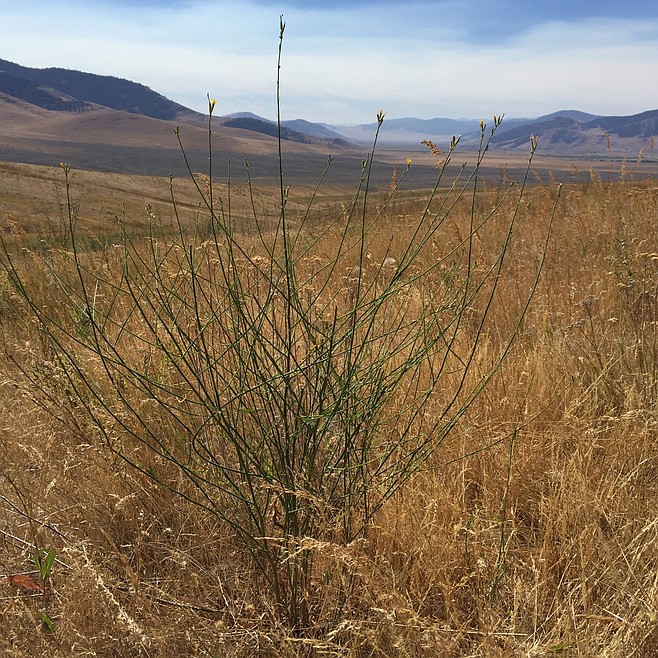
BOZEMAN — A Montana State University project aimed at educating state residents about noxious weeds recently investigated a newly discovered rush skeletonweed infestation in Pablo.
The Montana Noxious Weed Education Campaign in late Julyn evaluated 500 acres at the Pablo Reservoir and Irvine Flats to better understand the current infestation on both private and tribal lands.
Rush skeletonweed is a perennial invasive plant that lacks leaves on its stem, giving the plant a skeletal appearance, according to Shantell Frame-Martin, director of the Montana Noxious Weed Education Campaign. The flowers are small and yellow and occur at stem ends singly or in clusters of two to five. The plant spreads both by its creeping underground roots, and its seeds, which can be blown up to 20 miles by the wind or easily transported in the mud on recreational vehicle tire treads, running boards and undercarriages, Frame-Martin said.
“This plant has the capability to spread very far very fast, making control of these recently discovered infestations imperative,” Frame-Martin said. “It can be very detrimental to livestock, forage and crop production. It reduces native forage, crowds out desirable vegetation and reduces the carrying capacity of livestock on lands.”
According to Frame-Martin, if rush skeletonweed is suspected, the public should contact the Montana Department of Agriculture at 406-444-3140.
“It’s important not to remove rush until it is confirmed, however, as it can go to seed very quickly upon removal,” Frame-Martin said. “Special herbicides are necessary to treat it; publicly available remedies like Roundup won’t work. It is also important, once confirmed, that a yearly monitoring process become established. It is imperative that the site be investigated every year for any new plants, as the seeds live a long time in the soil and new plants can grow after treatments.”
Since 1994, Montana has spent approximately $1.1 million on rush skeletonweed management and control. Infestations currently occur in Sanders, Ravalli, Beaverhead, Lincoln and Lake counties. Washington and Idaho also have sizeable infestations, according to the weed education campaign.
For more information about noxious weeds in Montana, visit weedawareness.org, the Montana Department of Agriculture at agr.mt.gov or the Montana Weed Control Association at mtweed.org.
For more information about cleaning outdoor gear, visit http://playcleango.org.
ARTICLES BY MSU NEWS SERVICE
Research examines implications of an aging rural physician workforce
BOZEMAN — A paper published this week in the New England Journal of Medicine examines the aging physician workforce in rural areas — a demographic shift with important implications for the future — and offers strategies to forestall the resultant, projected diminishment in access to health care.
MSU fundraising campaign tops $413 million
BOZEMAN — Montana State University’s comprehensive fundraising campaign, “What It Takes,” raised more than $413 million for the university’s people, places and programs, MSU officials announced Tuesday, making it the most successful fundraising campaign in Montana’s history.
MSU plans pest management tour stops in the Flathead
The Montana State University Pesticide Education Program is offering a pest management tour for pesticide applicators at six locations across northwestern Montana from Oct. 2 to Oct. 4.