
Study suggests fee increase could price people out of parks
CHRIS PETERSON | Hagadone News Network | UPDATED 8 years AGO
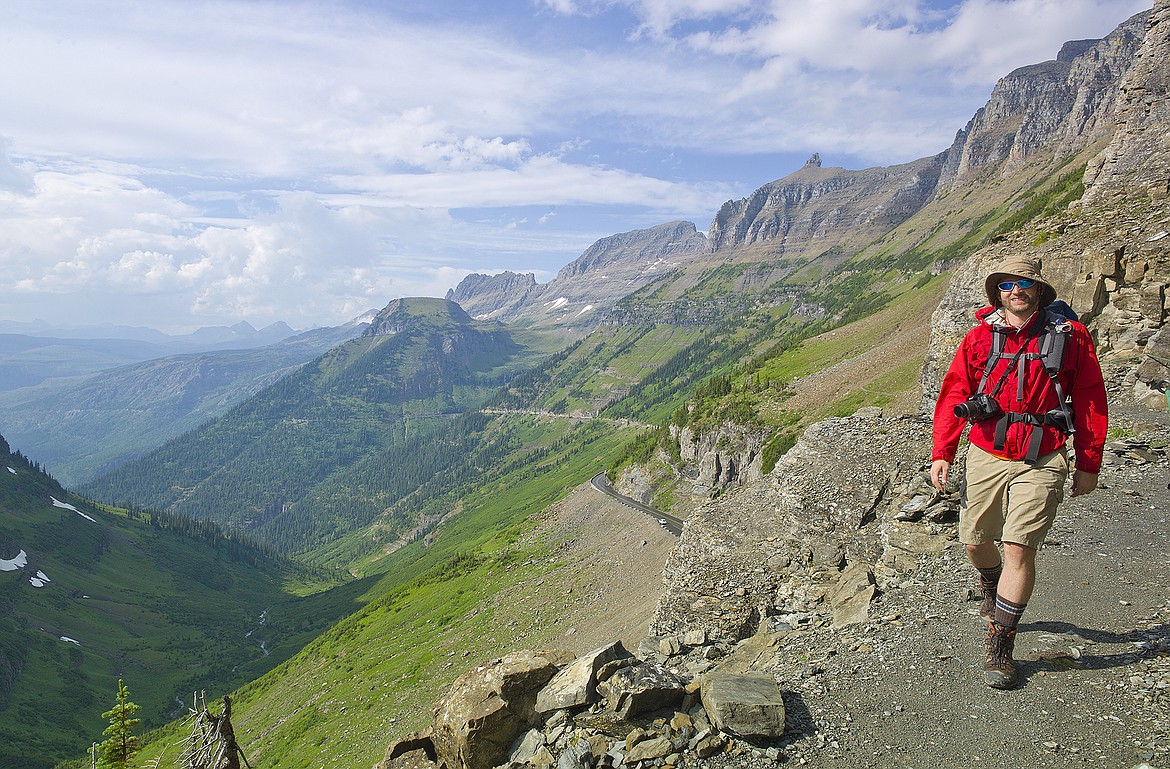
A hiker in Glacier National Park in this file photo.
Chris Peterson is the editor of the Hungry Horse News. He covers Columbia Falls, the Canyon, Glacier National Park and the Bob Marshall Wilderness. All told, about 4 million acres of the best parts of the planet. He can be reached at [email protected] or 406-892-2151. | December 6, 2017 7:43 AM
A new study by the University of Montana Institute of Tourism and Research argues that while an increase in weekly fees to large national parks like Yellowstone and Glacier will result in more funds for the Park Service, it could mean less money to neighboring businesses.
The Park Service, under U.S. Secretary of Interior Ryan Zinke, has proposed raising the weekly entrance fee from $30 for a seven-day pass to $70 for a seven-day pass during the peak season.
Other entrance fees would go up as well, including the annual pass, which is currently $50. That would rise to $75 under the Zinke plan.
Looking at Yellowstone as a case study, the Institute found that hiking the fee would result in a $3.4 million annual loss to spending in gateway communities by visitors to the park.
“Aside from the direct impact to the gateway communities from visitor spending, the entire nature of a $70 per vehicle fee should be carefully considered,” the study authors said. “At $70, concerns may be legitimately raised that many families are being priced out of visiting the major national parks in the U.S. As such, the rationale behind the increased revenue strategy should be questioned.”
Zinke proposed the fee hike as a way to pay for a $12 billion backlog in deferred maintenance at national parks. Seventeen major parks in the U.S. would see the fee hikes under the proposal.
The study looked at the pass increase as a travel expense — like gasoline. There is a direct correlation between travel expenses and visitation to the Parks, noted co-author Jeremy Sage.
For every 10 percent in transportation costs, there’s a 2.7 percent decrease in monthly visits to Yellowstone, Sage noted. In Glacier, surprisingly, that number is slightly lower. For every 10 percent increase, there’s a 2.4 percent decrease in visitation, Sage said. About 13 percent of people who travel to Montana specifically come to the state to visit Glacier, the Institute found through its survey of visitors.
According to figures provided by Glacier, in fiscal year 2017, which runs from September 2016 to October 2017, they sold 136,752 passes of one type or another. Of that, 87,609 were seven-day, single vehicle passes, or 64 percent. About 7,000 were motorcycle passes, and about 2,000 were walk-in individual seven day passes. The remaining were the America the Beautiful Pass annual passes (14,006), Glacier only annual passes (10,829) and senior passes (15,246).
The study found that the price hike, as a percentage of a typical trip, would have a greater impact on local visitors. For example, a person traveling from Wyoming might have a tight travel budget of just a few hundred dollars, while an international traveler, by contrast, would have paid $1,000 for an airline ticket alone.
Sage said the study didn’t look at Glacier because, unlike Yellowstone, they didn’t have the number of visitors that bought a 7-day pass immediately available when they did their study, but they had Yellowstone’s from a previous study. In Yellowstone, about 29 percent of visitors bought a seven-day pass. But as the figures show above, Glacier’s percentage is higher.
The study suggests the Park Service perhaps look at alternative fee structures. For example, Kilimanjaro National Park in Tanzania charges its citizens the U.S. equivalent of about $4.45 per day, while international visitors pay $70 per day.
Visitors who plan touring national parks across the country have another option — the America the Beautiful Pass, which covers entrance fees at national parks and national wildlife refuges as well as standard amenity fees at national forests and grasslands, and at lands and waters managed by the Bureau of Land Management, and Bureau of Reclamation and the Army Corps of Engineers.
It costs $80 a year.
If Zinke’s fee increase comes to fruition, it looks to be a bargain.
ARTICLES BY CHRIS PETERSON
Columbia Falls concerned sewer system could be bottleneck for growth
The City of Columbia Falls could see a significant bottleneck in future growth due to its sewage treatment plant, depending how the city and the state calculate the sewage treatment plant’s maximum treatment capacity without a major upgrade.
Columbia Falls City Council tables e-bike law
The Columbia Falls City Council last week voted to table a city ordinance that would restrict e-bikes and e-motorcycles along with other electrically powered vehicles on its sidewalks and city parks.
Oh, Christmas tree!
I usually talk to my mother on the phone once a week or so. She lives alone in Florida and works for a church doing funerals part-time.