
RED means STOP
Brian Walker; Staff Writer | Hagadone News Network | UPDATED 9 years, 1 month AGO
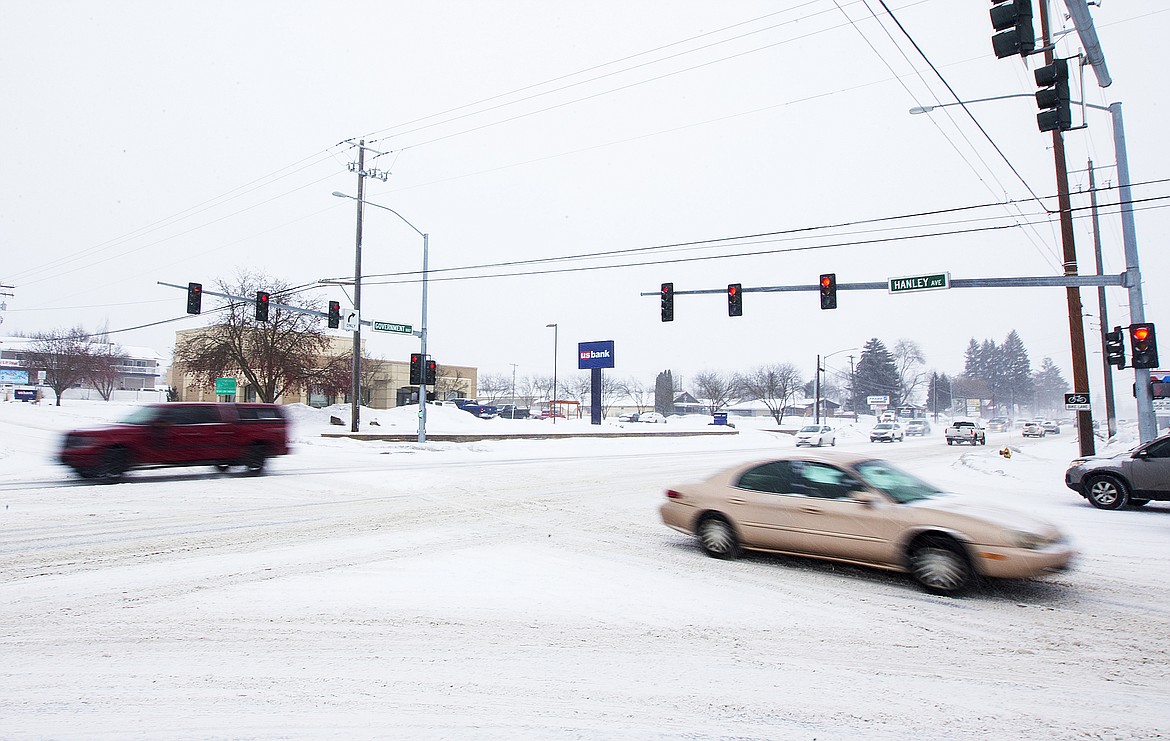
LOREN BENOIT/Press A truck enters the intersection of Government Way and Hanley Avenue on Friday as the light turns red. Some residents have expressed concerns over the number of drivers running red lights and stop signs, but law enforcement officials say their agencies are busier than ever responding to calls and there’s less time for monitoring traffic.
If Jerry Weaver hadn't been a defensive driver — a seemingly forgotten term in this age of aggression on the roads — a log truck running a red light would have crunched his vehicle, if not his body.
"I was coming out of Yoke's (Fresh Market) when the truck blasted through," said the Coeur d'Alene man and former law enforcement officer, referring to a recent near-disaster on Seltice Way in Post Falls.
"I didn't go (immediately on a green light), and it's a good thing I didn't."
Weaver said he sees blatant red light and stop sign violators on a daily basis. His personal experience prompted him to speak out about what he believes is an increasing and potentially deadly issue in Kootenai County.
"I often have to wait (after the light turns green) because, if you go, you may get hit," he said. "It's gotten that bad. It's time for it to stop. What I've noticed is a total disregard for stop signs and red lights. It happens all the time."
Speeding vs.
red light tickets
There’s a big difference in the number of speeding tickets local law enforcement agencies wrote in 2016 vs. traffic signal/stop sign violations.
Coeur d'Alene issued 2,113 speeding tickets and 144 traffic signal/stop violations; Kootenai County, 1,578 speeding and 212 signal/stop; Idaho State Police in Kootenai County, 2,277 and 31; and Post Falls, 180 and 107.
"The numbers prove my point," said Weaver, who worked in law enforcement in Kern County, Calif., as did his wife, Glenda. "Most efforts are focused on speeding, but we all know that intersection violations are more deadly than minor speeding."
Law enforcement officials say there are reasons speeding tickets are much higher than intersection infractions.
Post Falls Police Chief Scot Haug said since officers have radar in their patrol cars they can naturally catch a speeder at any time — whether they’re stationary or driving — as opposed to catching intersection violators only when they happen to be at the intersection.
Haug said his agency, like many others, also responds to a higher number of total calls for service each year, so officers today are often in more of a reaction mode going from call to call than a proactive one of monitoring intersections and roadways.
PFPD responded to 36,000 calls for service in 2016, about 3,000 more than in 2015. Capt. Pat Knight said it isn't unusual that officers will respond to a total of 100 calls for service each shift.
"It's not that signal and stop sign enforcement aren't critical, but that's not a primary focus when considering all the other duties of an officer," Haug said.
Chris Schenck of Idaho State Police said reasons why the number of intersection infractions issued by his agency is low includes there not being intersections on Interstate 90 and the traffic enforcement focus is in rural areas of U.S. 95 where lights are sparse.
"The larger metro areas have city officers who work within the city limits," he said. "ISP tries to focus on the areas outside the boundaries of a city jurisdiction where there is less of a police presence. If there is a problematic area where we are having crash issues, we tend to focus on that."
Haug and Coeur d'Alene Police spokesman Det. Jared Reneau said their agencies conduct occasional emphasis patrols at problem intersections and around schools, but officers generally don't have much time to monitor intersections.
"Citizens call in often to report (problem intersections and streets) and, when that happens, we'll send a traffic team out to keep an eye on it," Reneau said.
Haug and Reneau said drivers running red lights or stop signs hasn't risen to the level that's caused a strategic change in focus in lieu of other officer duties.
"But if we have a problem and we're not aware of it, we need to know about it and address it," Haug said.
A different theory
Weaver believes there's another reason officers' presence at specific intersections is limited.
"From experience, law enforcement officers simply don't like the boredom of monitoring intersections," he said.
Knight said sometimes officers will park near an intersection or along a stretch where speeding occurs to write their reports at the same time. He said just the visible presence of having a marked patrol car there is a deterrent for motorists to break the law.
Weaver said if a lack of officer time limits patrolling problem intersections, other avenues to address the issue should be explored.
He suggested, even if it's temporary, implementing a reasonable mandatory ratio of such enforcement by all officers issuing traffic citations should be considered. Unless something is done, some people just won't get it when it comes to stopping at proper times, he said.
"We have a neighbor who ran a stop sign all the time and she actually didn't believe it was there until we showed her," Weaver said.
Weaver said if agencies have time to set out speed trailers and monitor traffic that way, they should have some time for intersection patrol.
He also there's another factor that can fuel into people being in a hurry, agitated and running through red lights.
"The (road) infrastructure we have is not adequate to handle the amount of traffic," he said.
Cameras
not an option
Weaver also suggested looking into installing cameras at some intersections like Spokane did several years ago and issuing tickets via mail, but Haug said that would require a legislative fix because that technology isn't allowed in Idaho.
Cameras at some intersections in Kootenai County are for sensing movement to help with traffic flow, while others show the Idaho Transportation Department if there are traffic backups on U.S. 95 or other issues due to accidents and other factors. None of the cameras at intersections are used by law enforcement.
Haug, known for embracing many police technology advances, said he's not a fan of law enforcement cameras at intersections that catch red light violators anyway. He said they eliminate interaction between the officer and motorist.
"The officer needs to sell the citation and the citizen needs an opportunity to explain what went on," Haug said. "People can take it negatively when they receive something in the mail and their only way to respond is take a day off from work to go to court to state their case."
Haug, who is involved with law enforcement boards on the state and national levels, said lower overall citations issued by law enforcement agencies is a trend across the country.
"There's been a lot of discussion about why the number of citations are down and, when that happens, the potential for people running red lights or speeding goes up," he said, referring to when officers aren't monitoring a stretch of road or an intersection.
Haug said the main reason citations across the board are down here is that, as the county grows, there's less time to focus on traffic-related issues due to overall calls going up.
At the national level but not locally, he said the "Ferguson effect" is believed to be a factor. That term refers to the idea that increased scrutiny of police after the 2014 shooting of Michael Brown in Ferguson, Mo., and other controversial shootings have led to increased crime rates because officers have backed off some duties.
Haug said he doesn't believe that officer mentality has set in locally.
"Our community has been so supportive of us that we oftentimes can't eat all the food that's brought to the department," he said.
Weaver said his growing concern over people running red lights and stop signs — and how that can become fatal — isn't meant as a knock on law enforcement priorities.
He simply wants to bring awareness to the problem and open dialogue on what can be done if it hasn't started. He watched such violations become a major issue in California and believes it's risen to that point here.
"All I ask management to do is figure something out, somehow, so I don't get killed or my grandkids don't get killed out there," he said.
ARTICLES BY BRIAN WALKER; STAFF WRITER

Agencies brace for wildfires
COEUR d'ALENE — With hot temperatures becoming more common, wildfire season in North Idaho has heated up.
Agent Orange survey to help vets
Dick Phenneger is on a mission to assist his fellow Vietnam veterans and their families.

Suit claims mayor blocking RV park
SPIRIT LAKE — A lawsuit filed by a company pursuing an RV park in Spirit Lake accuses the mayor, who owns properties adjacent to the site, of not allowing the site plan to enter the city's public review process.