
Ray Gunn remembers old friend Evel Knievel
CHERYL SCHWEIZER | Hagadone News Network | UPDATED 8 years, 10 months AGO
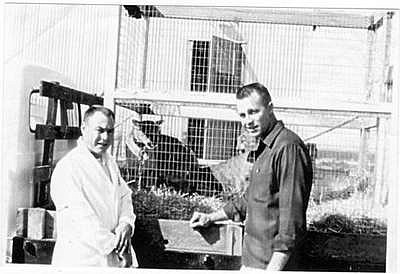
Latham McKay/Evel Knievel Thrill Show and Museum/Courtesy photo Evel Knievel, right, and longtime friend Ray Gunn show off the cage of mountain lions Knievel planned to jump in his first big show. The white coat, Gunn said, was supposed to make him look like a veterinarian.
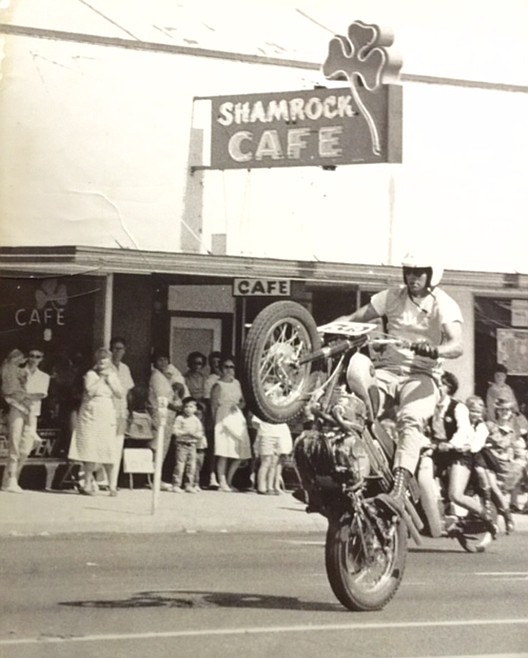
Latham McKay/Evel Knievel Thrill Show and Museum/Courtesy photo Robert Knievel - better known as Evel Knievel – rides down Broadway during a 1964 parade. Knievel lived briefly in Moses Lake in the early 1960s, and his longtime friend Ray Gunn still does.
Senior Reporter Cheryl Schweizer is a journalist with more than 30 years of experience serving small communities in the Pacific Northwest. She began her post-high-school education at Treasure Valley Community College and enerned her journalism degree at Oregon State University. After working for multiple publications, she has settled down at the Columbia Basin Herald and has been a staple of the newsroom for more than a decade. Schweizer’s dedication to her communities and profession has earned her the nickname “The Baroness of Bylines.” She covers a variety of beats including health, business and various municipalities. | February 20, 2017 2:00 AM
MOSES LAKE — It was 1965. A fast-talking young guy who owned a motorcycle shop in Moses Lake was looking for a new, more spectacular – and hopefully more lucrative – career. His name was Robert Knievel; his nickname, earned during a brush with the law about a decade earlier, was Evel.
His friend Ray Gunn, now 83, remembered what happened when Evel Knievel tried to jump 20 feet of cages filled with rattlesnakes and mountain lions with his motorbike.
He made it, mostly. The back tire clipped one of the rattlesnake cages, tipping it over and setting some of the rattlesnakes free. The crowd made a run for it, and the rattlesnake wrangler had his work cut out for him. “I don’t know if the guy ever got them rounded up or not,” Gunn said. It was one of the first times, if not the first time, Knievel performed one of those motorcycle stunts in what became a long career.
Knievel and Gunn stayed friends to Knievel's death in 2007. “We were friends for 40-some years,” Gunn said. More than a decade after his death Knievel still has many fans, and a museum dedicated to Knievel and his life will be opening in Topeka, Kansas, later this year. The museum curator Lathan McKay was in Moses Lake last week, looking for information on Knievel’s life in town. McKay persuaded Gunn to share some of his recollections.
Knievel lived in Moses Lake for two or three years, Gunn said, owning his own shop, first on Third Street and later on Broadway. (McKay was in town to pin down the shop’s actual location.)
They met “through motorcycles,” Gunn said. “I was one of his first customers” and they became friends. “We did a lot of riding together. A lot of beer drinking.”
Knievel was convinced there was money to be made as a motorcycle stuntman, making death-defying jumps over many obstacles, including long rows of buses to fountains to the famous attempt to jump Idaho’s Snake River Canyon. (Knievel's real ambition was to jump the Grand Canyon in Arizona, but the federal government put the kibosh on that.) “Sept. 8, 1974. I’ll remember that day for a long time,” Gunn said.
“I was in the ABC camera copter.” Knievel’s rocket made it all the way across the canyon, even after a parachute deployed prematurely, but the drag from the chute and prevailing winds pushed him back. The vehicle “bounced down the canyon wall” and came to rest on the bank of the river. Knievel walked away with relative minor injures. "He didn't get wet," Gunn said.
But Knievel wasn't always that lucky. Sometimes the stunts were death-defying, including a 1967 jump over the Caesar’s Palace fountains that went wrong and left Knievel seriously injured. He had numerous injuries over the course of his career.
Knievel usually jumped even with injuries, but was just too badly hurt to continue one night in Portland, Ore. Gunn said he worked for Knievel at the time, and told the promoter he’d jump in Knievel’s place for $20,000. The promoter had already started to refund the customers’ money and declined. “I was confident I could make it, but I was glad I didn’t have to,” he said.
Gunn said he worked for Knievel twice, in 1968-70 at the beginning of his career, and in 1973-94, until the Snake River Canyon event.
Back in the beginning he was skeptical Knievel would make it, he said. “I told him he was going to starve to death.” Then he wasn’t sure Knievel could survive all the punishing accidents. But Knievel kept going – it was good money, but it was also a lot of attention. “He liked the notoriety, I think, more than the money,” Gunn said.
“He made my life pretty interesting. It would’ve been a whole different story if I’d never met him.”
Cheryl Schweizer can be reached via email at [email protected].
ARTICLES BY CHERYL SCHWEIZER
Stevens Pass set to partially reopen
STEVENS PASS — A section of US Highway 2 will reopen Monday for daytime use, with a pilot car, but other sections of the road remain closed. A detour will be available for people trying to access the east section of Highway 2 from Leavenworth.
Winter temperatures to arrive and stay for a while
MOSES LAKE — All those mild days in November and December? All those 50-degree afternoons? Well, as people may have noticed, that late fall weather is going away, at least for the time being. Joey Clevenger, meteorologist with the National Weather Service office in Spokane, said weather patterns are starting to push cold air into Eastern and Central Washington.
Moses Lake man arrested for alleged assault after standoff
MOSES LAKE — A Moses Lake man was booked into the Grant County Jail on suspicion of first-degree burglary and fourth-degree assault after he allegedly broke into a woman’s home late Christmas night.