
History repeating itself
Coeur d'Alene Press | UPDATED 8 years, 9 months AGO
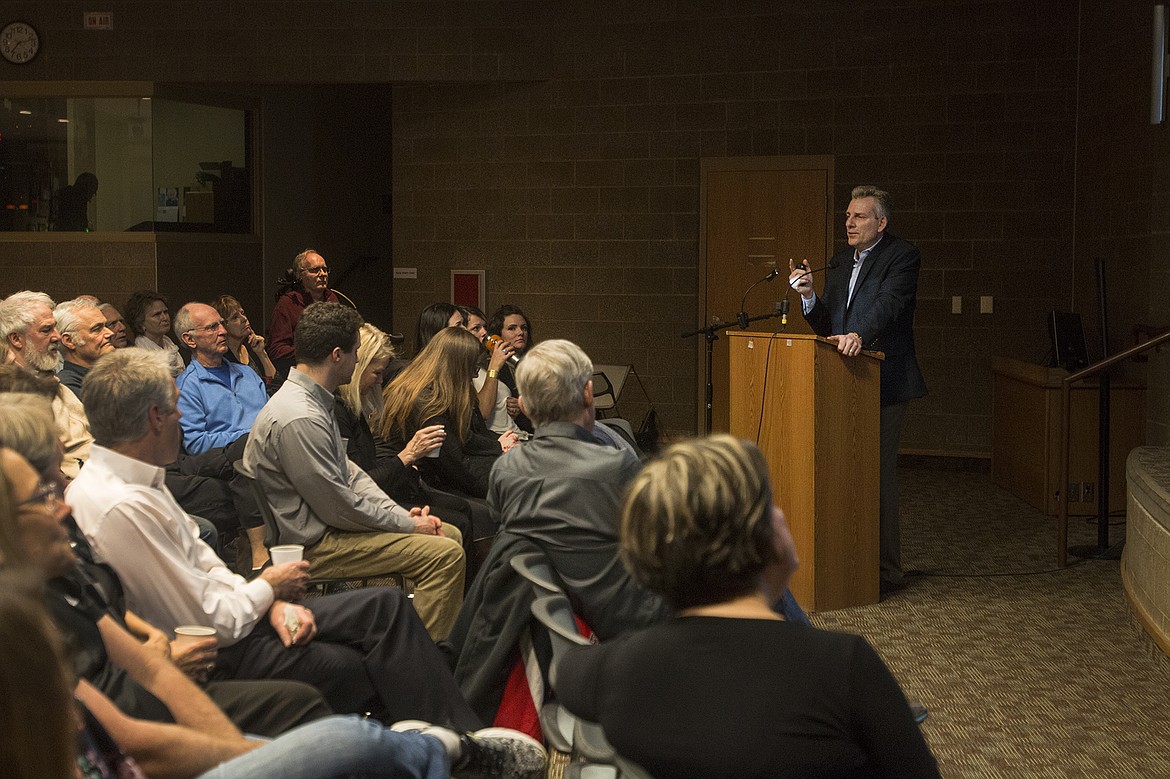
Dr. Cornell Clayton, director of the Thomas S. Foley Institute for Public Policy and Public Service at Washington State University and a Thomas S. Foley Distinguished Professor of Government, gave a lecture Thursday evening about populism and paranoia within the U.S. political system. BETHANY BLITZ/Press
By BETHANY BLITZ
Staff Writer
The crazy in today's politics is nothing new according to Dr. Cornell Clayton.
The director of the Thomas S. Foley Institute for Public Policy and Public Service at Washington State University and Thomas S. Foley Distinguished Professor of Government explained Thursday night how populist and conspiratorial politics came to be and differences between the left and right's views.
He first defined populism as the idea that the people are virtuous and good and the elite are evil. Paranoia, he said, focuses on a sense of impending doom and losing our country.
?Today we are surrounded by populists, left and right,? Clayton said to the room of more than 80 people at the Coeur d'Alene Public Library. ?You have Donald Trump, Sarah Palin and the Tea Party and on the left you have Bernie Sanders, Elizabeth Warren and the Occupy Wall Street.?
He said both Republicans and Democrats are equally as likely to hold populist attitudes; it's one's partisanship and ideologies that shape those views.
He explained that people on the political left believe the political system is controlled by corporate elites; the country's economic system is rigged against workers and in favor of the 1 percent; and that immigrants and minorities are part of the ?people.?
On the right side of our nation's political spectrum, he said, people believe the system is controlled by corrupt politicians or the ?establishment,? the media and culture are controlled by liberal elites, and immigrants and minorities steal jobs from the ?real? Americans.
Clayton then explored the history of populism and paranoia in the United States, looking at the language in the Declaration of Independence, the rise to power by Thomas Jefferson, Andrew Jackson, Franklin Roosevelt and Ronald Reagan.
At the end of his lecture, he gave four conclusions: 1. Populism and paranoia are not new and have been important forces in the past. 2. Many Americans today hold populist and paranoid attitudes which are defined by their political identities. 3. Populism and paranoia are responses to major economic, cultural and demographic changes as well as the changes in media and how political parties are run. 4. Populism and paranoia aren't necessarily undemocratic, but they are dangerous when paired with undemocratic attitudes like racism.
John Neils, whose wife is the head of the Democratic Party in Kootenai County, said as a Vietnam veteran, he sees a lot of similarities between what's happening now to what was happening when he fought in the war, and that scares him.
He made sure to note that he himself is an independent, and that he learned a lot from Thursday night's presentation.
?One of the big problems now is the idea that things are black and white when they're more complicated than that,? he said, referring to part of the lecture that addressed how a divided country could come together. ?In history, we switched from agriculture to industry and that caused a lot of trauma. Now we need a discussion on how to run society to deal with the blessing of productivity.?
Ron Litz from Coeur d'Alene said he attended the lecture because he has seen Clayton speak before and enjoyed it and the topic sounded interesting.
?It was a very good talk,? he said. ?I learned this is really not a new political environment. We think we understand things but when we have someone sit us down and talk us through what's going on, it helps us enunciate what we're seeing.?