
Hill Beachey: Something else to celebrate along with Idaho Day
Ron Roizen Special to News-Press | Hagadone News Network | UPDATED 8 years, 9 months AGO
Today, March 4, marks the 154th anniversary of Idaho becoming a United States Territory, something worthy of our recollection.
But there’s another March 4 event in the Idaho’s early history that also deserves being remembered and revered.
It happened on March 4, 1864, Idaho Territory’s first anniversary.
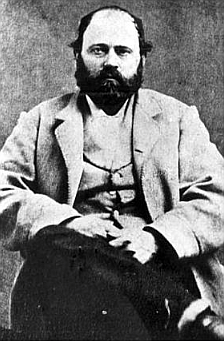
On that date, three bad men were hanged in Lewiston for what became known as the “Magruder murders.” Their capture and transportation for trial, at Lewiston, was chiefly the accomplishment of one man, Hill Beachey. Beachey was a businessman in Lewiston and a friend of Lloyd Magruder.
The story of Beachey’s brave and heroic deed has been one I’ve admired and held dear ever since learning it a few years ago.
Hill Beachey set out from Lewiston on Oct. 24, 1863 to track down and return to justice three men named James Romaine, David Renton, and George Christopher Lower. They, he strongly suspected, had murdered Lloyd Magruder, Charles Allen, William Phillips, and the brothers Horace and Robert Chalmers. Not much about murders isn’t disputed or rendered differently by different historians and writers. Yet the story’s main elements are clear enough. It was one of the most ghastly and notorious crimes in the history of the American West. It also tested for the first time the new justice system of the new Idaho Territory.
Lloyd Magruder took a pack train of mules loaded with mining supplies and other goods from Lewiston to the Alder Gulch mining camps in the summer of 1863. He set up shop in Virginia City, where he soon sold out his wares. In early October, he started back toward Lewiston, now with unloaded mules but carrying considerable gold dust from his successful trading venture. En route, Magruder and his crew were brutally and cold-bloodedly killed by the three men (and perhaps a fourth), who by then were ostensibly traveling with the company as helpers.
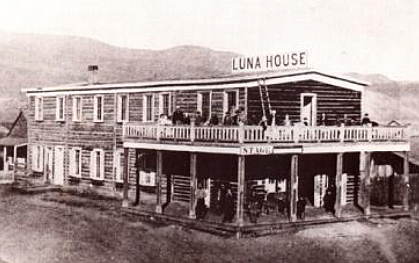
The killers then made their way to Lewiston and booked passage on the stagecoach to Walla Walla, heading thence to San Francisco. How, exactly, they aroused suspicions as they passed through Lewiston is a matter of considerable debate. Some accounts, going back to Nathaniel Langford’s semi-fictionalized account in his Vigilante Days and Ways (1890), emphasized the importance of a prophetic dream Hill Beachey, Magruder’s friend and owner-manager of the Luna House hotel in Lewiston, is supposed to have had, in which Beachey foresaw Magruder’s murder by an ax-wielding Chris Lower. But Julia Conway Welch, whose book, The Magruder Murders: Coping with Violence on the Idaho Frontier (1991), offers arguably the most scholarly and sober rendering of this history, makes a strong case against the dream and its role. Welch suggested Langford introduced the dream merely for dramatic effect.
One nearly contemporary newspaper account reported that suspicions gathered around the fact that the suspects abandoned fine horses and expensive gear in Lewiston without making any provision for their sale. Perhaps there is even something to historian Hubert Howe Bancroft’s suggestion that Beachey saw “the mark of Cain, which seldom fails to be visible” in the suspects. Whatever the full array of suspicion-exciting clues may have been, on Oct. 24 Hill Beachey, accompanied and assisted by Thomas Farrell, headed out of Lewiston to track down and bring to justice the suspects.
It’s well to pause, here, and consider some of the remarkable features of Beachey’s fateful decision. He was not a trained lawman or tracker. His absence would be costly. He had at least two businesses to run in Lewiston — a stagecoach line as well as the hotel — and he had other new projects in progress in town as well. He did not know the four suspects names or much about them. He did not know where they were headed or whether they would all travel together or soon split up and go in different directions. His decision obliged him to leave the comforts of home and the warm bed he shared with his wife. He’d be gone for an unknown length of time and at his own expense. Moreover, he could not be one hundred percent certain that his friend Magruder had actually met with foul play. Finally, believing that the men he pursued were coldblooded killers, giving chase would obviously expose him to no little danger and peril. Yet Beachey, despite all of the above, decided to embark all the same.
The suspects had a several-days head start on him. The trail Beachey and Farrell picked up indicated they’d boarded a steamer for San Francisco at Portland. Rather than wait for another steamer’s departure, Beachey headed overland, by stage, to Yreka, California, the first place with telegraph service to San Francisco. There, he wired police chief Martin Burke requesting that the men be detained. Burke, in turn, assigned the case to Isaiah Lees, his department’s crack detective. Lees soon found and arrested the suspects. The suspects made a substantial deposit of gold dust at the San Francisco Mint for conversion to coin. The police’s unearthing of this clue speeded their capture.
But the apprehended suspects were not without resources and soon hired a lawyer to fight their extradition to Idaho Territory. The question of whether the police department should surrender the prisoners to Beachey was kicked up to the governor’s office in Sacramento. California’s Governor Leland Stanford issued an order for the prisoners’ transfer to him on Nov. 2, 1863. Meantime, a habeas corpus suit filed on the prisoners’ behalf was making its way through California’s judicial system. Among other points, the suspects’ lawyer argued that the U.S. Constitution made no specific provision for extradition from a U.S. state to a U.S. territory. On Nov. 11, after a second day of hearing the case, Justice Edwin B. Crocker announced from the bench that the defendants’ writ was denied and a written opinion would follow “as soon as practicable.” Beachey now took custody of the prisoners and, from San Francisco, soon boarded the steamer Pacific for Portland. Below the mouth of the Williamette River his party transferred to the steamer Julia. They were henceforth accompanied by a military guard provided by General Alvord at Vancouver. “Steam had been kept on the Julia for more than thirty hours, awaiting their arrival,” reported the Portland Oregonian. At Walla Walla, Beachey’s party once again transferred, this time to a stagecoach for the final leg to Lewiston.
The three alleged killers were tried in Lewiston in January, 1864. A fourth man, Billy Page, pleaded that he took no part in the killings and testified against the other three. Page was spared. Considerable care was taken that the defendants received a fair trial. A contemporary newspaper account noted:
“It might not be inappropriate to say that this trial, conducted so formally and orderly, will be productive of much good in this country. It is the first session of the District Court ever held in the Territory, and the first cause tried, and one unparalleled in brutality of design and accomplishment ever placed in the records of crime.”
The trial’s outcome would also become the first legally sanctioned execution in Idaho Territory, held, as I noted at the outset, on March 4, 1864.
What can mere words add about Beachey’s brave and loyal service to his friend, Lloyd Magruder? Giving chase, as he did — with so little evidence to go on, so much risk to face, and what must have seemed no great prospect of success — was an action that would become stamped indelibly Idaho Territory’s early history. His ultimate success also marked him as a man who could effectively surmount challenges and bring even the most difficult and trying task to completion.
Idaho’s territorial legislature granted Beachey $6,244 “for money expended, and time employed” in the capture and return of the three murderers. This was a tidy sum in 1864, to be sure. Yet, it doesn’t seem quite sufficient somehow. Without his courageous decision, the Magruder murders would have become lodged in Idaho’s history without the closure wrought by justice well served. It elevates Idaho’s historical story to know that the first year of the Territory’s existence witnessed Hill Beachey’s towering act of friendship, loyalty, courage, and commitment to justice.
I suggested some years ago that the Idaho State Legislature should create an “Hill Beachey Day” for our state’s annual calendar. My own choice for the designated date of this holiday would not be March 4th, the execution’s date. My pick would be Oct. 24, the day Beachey and Farrell embarked on their heroic mission.
ARTICLES BY RON ROIZEN SPECIAL TO NEWS-PRESS
I draw the line at the U.S. Constitution
OK, I think I get it. In 2016, a significant portion of the American electorate voted to roll a grenade into the Washington, D.C., establishment. They wanted to destroy the liberal consensus, broadly defined, that has exerted some sort of hegemony in the federal government, and the national consciousness, since (let’s say) the 1960s. They wanted to terminate coastal elitism, turn back the regulatory clock, undo almost everything Obama accomplished, seal the nation’s southern border, overrule the rule of PC, and turn their backs on established expertise, whether scientific or otherwise. And Trump was the man to do it. Fortunately for him, he had an opponent, in Mrs. Clinton, who symbolized many aspects of this kind of elite entitlement, even down to her implicit claim that it was time for a woman in the Oval Office.

Safeguarding Col. Wallace's semi-sullied reputation: Part 1
There are weighty questions in history’s halls — Why did Rome fall? What launched the Renaissance? Why the American Civil War? The following doesn’t deal with one. It merely touches on one of history’s countless minor footnotes — in this case, here in Wallace.

PVT Dowling remembered (or Mis-remembered)
This year’s Veterans Day — Sunday, Nov. 11 — will fall on the 100th anniversary of World War I’s end, which happened at the 11th hour of the 11th day of November, 1918. It’s an important centennial. In early October there will be a brief but appropriate commemorative ceremony in Wallace at the War Mothers Plaque on the green of the Wallace Carnegie Library. The event is part of this year’s Fall For History program, scheduled for Oct. 4-7. Ed Vang and Mike Feiler, both of the FFH’s organizing committee, are orchestrating the WWI element, which will begin outside the library, by the flagpole, at 11 a.m. on Saturday, October 6th and will run for about 45 minutes.