
Rates driven by expenses, PUD analysts say
CHERYL SCHWEIZER | Hagadone News Network | UPDATED 9 years AGO
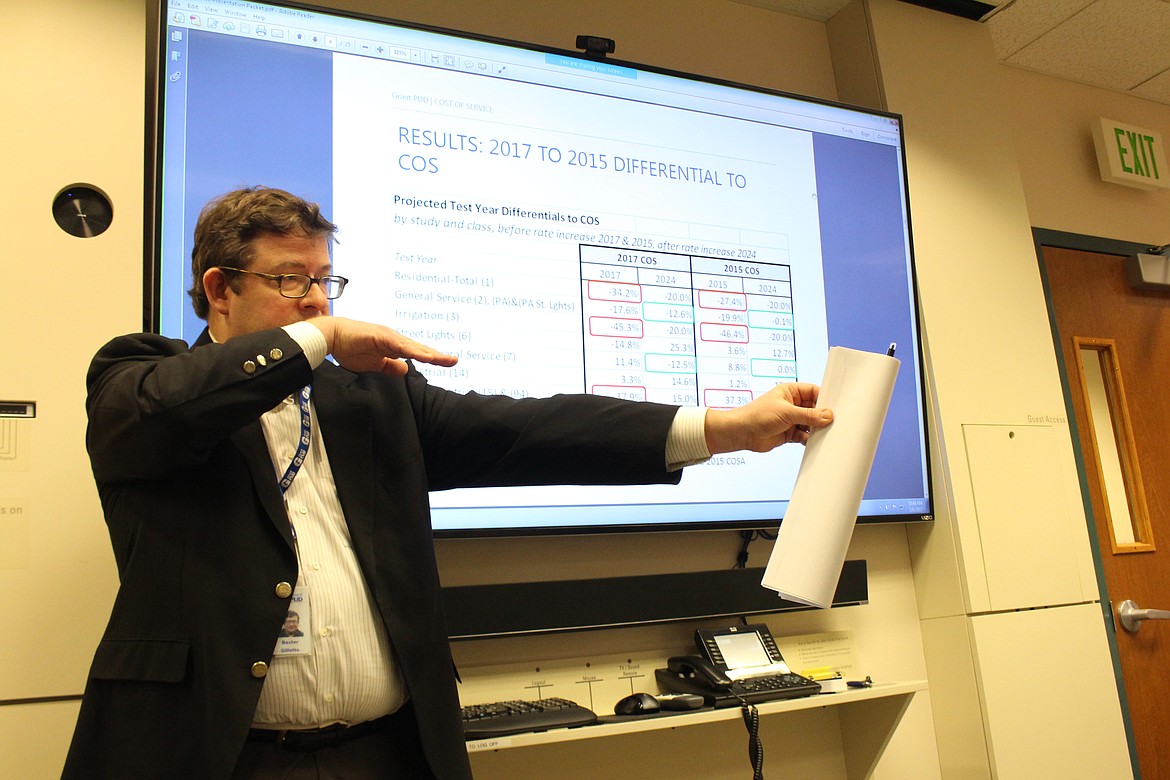
Cheryl Schweizer/Columbia Basin Herald Baxter Gilette of the Grant County PUD said results of a cost-of-service study went in a different direction than originally anticipated.
Senior Reporter Cheryl Schweizer is a journalist with more than 30 years of experience serving small communities in the Pacific Northwest. She began her post-high-school education at Treasure Valley Community College and enerned her journalism degree at Oregon State University. After working for multiple publications, she has settled down at the Columbia Basin Herald and has been a staple of the newsroom for more than a decade. Schweizer’s dedication to her communities and profession has earned her the nickname “The Baroness of Bylines.” She covers a variety of beats including health, business and various municipalities. | March 7, 2017 2:00 AM
EPHRATA — An updated study on the cost of providing service to Grant County PUD customers was the subject of discussion at the rescheduled commission meeting Monday.
Utility district employees conducted a study in 2015 to determine how much it actually costs to provide electricity to each class of customers. That followed approval of a policy in 2014 that requires customers to pay at least 80 percent of the actual cost of providing service. The policy says customers should pay a maximum of 15 percent above the cost of providing their electricity.
The 2015 study revealed that some customer classes, notably residential and irrigation customers, were not reaching the 80 percent threshold, while others, including large industrial customers (server farms being an example) were paying more than 15 over cost of service.
Commissioners set a target of overall 2 percent rate increases for the 10-year period in ending in 2024. The last two years the increases have been higher for some classes, residential and irrigation customers among them, in an attempt to get them closer to the 80 percent target.
But what actually happened, said Baxter Gilette of the PUD’s accounting office, is that irrigation customers got farther from the target and the residential class barely changed.
Gilette said capital expenditures – money spent for maintenance, upgrades and expansion – went up by about $24 million in 2017. “We had more capital expenditures coming in and those are borne much more by residential and irrigation than some of the other classes.”
Utility district financial analyst Jeremy Nolan said the additional expenses considered in the cost of service are just for the electrical system. When costs are allocated, about 55 percent are assigned to residential and irrigation customers, Nolan said. Transmission, including maintenance, and rural lines are where most of the money is being spent, he said.
In addition, some customers changed the way they use electricity. “They look different, they’re acting differently and the costs are therefore assigned somewhat differently,” Gilette said.
Gilette was answering a question from commissioner Larry Schaapman, who asked why irrigators were getting further behind even though their annual rate increase is higher than 2 percent. Commissioner Bob Bernd said revenue from irrigators increased by 4 percent, but that didn’t seem to have much impact.
Nolan said irrigation electrical consumption increased by 8 percent. While the accounting staff hasn’t done a detailed study, it looks like irrigators are changing the way they use electricity to reduce their costs.
“I think the rub is, our customers feel they have no equity in their system. It’s almost like they continuously lease the system. They never get it paid for,” said commissioner Tom Flint. Schaapman said customers have said to him that the system has been in place for half a century and more, and that at some point expenses should decrease.
General manager Kevin Nordt said he understands that feeling. “Because the network behind is always having to be upgraded and replaced, it does feel almost like it’s never paid for. But that’s because of the cost of those incremental investments constantly being made to keep everything safe and reliable,” Nordt said.
Cheryl Schweizer can be reached via email at [email protected].
ARTICLES BY CHERYL SCHWEIZER

Road closures, roundabout, mean construction season underway
EPHRATA — The grass is starting to turn green, the trees are starting to leaf out, construction crews are starting to build roundabouts – hey, it’s spring. At least one roundabout project is in its final phase, held over from fall 2025. The intersection of State Route 282 and Nat Washington Way will be closed the week of April 6 to allow crews to install permanent lights. “This really is the final (closure),” wrote Grant County Administrator Tom Gaines in a media release. “The roundabout will close at 6 a.m. Monday, and we plan to reopen by Friday, possibly sooner if the work finishes early.”

Ybarra announces run for Washington Senate
QUINCY — State Representative Alex Ybarra, R-Quincy, has announced his candidacy for the Washington Senate. If he’s elected, he would replace Judy Warnick, R-Moses Lake, who announced her retirement in March.
Othello Community Museum to open April 25
OTHELLO — With a couple of new exhibits, a new heating-cooling system, rearranged displays and a thorough cleaning, the Othello Community Museum will open for the summer April 25. The goal, said Molly Popchock, museum board secretary, is to operate for a full season.