
SmartLam expansion a $20 million investment here
CHRIS PETERSON | Hagadone News Network | UPDATED 8 years, 1 month AGO
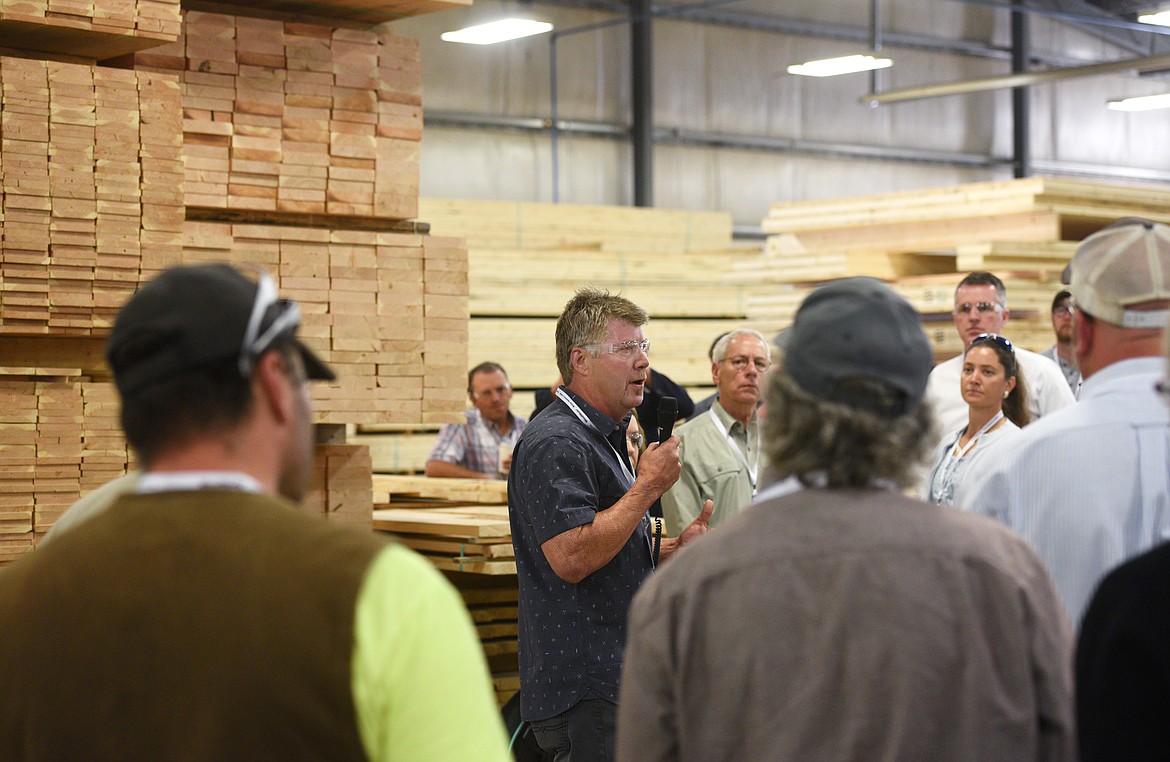
SmartLam President and General Manager Casey Malmquist gives a tour of the company's facility in Columbia Falls in this file photo.
Chris Peterson is the editor of the Hungry Horse News. He covers Columbia Falls, the Canyon, Glacier National Park and the Bob Marshall Wilderness. All told, about 4 million acres of the best parts of the planet. He can be reached at [email protected] or 406-892-2151. | November 1, 2017 10:51 AM
The expansion of the SmartLam facility in Columbia Falls is a $20 million investment, president and CEO Casey Malmquist said during a presentation last week to members of Montana West Economic Development.
SmartLam has begun installing new equipment in the former Plum Creek Timber Co. planer building that will have capacity to produce about 80,000 cubic meters of material annually.
The new facility will house bigger and better presses to create the cross-laminated timber panels the company makes. CLT is made by taking dimension lumber and gluing it together with a non-toxic high strength adhesive with a huge press.
The resulting high-strength panels can be used to make everything from homes to bridges to multi-story buildings.
“Plywood on steroids,” Malmquist said.
SmartLam got it start about five years ago building industrial mats for oil rigs. By its second year, it was in the black, with $10 to $12 million in revenue annually, manufacturing the CLT out of its plant behind Super 1 Foods in Columbia Falls, Malmquist said.
But in 2015 the oil industry stalled and the company began transitioning to the building market. It took a couple of years to get the product fully complied with American National Standards Institute/American Plywood Association standards for CLT.
Their product has also passed tests for fire and blast resistance. The wood product, even under a four-hour fire test, only chars the outside of the wood, much like the trunk of a tree after a wildfire.
Meeting those standards was paramount to the company’s success, Malmquist noted.
“It was huge for getting it into buildings,” he said.
CLT has many advantages over steel and concrete, Malmquist noted. For one, it’s much better for the environment. Wood is a renewable resource, unlike concrete and steel and SmartLam’s timber is all sustainably sourced. It takes less labor to install. As an example, an elevator shaft made of concrete blocks and steel might take a crew of 12 men three to four weeks to install, while the same shaft made of CLT would take a crew of three to four men just a couple of days, Malmquist said.
The material is also blast resistant, and like the trees it’s made of, bends, rather than breaks in high winds, like hurricanes.
SmartLam is not the first to produce CLT. It was originally developed in Europe and has been used there for about 20 years. It’s just now being used more int he United States. Right now, the material is most economical for buildings in the four to eight story range.
SmartLam has been taking on unique and aesthetically pleasing projects recently, including building furniture for Vassar College, the Greenville Transportation Center in North Carolina and the roof of the Tacoma Amtrak Station, to name a few.
“We’ve taken on some challenging products,” Malmquist said.
It also makes some practical products as well. For example, it builds a temporary bridge material that’s laid down over streams during timber sales. The product works so well, the state Department of Natural Resources has written the use of the bridge material into its specs. It works much better than placing a culvert in a stream and then building a roadbed over top it.
Malmquist said the company hopes to build two more plants — one in the Southeast and another in the Northeast. Preliminary talks with the governor of Maine have gone well.
One issue in the west is timber supply — the plant here can use about 48 million board feet a year. That’s well over the annual saw log sales of about 30 million board feet on the Flathead National Forest.
Malmquist suggested, like many have before him, that we re-think how local forests are managed, particularly with the benefits the material provides.
He noted the Columbia Falls plant at full capacity would provide about 264 direct jobs, $21 million in wages and $6 million in tax revenue.
ARTICLES BY CHRIS PETERSON
Columbia Falls School District makes pitch for charter school
Columbia Falls School District Superintendent Cory Dziowgo and staff recently made a pitch to the Montana Board of Public Education for a new Columbia Falls Trades Academy.
Columbia Falls concerned sewer system could be bottleneck for growth
The City of Columbia Falls could see a significant bottleneck in future growth due to its sewage treatment plant, depending how the city and the state calculate the sewage treatment plant’s maximum treatment capacity without a major upgrade.
Columbia Falls City Council tables e-bike law
The Columbia Falls City Council last week voted to table a city ordinance that would restrict e-bikes and e-motorcycles along with other electrically powered vehicles on its sidewalks and city parks.