
Look, listen, live
Coeur d'Alene Press | UPDATED 8 years, 2 months AGO
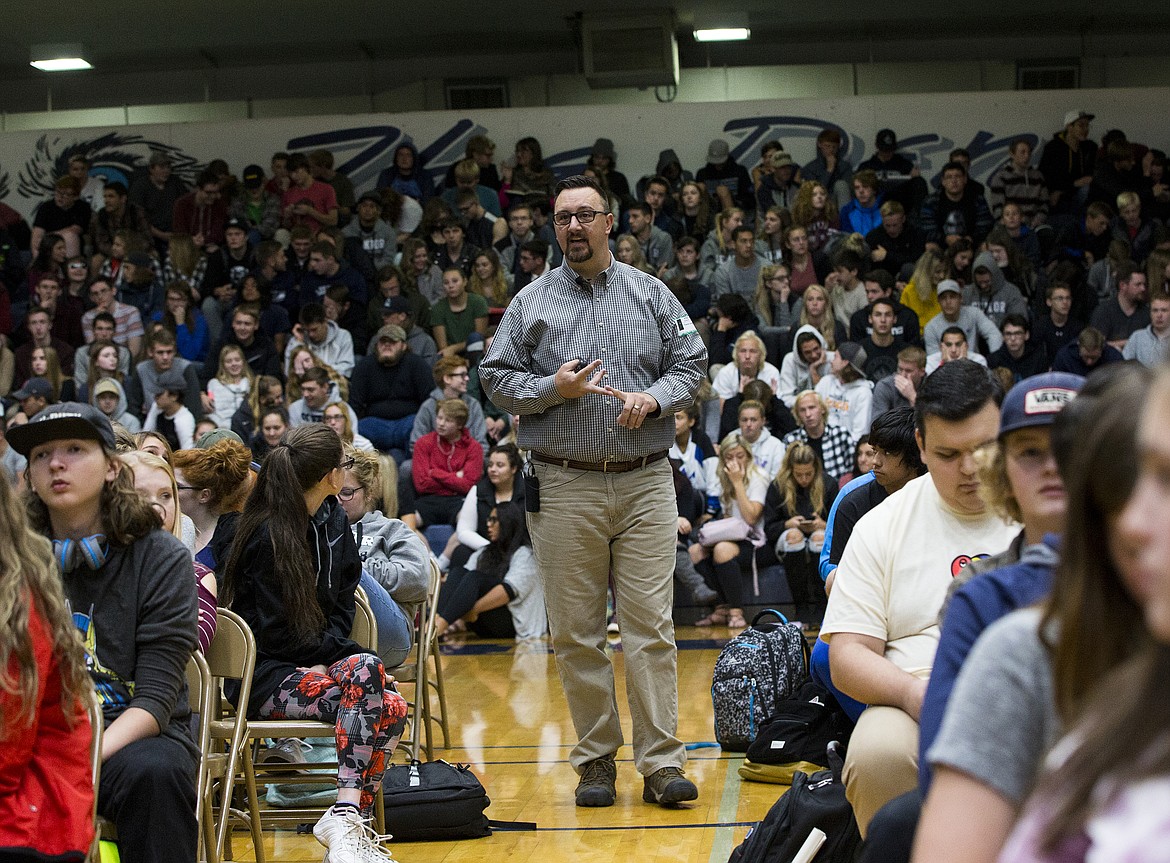
LOREN BENOIT/Press Travis Campbell, Idaho Operation Lifesaver executive director, speaks to students Wednesday morning at Lake City High School about railroad safety.
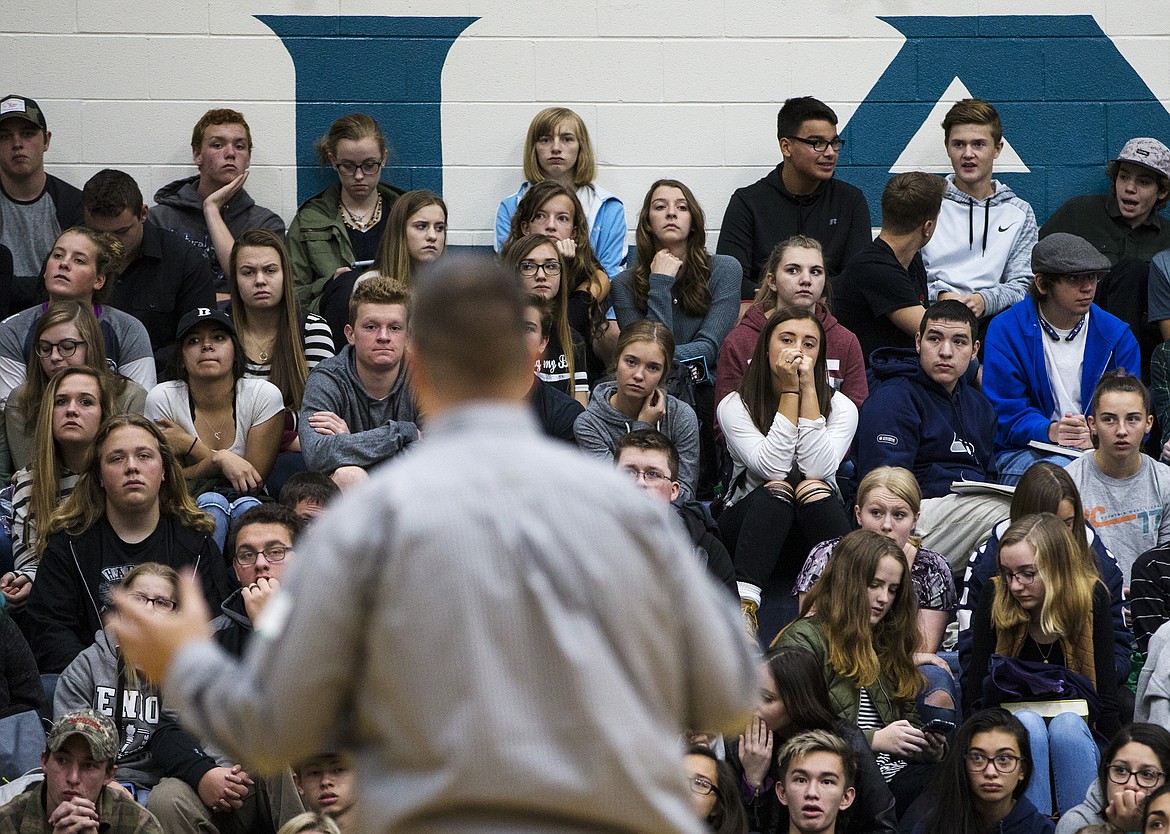
LOREN BENOIT/Press Students listen as Travis Campbell, with Idaho Operation Lifesaver, gives a presentation about railroad safety Wednesday morning at Lake City High School.
By BRIAN WALKER
Staff Writer
COEUR d'ALENE — When Payton Barber heard all the laws aimed at railroad crossing safety, she wondered how the Rathdrum Prairie has become notorious for collisions.
"There should be no excuses for any accidents because there's so many laws," the Lake City High senior said.
But she also realizes how distracted drivers can be, falling victim to tunnel vision or simply making poor choices.
"That's why it's important for everyone to hear about safety, especially after what happened last school year," she said.
With April's vehicle-train collision involving two Lake City students still fresh in the minds of many at the school — both survived — the student body on Wednesday heard a presentation from Idaho Operation Lifesaver executive director Travis Campbell on railroad crossing safety.
Senior Val Lago-Sosa said she was thankful for the presentation's stark video reminders of how vehicles, when struck by a train, resemble soda cans decimated by an automobile.
"So many kids our age are distracted while driving," Lago-Sosa said.
Campbell said students have a responsibility to set a good example to their friends and siblings while behind the wheel.
"They're watching you," he said. "Whatever you do, they'll do the same thing. Let's show them what's right."
Campbell said nationwide, there is a train collision involving a motorist or pedestrian every three hours.
"I get a call just about every day, and oftentimes it doesn't turn out well for the person in the car," he said, adding that Kootenai County tops Idaho for such accidents.
The Rathdrum Prairie, where there has been significant growth and the Union Pacific and BNSF Railway both operate lines, has been a hotbed for crashes for years. In a recent railroad crossing emphasis patrol involving Idaho Operation Lifesaver, police and UP, law enforcement pulled over 140 drivers in eight hours.
Campbell said there are several reasons accidents occur, including not paying attention on routine routes.
"You may never see a train there, but if you run a stop sign or do not look, there could be one there today," he said.
Campbell said he's often asked why trains don't stop before colliding with a vehicle. When traveling 55 mph, trains take about a mile — 18 football fields — to stop. By comparison, a semi takes about 3,000 feet and a car 200 feet to stop at that speed.
If motorists see risky behaviors at crossings or equipment problems, they’re encouraged to call the number posted on a sign at intersections, which also identifies the location.
Campbell said walking or riding on railroad rights of way is not only dangerous, but is also trespassing.
"If a photographer tries to take you on railroad tracks for your senior pictures, don't go out there with them," he said. "They're risking your life, and it's against the law."
Campbell said through the three Es — education, engineering and enforcement — there has been an 83 percent reduction in incidents since Idaho Operation Lifesaver was formed in 1972.
He said community partners, including schools, railroad companies, law enforcement and businesses, have played a key role in making a difference.
TraffiCalm Systems recently donated LED sign enhancements at the crossing on Huetter Road where the Lake City students collided with a train.
"The goal is to use technology to enhance driver awareness and compliance," said Andy Pedersen, a sales manager for the company who attended Campbell's presentation.
A limited amount of money from the federal government for railroad crossing improvements prevents lights and gates from being installed at all dangerous crossings, Campbell said.
"There's only enough money to improve three or four crossings in the state every year," he said. "If it was up to me. there would be gates and lights at every crossing. If I could prevent every one of these (crashes) and work myself out of a job, that's what I'd do. Every time somebody loses a life, it affects the whole community."
During the assembly, potential hazards at specific local intersections, including trees and road markings that may not be far enough back from the crossing, were brought to Campbell's attention. He said he would check on and report to proper jurisdictions if need be.
Campbell said he's amazed with how some people are unaware of the capabilities of trains. One man told him if the train would have swerved just a bit, it would've missed a car.
"The train is not going to swerve to miss us," he said.