
Machining makes the world go round
Kaye Thornbrugh North Idaho College | Hagadone News Network | UPDATED 8 years, 3 months AGO
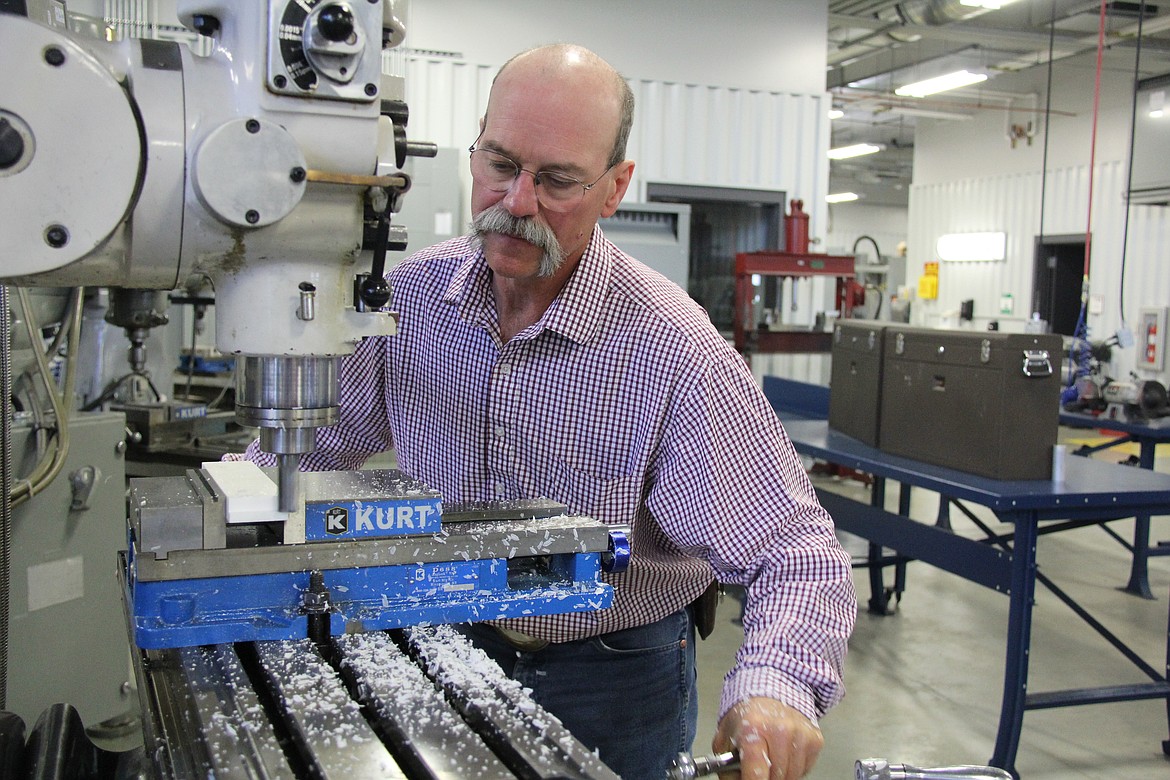
Photo by TOM GREENE/North Idaho College Kurt Kimberling instructing Machining and CNC Technology at North Idaho College’s Parker Technical Education Center in Rathdrum. The new NIC Parker Technical Education Center in Rathdrum opened in 2016, the 110,960-square-foot facility has state-of-the-art equipment to meet student training needs and regional workforce demands.
Your car. Your phone. The spare change in your pocket. They have one thing in common: A machinist helped to make all of them.
“Most people don’t understand how products get made,” said Kurt Kimberling, an instructor in the Machining and CNC Technology program at North Idaho College. He has more than 30 years of industry experience. “Machinists have a hand in everything you use on a daily basis.”
At NIC, Kimberling teaches basic to advanced machining concepts, such as precision measuring, operating a milling machine, and operating computer numerical control (CNC) machines. Students can earn an intermediate or advanced technical certificate, or a two-year associate degree in machining and CNC technology.
“My goal is to teach students critical thinking and problem solving,” Kimberling said. “As a side effect, they learn all the basic skills. I consider myself a trainer, not a teacher. You learn competencies and master different skills.”
Upon completing the program, students will be qualified for entry-level machinist positions. Because machining is one of the biggest parts of manufacturing, and part of every industry, there’s a wide variety of jobs for machinists.
Max Clemons learned welding in the military. When he came to NIC, he enrolled in the welding program, then switched to machining.
“I could weld anything, but I had limited on-the-job training,” Clemons said. In the machining program, he received comprehensive training. “Now I can do anything, from top to bottom.”
Machining and fabrication came easily to Clemons, so in class, he would often help other students. After graduation, he soon found work as a prototype machinist.
At NIC, Clemons said, the instructors teach the fundamental skills, and from there students can explore what interests them and how they can use machining to pursue those interests. Because machining technology is used in so many industries, the applications are virtually endless.
“They give you an opportunity to see what interests you,” Clemons said, “and then they challenge you to think outside the box.”
In fact, Kimberling estimates that there are around 600 different facets of machining, from tool and die makers, to precision grinders and mold makers, and beyond. In recent years, he said the industry has become somewhat compartmentalized, so many machinists specialize in certain areas.
Jobs for machinists will increase by six percent between now and 2024. Kimberling said that a lack of skilled labor has created a deficit in the machining industry.
“The need for machinists is huge,” Kimberling said. “There’s a huge demand for these skilled workers, and there’s a good salary to go along with it.”
The median pay for machinists is $41,510 per year.
Machining is a craft that requires a commitment of time and effort to master, Kimberling said, but the ultimate payoff is well worth it. “It’s a very satisfying, challenging career,” he said. “From a raw piece of material, you can create anything you can imagine.”
For information on NIC’s Machining and CNC Technology, call (208) 769-3311 or visit www.nic.edu, click on “Instructional Programs” and then select “Machining and CNC Technology” from the drop-down menu.
ARTICLES BY KAYE THORNBRUGH NORTH IDAHO COLLEGE

Trucking not just a job - it's a lifestyle
Doug Odegaard never pictured himself as anything but a truck driver.

Free training being offered at NIC's Safety Fest Feb. 22-24
It could cost nothing to save a life in the workplace.

Hospitality takes one student to magical places
The happiest place on Earth became even happier for North Idaho College student Ashley Baker.