
Volga German settlers subject of museum lecture
CHERYL SCHWEIZER | Hagadone News Network | UPDATED 8 years AGO
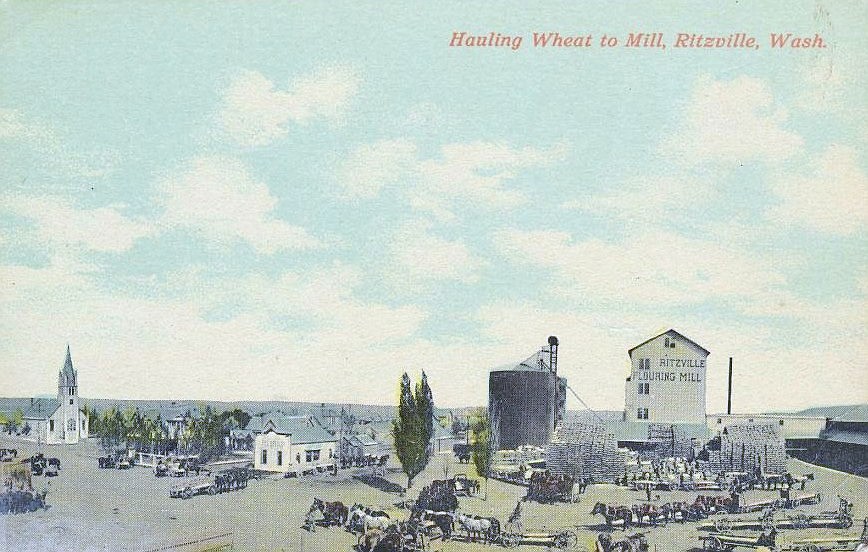
Courtesy image Volga German immigrants used their dryland farming expertise all over eastern Washington, including Ritzville, shown here on an old postcard.
Senior Reporter Cheryl Schweizer is a journalist with more than 30 years of experience serving small communities in the Pacific Northwest. She began her post-high-school education at Treasure Valley Community College and enerned her journalism degree at Oregon State University. After working for multiple publications, she has settled down at the Columbia Basin Herald and has been a staple of the newsroom for more than a decade. Schweizer’s dedication to her communities and profession has earned her the nickname “The Baroness of Bylines.” She covers a variety of beats including health, business and various municipalities. | April 3, 2018 3:00 AM
MOSES LAKE — The fate and contributions of an unusual immigrant group in central Washington will be the subject of a lecture at 3 p.m. Wednesday at the Moses Lake Museum & Art Center, 401 South Balsam.
Mick Qualls will trace “Volga German History in Central Washington.” Admission is free.
Qualls said Volga Germans had a big impact on late 19th-century settlement in Washington, among many other places in the United States. “All of the towns in central Washington are Volga German towns,” he wrote.
So – anybody with a knowledge of geography (or who looks at a map) knows the Volga River is a long way from Germany. There’s a story behind that, one that dates back 350 years to the formidable Russian empress Catherine the Great.
The empress invited people from what became Germany – and not just anyone; she wanted farmers – to settle in Russia. Many of the settlers chose the Volga River basin. The settlers were promised the right to keep speaking German and practice their own religion.
The settlers’ gamble didn’t always work. They got killed in rebellions, their neighbors were resentful, the promises made to them were broken. There was land in the United States, and Volga Germans joined the streams of people heading for America. Drought and famine hit the Volga region frequently in the late 19th and early 20th centuries, especially in 1891 and again in 1901. The recurrent famines prompted even more people to leave Russia.
Development had reached central Washington, courtesy of the rail lines snaking across the state. Railroad companies had lots of land and wanted settlers for it, Qualls said. Recruiters went to Russia and “offered them a great deal to come to America,” Qualls wrote. Volga Germans “were getting massacred in Russia and they needed to migrate out.”
At the time all central Washington agriculture was dryland farming, attractive to the immigrants because the Volga was also a dryland farming region.
The presentation is part of the museum’s spring Salon Series, lectures on subjects of local interest. Qualls is a repeat speaker, having told the story of saloons in eastern Washington and the Ephrata airport, among others.
ARTICLES BY CHERYL SCHWEIZER

Road closures, roundabout, mean construction season underway
EPHRATA — The grass is starting to turn green, the trees are starting to leaf out, construction crews are starting to build roundabouts – hey, it’s spring. At least one roundabout project is in its final phase, held over from fall 2025. The intersection of State Route 282 and Nat Washington Way will be closed the week of April 6 to allow crews to install permanent lights. “This really is the final (closure),” wrote Grant County Administrator Tom Gaines in a media release. “The roundabout will close at 6 a.m. Monday, and we plan to reopen by Friday, possibly sooner if the work finishes early.”
Ybarra announces run for Washington Senate
QUINCY — State Representative Alex Ybarra, R-Quincy, has announced his candidacy for the Washington Senate. If he’s elected, he would replace Judy Warnick, R-Moses Lake, who announced her retirement in March.
Othello Community Museum to open April 25
OTHELLO — With a couple of new exhibits, a new heating-cooling system, rearranged displays and a thorough cleaning, the Othello Community Museum will open for the summer April 25. The goal, said Molly Popchock, museum board secretary, is to operate for a full season.