
Local youths become Memory Masters
Mary Malone Staff Writer | Hagadone News Network | UPDATED 7 years, 11 months AGO
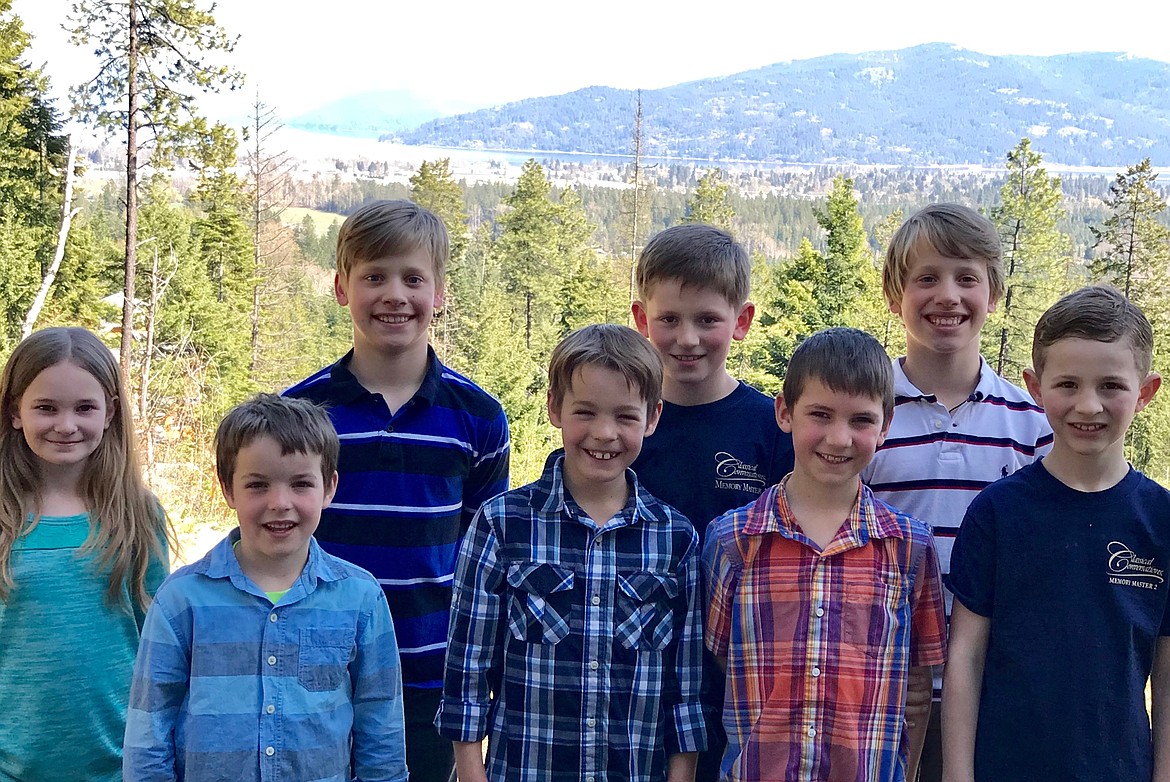
Eight Classical Conversations North Community youth were recently given the title of Memory Masters, though for many it was not the first time. Pictured from left, Ella Stevens, 9, third year Memory Master; Oliver Gish, 7, first year Memory Master; Luc LeBlanc,11, second year Memory Master; William Gish, 8, second year Memory Master; Jared Gardner, 9, fifth year Memory Master; Joel Kuhn, 9, first year Memory Master; Lonnie LeBlanc, 11, second year Memory Master; and Enoch Gardner, 7, fourth year Memory Master. (Courtesy photo)
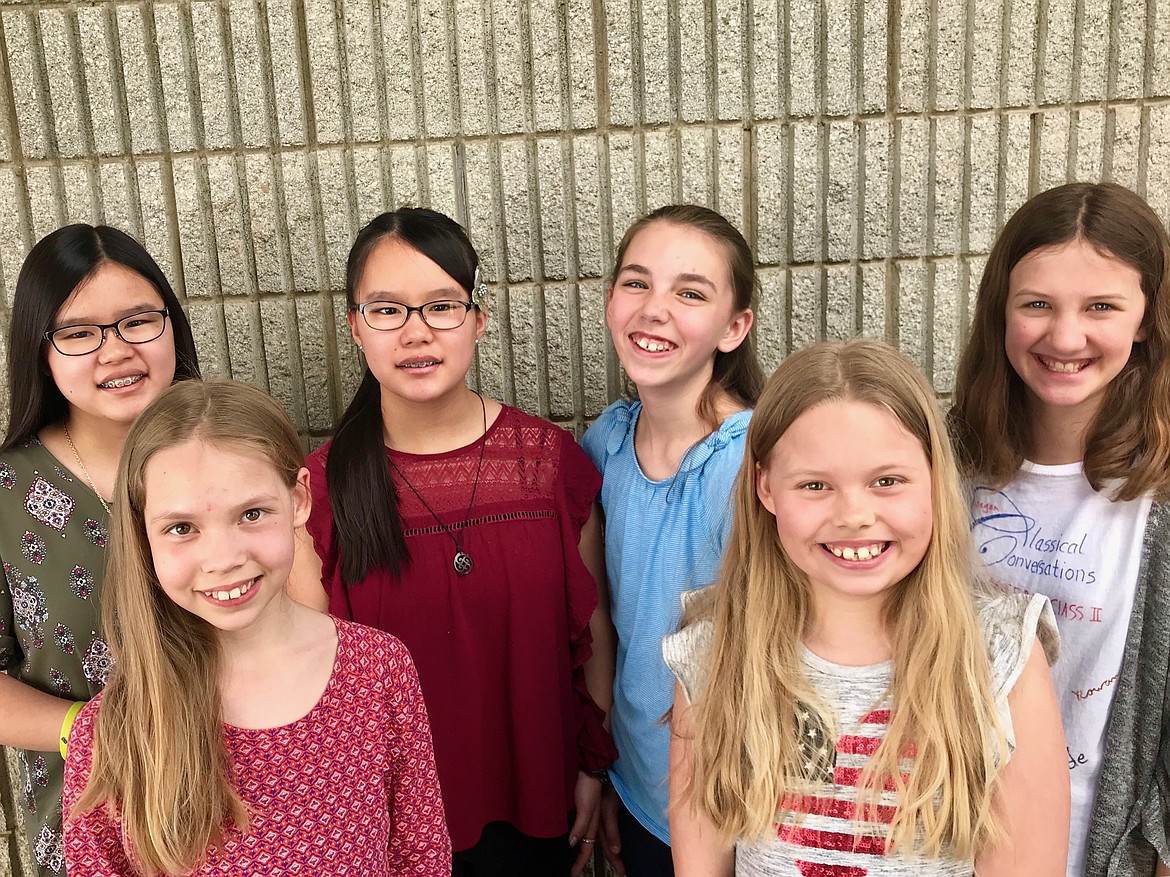
(Courtesy photo) Six Classical Conversations West Community youth were recently given the title of Memory Masters, though for many it wasn't the first time. Pictured from left, Alyssa Howarth, 12, second year Memory Master; Anna Fuller, 11, second year Memory Master; Anna Howarth, 12, second year Memory Master; Elsie Brown, 11, first year Memory Master; Kristina Fuller, 10, first year Memory Master; and Raegan Samuels, 11, third year Memory Master.
SANDPOINT — Fourteen local youngsters have been dubbed Memory Masters this week in their respective Classical Conversations communities.
To become a Memory Master, the kids had to memorize and recite hundreds of pieces of information to their parents and other adults without missing any by the final round.
"It's a big commitment," said Gretta Gardner, director of the Classical Conversations Foundations and Essentials programs at the Sandpoint North Community. "It's something that you don't enter into lightly, and I am really proud of these students."
Classical Conversations is a Christian community for home-school students. It is an international organization founded in 1997, with several local sites, including two in Sandpoint, and one in Priest River, Bonners Ferry and Athol. There are four programs within Classical Conversations, including the Scribblers program for ages 3-8, Foundations for ages 4-9, Essentials for ages 9-12 and Challenge for students 12 and up.
The Memory Masters are in the Foundations program, which is the grammar stage of Classical Conversations, Gardner said. The students memorize, for example, 161 points on a chronological timeline, which Gardner said can serve as a "memory peg" for future pieces of information. Foundations is divided into three cycles — one cycle each year for three years, then the cycles repeat.
The program is currently in cycle three, she said. In addition to memorizing the timeline points in cycle three, the students memorized 24 detailed history sentences, more than 120 locations and geographic features in North America, 24 scientific facts, detailed English grammar, Latin rules and vocabulary and multiplication tables — more than 400 bits of information during the two-and-a-half hour, once-a-week sessions over the course of 24 weeks.
Gardner had 57 students attending the Classical Conversations North Community this session and of those, 12 chose to attempt to become Memory Masters. In the first round, Memory Master hopefuls test with their parents and are allowed to miss up to three of the points in order to progress to the next round. In the second round, they test with another adult and are only allowed to miss one.
"In the third round, they have to recite it with 100-percent accuracy to their tutor," Gardner said. "If they miss even one, they have to drop out."
And it doesn't end there. Those who make it through the first three rounds then progress to the fourth and final round, which Gardner said is a random test. As director of the community, Gardner tested the kids with a random sampling of everything they learned.
"If they can do that with 100-percent accuracy, they are called a Memory Master,"
In the end, the North Community had eight finalists this session. The West Community, in addition, had six finalists, though Gardner was unsure of the exact number of students at the sister community.
By committing the information to memory, Gardner said, it creates a foundation for further information in the future. Some people call the bits of information "memory pegs" or "schemas," she said.
In the 1940s, Gardner said, author and poet Dorothy Sayers gave a presentation to a group at the University of Oxford in which she argued that classical education follows a child's natural development stages. When they are young, they are prone to memorize things through repetition. They "thrive" on that repetition, she said, and then when they are between the ages of 7 and 9, kids begin questioning everything, wanting more information. Sayers coined that as the "dialectic stage," Gardner said. Then there the stage when they crave self-expression.
"That comes at around 12 years old or so, when they really want people to hear their voice; they really want to voice their opinions," Gardner said. "But unfortunately, if we haven't taken the time in those earlier years to give them quality knowledge and information, we find a discrepancy in those later years."
Classical Conversations was designed "from the top down," Gardner said, to fill some of the holes that the founder, Leigh Bortins, saw in high school students regarding areas such as communication and critical thinking.
Gardner said she has been with Classical Conversations for five years, starting out as a tutor before becoming a director. She has four of her own kids in the program as well — two of them Memory Masters — and said she "loves" it and enjoys seeing her kids thrive with classical education.
"The beautiful thing about classical education is it transcends cultures," Gardner said. "That's why it can thrive in Asia and Europe and Africa, is because it's for every human. It comes from the basic ideas that we grow by conversations, we grow by talking to each other, by being a community."
Parents and educators who are interested in Classical Conversations can attend a three-day parent practicum in Bonners Ferry on June 25. For details, visit parentpracticum.com. For information on Classical Conversations, visit classicalconversations.com.
Mary Malone can be reached by email at [email protected] and follow her on Twitter @MaryDailyBee.
ARTICLES BY MARY MALONE STAFF WRITER

Shotgun and drugs lead to arrests
BONNERS FERRY — Two individuals were arrested after a shotgun and drugs were found following an alleged incident at Bonners Ferry High School.

Drones take off at Priest River Elementary
PRIEST RIVER — Wearing their flight crew colors, the fifth-grade students walked side by side across the gymnasium to ensure the flight deck was clear of debris.

Mentoring foster kids & the art of fly fishing
SANDPOINT — Giving foster kids the opportunity to get out into nature and learn the art of fly fishing is a powerful therapeutic tool, allowing the youngsters to leave behind some of the stress while also building their confidence and self-esteem.