
Last winter was tough on local game herds
CHRIS PETERSON | Hagadone News Network | UPDATED 7 years, 4 months AGO
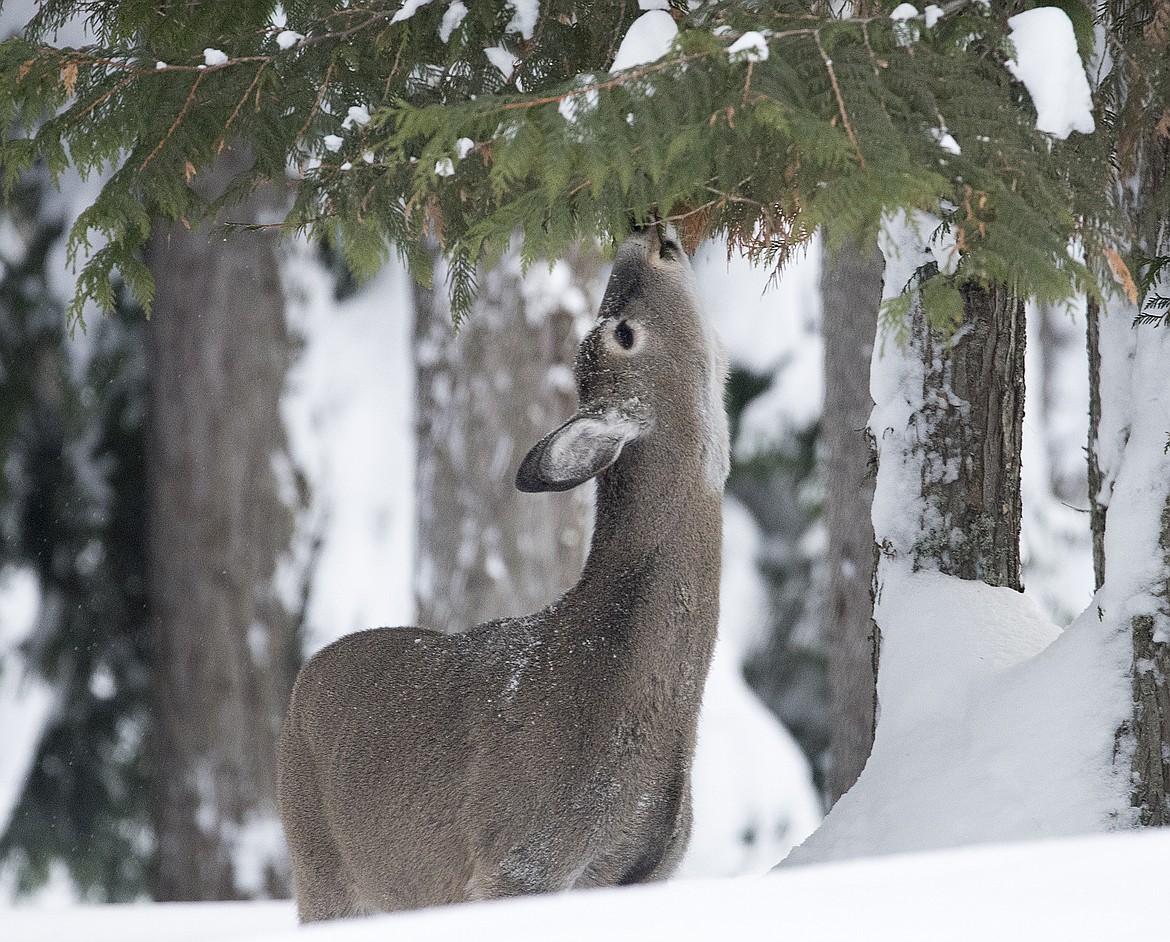
A whitetail deer feeds on cedar branches in deep snow in January 2018 in Glacier Park.
Chris Peterson is the editor of the Hungry Horse News. He covers Columbia Falls, the Canyon, Glacier National Park and the Bob Marshall Wilderness. All told, about 4 million acres of the best parts of the planet. He can be reached at [email protected] or 406-892-2151. | August 1, 2018 7:55 AM
Montana Fish, Wildlife and Parks spring big game surveys show the tough winter did have an impact on local game herds.
In hunting district 110, which is the North Fork of the Flathead to the Whitefish Divide, biologists estimate this spring that there were just 17 fawns per 100 adults, the lowest ratio of any district in the region.
Just 62 whitetail deer were counted in hunting district 110.
“The long, harsh, winter and heavy snowpack across much of Northwest Montana resulted in some fawn and adult deer mortality,” the survey report noted.
FWP region one wildlife manager Neil Anderson noted the North Fork also has a lot of predators.
Hunting districts in Thompson Falls, (121) and the Swan Valley (130) also had low recruitment rates. Thompson Falls had about 25 fawns per 100 adults and the Swan Valley had 26 fawns per 100 adults.
Biologists use the fawn-to-adult ratio to gauge the health of the herd. The higher the number, the better the population.
But several districts continue to have robust herds. For example, in hunting district 122, which is the lower Clark Fork, the number of fawns was 43 to 100 adults.
“Areas where recruitment was near or above 35 fawns should remain somewhat stable in terms of population numbers compared to last year. Regardless, the last two winters have been severe with deep snowpacks and prolonged winter conditions, resulting in reduced recruitment,” the report noted.
The overall harvest trend has increased for whitetails since the 1970s, according to the report.
Last year, hunters could take either sex whitetails in the first week of the season in most hunting districts. That will continue this year, even though some districts are down. The hunting seasons have been set through 2019.
Anderson said that if we have another bad winter, the commission make emergency changes, if need be.
Mule deer continue their downward trend.
The estimated buck harvest of 773 in 2017 was the lowest since the late 1960s and early 1970s, the report noted.
Early October snow may have been a factor.
FWP is studying the mule deer herds in the Whitefish Range and the Fisher River to get a better idea of why mule deer are declining across much of their range.
Elk surveys were hampered this spring due to helicopter issues and the elk still being in cover. But, in general, there was lower cow-to-calf ratios in the Thompson River Valley and the Bob Marshall and Great Bear Wilderness.
Surveys conditions were poor in the wilderness, with just 202 elk counted. The Thompson River Valley, by contrast, had a total count of 1,510 elk.
ARTICLES BY CHRIS PETERSON

Columbia Falls School District makes pitch for charter school
Columbia Falls School District Superintendent Cory Dziowgo and staff recently made a pitch to the Montana Board of Public Education for a new Columbia Falls Trades Academy.

Columbia Falls concerned sewer system could be bottleneck for growth
The City of Columbia Falls could see a significant bottleneck in future growth due to its sewage treatment plant, depending how the city and the state calculate the sewage treatment plant’s maximum treatment capacity without a major upgrade.
Columbia Falls City Council tables e-bike law
The Columbia Falls City Council last week voted to table a city ordinance that would restrict e-bikes and e-motorcycles along with other electrically powered vehicles on its sidewalks and city parks.