
Phase-in recommended for new PUD rate class
CHERYL SCHWEIZER | Hagadone News Network | UPDATED 7 years, 8 months AGO
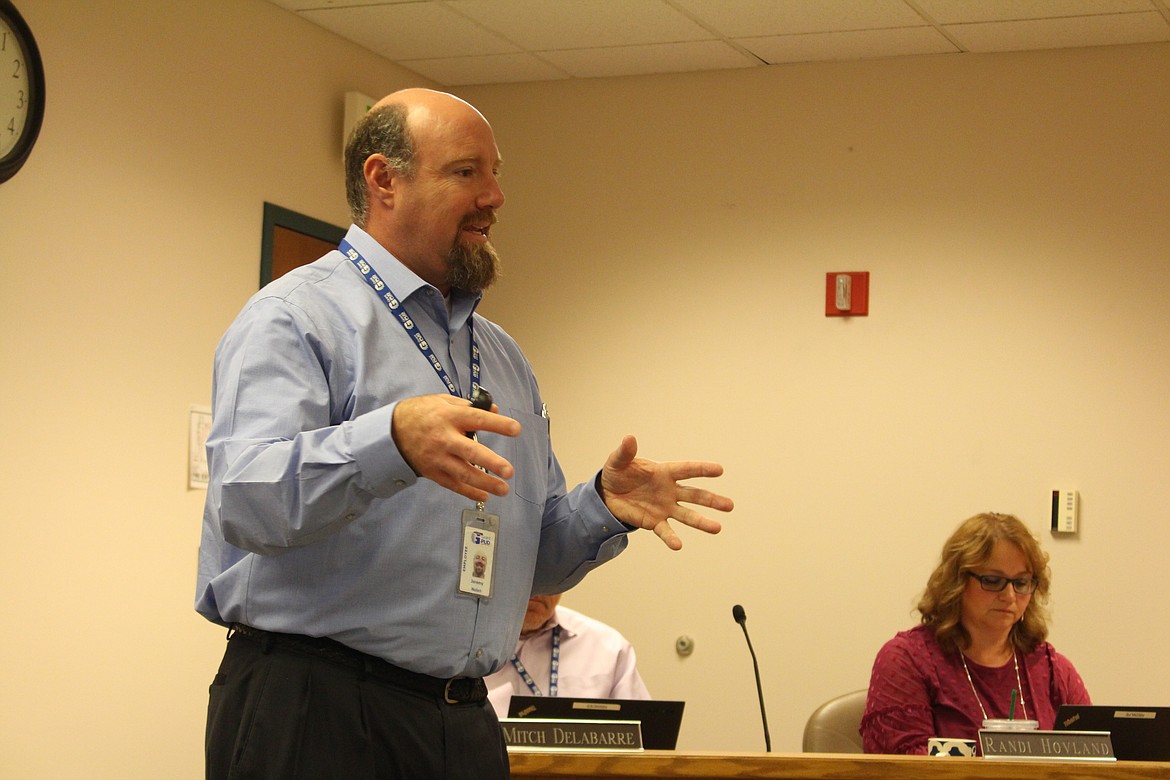
Cheryl Schweizer/Columbia Basin Herald Jeremy Nolan of the Grant County PUD detailed some of the criteria for the new ‘emerging industries’ class at a PUD commission workshop Tuesday.
Senior Reporter Cheryl Schweizer is a journalist with more than 30 years of experience serving small communities in the Pacific Northwest. She began her post-high-school education at Treasure Valley Community College and enerned her journalism degree at Oregon State University. After working for multiple publications, she has settled down at the Columbia Basin Herald and has been a staple of the newsroom for more than a decade. Schweizer’s dedication to her communities and profession has earned her the nickname “The Baroness of Bylines.” She covers a variety of beats including health, business and various municipalities. | August 1, 2018 3:00 AM
EPHRATA — Grant County PUD employees will recommend phasing in the new “emerging industries” rate class over a period of three to four years. That announcement came during a workshop on the proposed emerging industries class for PUD commissioners Tuesday.
The new Class 17 was prompted by a flood of inquiries for service in summer and fall 2017. Many of them came from potential customers working with cryptocurrency, which uses a technology called blockchain. A blockchain can be shared by all people or companies involved in a transaction, and it can be updated by anybody involved, at any time. A lot of the current use of blockchain is for cryptocurrency, but it can be adapted to other uses.
Cryptocurrency can be a large commercial operation, or it can be set up in a residential area, like a shed. Under the current proposal, the basic electricity charge for Class 17 customers in residential areas would be $1.04 per day, plus 13.7 cents per kilowatt hour.
For Class 17 customers that use more than 200KW per hour, the basic charge would be $1,000 per month and 7.09 cents per kilowatt hour. Those customers also would pay a demand charge, $6 per kilowatt during the billing period.
Jeremy Nolan of the PUD’s accounting department said the first criteria in determining if a business will qualify for Class 17 is the amount of electricity used by that class. The “concentration risk” is of interest not only to the PUD and to the utility's other customers, but also to the financial agencies that evaluate the PUD’s ability to pay back its bonds.
If there’s concentration risk, the next step in evaluating potential inclusion in Class 17 is “regulatory risk,” whether or not the industry class is subject to regulation that will affect its ability to stay in business. The third is “business risk,” evaluating the business’s long term liability.
If an industry meets the threshold for concentration risk, it must meet the criteria for one of the other two risk factors to be considered for the emerging industries class, Nolan said.
Cheryl Schweizer can be reached via email at [email protected].
ARTICLES BY CHERYL SCHWEIZER

Road closures, roundabout, mean construction season underway
EPHRATA — The grass is starting to turn green, the trees are starting to leaf out, construction crews are starting to build roundabouts – hey, it’s spring. At least one roundabout project is in its final phase, held over from fall 2025. The intersection of State Route 282 and Nat Washington Way will be closed the week of April 6 to allow crews to install permanent lights. “This really is the final (closure),” wrote Grant County Administrator Tom Gaines in a media release. “The roundabout will close at 6 a.m. Monday, and we plan to reopen by Friday, possibly sooner if the work finishes early.”

Ybarra announces run for Washington Senate
QUINCY — State Representative Alex Ybarra, R-Quincy, has announced his candidacy for the Washington Senate. If he’s elected, he would replace Judy Warnick, R-Moses Lake, who announced her retirement in March.
Othello Community Museum to open April 25
OTHELLO — With a couple of new exhibits, a new heating-cooling system, rearranged displays and a thorough cleaning, the Othello Community Museum will open for the summer April 25. The goal, said Molly Popchock, museum board secretary, is to operate for a full season.