
Tariffs unsettle hay market
CHERYL SCHWEIZER | Hagadone News Network | UPDATED 7 years, 8 months AGO
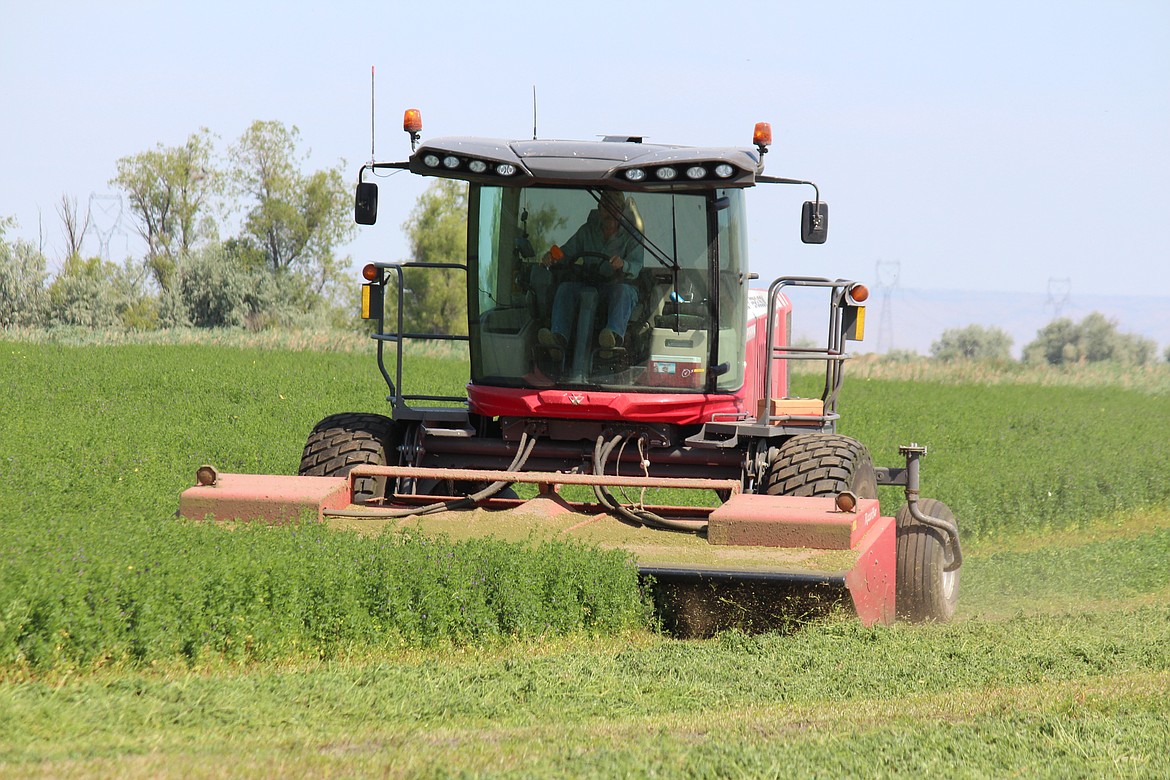
Cheryl Schweizer/Columbia Basin Herald Farmers harvest alfalfa in a field near Royal City. The 2018 hay crop is coming into a market roiled by trade disputes.
Senior Reporter Cheryl Schweizer is a journalist with more than 30 years of experience serving small communities in the Pacific Northwest. She began her post-high-school education at Treasure Valley Community College and enerned her journalism degree at Oregon State University. After working for multiple publications, she has settled down at the Columbia Basin Herald and has been a staple of the newsroom for more than a decade. Schweizer’s dedication to her communities and profession has earned her the nickname “The Baroness of Bylines.” She covers a variety of beats including health, business and various municipalities. | August 3, 2018 3:00 AM
MOSES LAKE — In any war, real or metaphorical, somebody gets caught in the crossfire. And in the 2018 trade wars, that could include Washington agricultural exports. Like hay.
For the uninitiated, there are two types of hay grown in Grant County for feed, timothy hay and alfalfa. The growing season in the county is long enough to harvest multiple crops, two in the case of timothy hay and three or four of alfalfa.
China is a major customer for Washington alfalfa, the third-largest export market in 2017, according to information from the Washington Department of Agriculture. China bought about $103.9 million of Washington hay last year, according to WSDA statistics.
Unfortunately, the Trump Administration is involved in a trade dispute with China, among other countries. The resulting rounds of tariffs have unsettled all markets, including agriculture. “It’s definitely confused the market,” said Mark Anderson, chief executive officer of Anderson Hay, Ellensburg. Other customers for Washington products including hay, both domestic and export, are waiting to see how events unfold.
The U.S. Department of Agriculture releases market reports each Friday, and as of July 27 the market was “slow to moderate.” Alfalfa rated good quality for export was selling at $180 to $185 per ton. Premium quality alfalfa for domestic sales was averaging $220 per ton.
Timothy hay prices as of July 27 were about $260 per ton for fair quality hay for export, according to the USDA.
The Trump Administration has pledged $12 billion in offset support for farmers affected by tariffs. But how that would be distributed is still to be determined.
Exporters “remain cautious,” the USDA report said.
“Meanwhile, we’re having a really good second (alfalfa) harvest cutting,” Anderson said. “We’ve had some good weather for second cutting.”
“Timothy harvest was a little more of a challenge,” Anderson said. Rain during harvest is bad for some products, cherries and hay among them. Both timothy and alfalfa growers battled the rain during first cutting, Anderson said.
The 2018 alfalfa crop could extend to four cuttings for some growers in the Columbia Basin, and two cuttings for some timothy growers.
ARTICLES BY CHERYL SCHWEIZER

Road closures, roundabout, mean construction season underway
EPHRATA — The grass is starting to turn green, the trees are starting to leaf out, construction crews are starting to build roundabouts – hey, it’s spring. At least one roundabout project is in its final phase, held over from fall 2025. The intersection of State Route 282 and Nat Washington Way will be closed the week of April 6 to allow crews to install permanent lights. “This really is the final (closure),” wrote Grant County Administrator Tom Gaines in a media release. “The roundabout will close at 6 a.m. Monday, and we plan to reopen by Friday, possibly sooner if the work finishes early.”

Ybarra announces run for Washington Senate
QUINCY — State Representative Alex Ybarra, R-Quincy, has announced his candidacy for the Washington Senate. If he’s elected, he would replace Judy Warnick, R-Moses Lake, who announced her retirement in March.
Othello Community Museum to open April 25
OTHELLO — With a couple of new exhibits, a new heating-cooling system, rearranged displays and a thorough cleaning, the Othello Community Museum will open for the summer April 25. The goal, said Molly Popchock, museum board secretary, is to operate for a full season.