
Nature walk builds path to wildlife education
Dave Gunter Feature Correspondent | Hagadone News Network | UPDATED 7 years, 8 months AGO
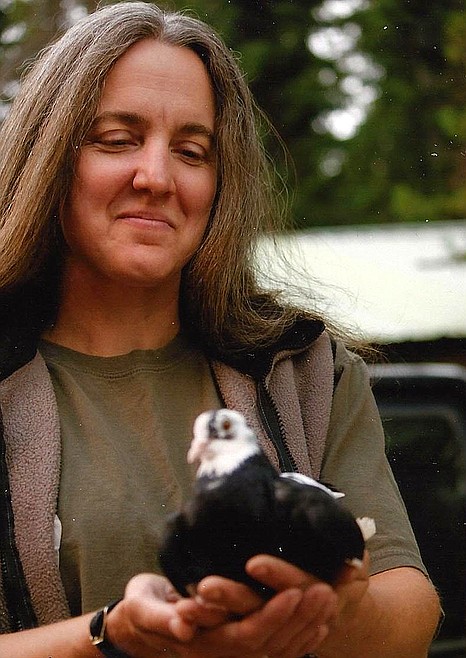
(Courtesy photo) American Heritage Wildlife Foundation founder and board president Kathleen St. Clair-McGee shown with young pigeon, named “Little Eagle” and one of the first patients to be helped at the wildlife facility, just before its release.
CLARK FORK — A conversation between two zookeepers that took place in 2001 will now have an impact on wildlife education for generations to come.
This month, the American Heritage Wildlife Foundation, based just a few miles east of Clark Fork, received a $10,000 grant to begin construction on a nature walk component to the existing 2-acre parcel that houses the foundation and its work.
Established as a non-profit organization in 2002, AHWF is 100 percent community supported, using no county, state or federal funds to finance its mission. According to founder and board president Kathleen St. Clair-McGee, approximately 3,000 volunteer hours are logged each year and more than $15,000 required annually to support the group’s work.
St. Clair-McGee, whose career background was in zoo keeping, has three decades and change as a professional animal caretaker. Her organization began because she believed this area needed a facility where residents could get answers about wild animals and a place that was able to accept those creatures that were injured, orphaned or in need.
At this point, AHWF is the only facility in the Idaho panhandle with permits for both mammals and birds, she explained. The group fields hundreds of phone calls every year and assists in cases that involve about 100 animals on an annual basis.
While the organization already has been reaching out to the community with information and services, St. Clair-McGee and the board of directors felt it was time to immerse the public in a more direct relationship with nature. The grant from the Laura Moore Cunningham Foundation will cover the majority of the new trail, which will turn the AHWF property into an outdoor classroom.
“The parcel of land is unique because it is not one flat piece that has been modified to look like a golf course,” the founder said. “This parcel at one time had a creek run through it and the land at the back was a seasonal pond. Because of this topographical variation, we will be able to explain water habitats, thick forests and meadow habitats.
“We will also be able to discuss the importance of sharing the yard with the native neighbors,” she added.
Unlike many of the hiking trails in the region, the nature walk will be designed to accommodate a variety of age groups and levels of physical ability.
“The walk will be open to all ages and fitness levels,” said St. Clair-McGee. “There will be sections that are level and therefore more accessible to those who are not able to walk the entire 1,000 foot trail. The AHWF nature trail will also be open for senior citizen and school groups to take field trips.”
As Idaho’s population continues to grow and construction moves farther into areas formerly populated by animals alone, residents have more interactions with wildlife. Along with that, they have more questions about what it takes to share the space or what to do when they encounter an injured or orphaned animal. AHWF has been a strong resource for that information, but St. Clair-McGee wants to form a stronger bond with the community and sees the nature walk as the path to making that happen.
“Nature must be felt, heard, smelled and tasted — not just seen,” she said. “The sad fact is our citizens are not, on a large scale, taking the time to learn on their own. Old wives tales and misconceptions are being taken as fact. This current lack of education and misinformation has created a volatile situation in our region.
“The impression given by many of the local citizens casts the shadow of wildlife as being ‘good’ or ‘bad,’” she continued. “The understanding that each and every species is invaluable to human survival is lost.”
In a protected outdoor environment on a private piece of land, AHWF seeks to change that perspective and — on the ground — offer facts about nature to people standing in the midst of it.
“Education is the driving force behind this project,” St. Clair-McGee said. “AHWF feels this trail would be our first step in creating a neutral environment for us to listen to our communities’ concerns and thoughts, while bringing education to the forefront through hands-on displays and conversations with experts in the fields of water, timber, soil, native plants and wildlife.”
According to the founder, the trail “will provide a complete sensory experience to each patron.” A guide will lead one group at a time on a walk that will introduce diverse flora and its importance, while also identifying the fauna that inhabit the region and rely on these native plants for survival.
Signs will also be placed along the trail to provide information on native plants, birds and mammals, as well as methods of soil conservation, water preservation and timber harvesting.
With funding in place, construction will begin as soon as AHWF puts together a volunteer team to tackle the project. Work is expected to begin this summer, with the majority accomplished before snowfall and an opening scheduled for late spring of next year — just in time for the return of migrant birds.
“Volunteers will be needed for all tasks — from spreading bark to identifying plants and creating data sheets about the native flora to actually being one of the volunteer trail guides,” St. Clair-McGee said.
Based on experience, the founder knows that two acres — these two acres, in particular — can be more than sufficient for a natural teaching facility.
“Several years ago, we held a summer day camp for the youth of Bonner County,” she said. “One day was dedicated to the flora and these children wandered around with a guide and got to see, touch and at times taste the vegetation. They also were able to experience the songs of passerine birds, touch the native plants and trees, and learn about the assorted mammals.
“The river is very near, so Osprey, Canada Geese and Great Blue Herons fly overhead,” she added. “Ravens and Turkey Vultures have habitats nearby. From Lazuli Bunting to Cedar Waxwing, Least Flycatcher to Solitary Vireo, Western Tanager to Pileated Woodpeckers, so many other birds call our (National Wildlife Federation)-certified parcel their home.”
Having kept things relatively small and affordable until now, AHWF sees the project as a springboard to greater awareness — both of nature’s importance and the organization’s work to conserve and protect it.
“The nature walk is our largest educational expense to date,” said St. Clair-McGee. “It ties directly into our mission of conserving the local wildlife through rehabilitation of the injured and orphaned, as well as community education. This trail is important to our group because it will be a tangible way for the public to discover what AHWF is all about.
“Our vision is to create the first nature center of the Inland Pacific
Northwest,” she added. “The approval by the Laura Moore Cunningham Foundation for funding the nature walk is the first step.”
For more information on American Heritage Wildlife Foundation, the nature walk project or to volunteer, call 208-266-1488 or visit ahwf.org.
ARTICLES BY DAVE GUNTER FEATURE CORRESPONDENT

Butterfly Coins inspire, track acts of kindness
SANDPOINT — What happens to an act of kindness once it has been given and received? Does it stop there? Or does it gain momentum and touch additional lives?

USA Dance chapter kicks up heels
SANDPOINT — For more than 18 years, a group of local residents — and a few folks who travel into town to join the fun — have been gathering monthly to celebrate their enjoyment of social dance.

Saturday march part of national movement
SANDPOINT — On Saturday, the third North Idaho Women’s March will keep up the momentum that began immediately after the presidential inauguration in 2017.