
City listens for leaks in water system during survey
HEIDI DESCH | Hagadone News Network | UPDATED 8 years, 2 months AGO
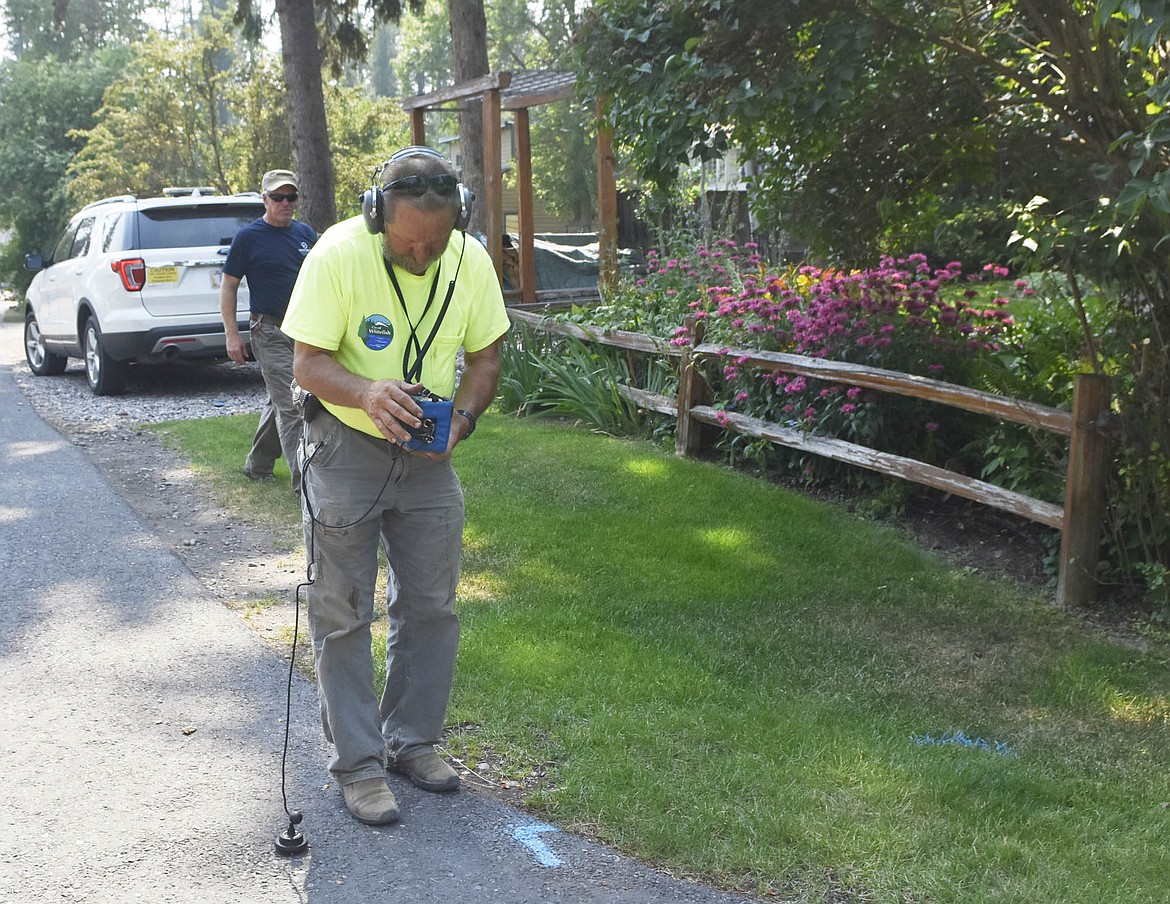
Chuck Allen, with the city of Whitefish, makes adjustments to acoustic leak detection equipment while working on Scott Avenue with Eric Kelsay, background, of Utility Services Associates, which the city contracted with to perform a sound survey of the city’s underground water system to detect leaks. (Heidi Desch/Whitefish Pilot)
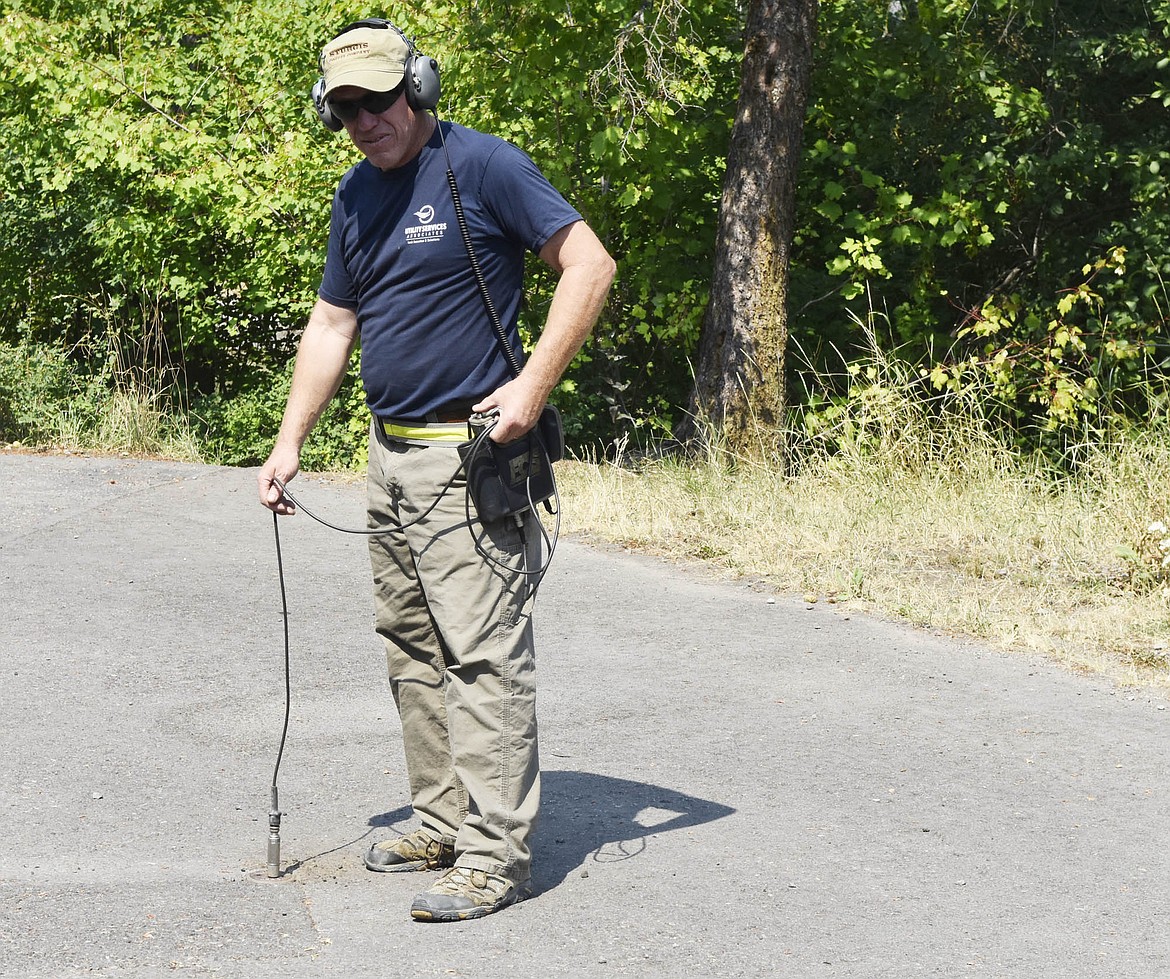
Eric Kelsay, of Utility Services Associates, listens for water leaks on Scott Avenue. The city of Whitefish contracted with the company to perform a sound survey of the city’s underground water system to detect leaks. (Heidi Desch/Whitefish Pilot)
DEPUTY EDITOR, FEATURES Heidi Desch is the Deputy Editor at the Daily Inter Lake, overseeing coverage of arts, culture, lifestyle, community, and business. Desch leads reporters in developing stories that highlight the people, traditions, and events shaping Northwest Montana, guiding content across print and digital platforms. With more than 20 years of journalism experience, including serving as managing editor of the Whitefish Pilot, Desch is a graduate of the University of Montana School of Journalism. She has received multiple Montana Newspaper Association awards, including part of the team leading the Daily Inter Lake to Best Daily Newspaper in Montana Award and the General Excellence Award in 2024 and 2025. IMPACT: Heidi’s work connects readers with stories that deepen the understanding of the community beyond daily news. | August 22, 2018 1:42 PM
Whitefish has been listening for leaks in the water pipes under the city.
A four-week project using sound to survey to the city’s roughly 70 miles of water pipes, recently wrapped up. The city of Whitefish contracted with Utility Service Associates to perform the work, which involved following the water lines, along with surveying 750 fire hydrants and 1,500 water valves, listening for leaks using acoustic leak detection equipment.
Eric Kelsay, senior water loss consultant with Utility Service Associates, describes the equipment used to survey water systems simplify as an “amplified stethoscope.” The energy lost when water is forced through a leak in a pipe wall creates sound waves that are audible.
“Pressurized water makes noise when it escapes pipes,” he said. “A trained person can audibly pick up those leaks.”
The city is currently losing an estimated 25 percent of the water moving through its system that is unaccounted for after it leaves the water treatment plant flowing through the pipes through town to homes and businesses.
Public Works Director Craig Workman said the audio detection survey is an effort to find and repair those leaks that are occurring in the underground system. Unaccounted water can also result from meters being bypassed, new connections without meters or through routine maintenance such as flushing fire hydrants, he noted.
“This gives us a quantitative amount for what were are losing,” he said. “By finding those leaks and repairing them it allows us to decrease our expenses because we’re losing water.”
Following the survey the city will be able to do a full water system audit, he noted, by looking at the amount of water the city is pumping and distributing while comparing that with the amount it is billing customers for.
Workman said the city attempts to complete a leak detection survey every 10 years to do a complete evaluation of its underground system. The industry standard for water loss in a system is 15 percent, he noted, so the goal is to have the city’s loss percentage below that figure.
The city has a 23-day contract with Utility Service Associates to complete the survey. The contract is in the amount of $29,500.
Putting on headphones attached to the leak detection device provides a sense of what it what it must be like to have the supernatural hearing of Superman — any sound is amplified and a normal speaking voice can seem piercing. With the ground microphone set to the pavement even an untrained ear can hear the whooshing sounds of water moving through pipes several feet below.
Busy streets in the city — like U.S. Highway 93 and Wisconsin Avenue — were surveyed at night for safety of those working, but also because traffic noises can make it difficult to hear the leaks. A number of conditions impact the loudness of a leak — size, water pressure, depth of pipe and the type of soil covering the pipe.
There are two main ways to identify leaks.
Two leak noise correlator boxes can be placed at two listening points on a line and then they record sounds to determine the location of the leak based up on the time it takes for the sound waves to travel from the leak to the two points.
A handheld transducer with a ground microphone allows for the leak noise to be amplified while filtering out background noises, so the operator can walk the path of the pipe while listening to pinpoint the location of the leak. Usually, the spot where the leak sounds are the loudest is the location of the leak.
“It allows us to find the leak rather than wait until water is coming to the surface,” Kelsay said.
But surveying using sound can also find leaks that might never have been detected otherwise. Kelsay notes a leak he discovered in another city that was losing water at a rate of 100 gallons per minute, but had gone unnoticed.
“It never surfaced because the water was going into a storm drain and then into a river,” he said.
It’s not only large leaks that can be found through the auditory system. Leaks as small as a quarter-gallon per minute can be detected. Kelsay likens that to a slow drip on a faucet or toilet, but while it doesn’t seem like much water loss, it does add up over time.
“If you put a bucket under that dripping faucet it eventually fills the bucket,” he said.
Once the leaks have been located, the city can make repairs based upon the type of leak, Workman said.
“The main goal for the smaller acute leaks is to fix them in the next couple of weeks,” he said. “For the older cast iron mains we have a schedule to replace those on an annual basis and the results for this will allow us to prioritize that list [based upon the largest leaks].”
In addition, after the full water audit the city can begin looking at correcting other areas that could account for water losses — calibrating water meters or those connections without meters.
The cost for providing water includes a number of items — the energy it takes to pump water from Whitefish Lake to the city’s treatment plant and then throughout the city, the cost of chemicals to treat the water and personnel costs to run the plant.
In addition to detecting leaks in the city’s pipes, the survey also looks for leaks that occur on private lines that run from the curb to the house. The city plans to notify property owners of those leaks so that owners can repair them.
ARTICLES BY HEIDI DESCH

Whitefish wildfire protection plan up for City Council review
Fourteen areas of concern that are primed for mitigating wildlife risk are at the center of a draft Whitefish Community Wildfire Protection Plan.

Kalispell resident advocates for more women in the trades after being crowned Mrs. America
Standing on the stage in Las Vegas, wearing a white formal gown accented with feathers on one shoulder, Qadra Evans gripped hands with a fellow competitor.

Whitefish mulls updates to community growth plan
Whitefish City Council on Monday will consider updates to its community plan including language that looks to protect the historic character of its downtown amid state requirements allowing buildings up to 60 feet in height in certain zoning districts.