
Fall-related deaths on the rise in senior population
Devin Weeks Staff Writer | Hagadone News Network | UPDATED 7 years, 4 months AGO
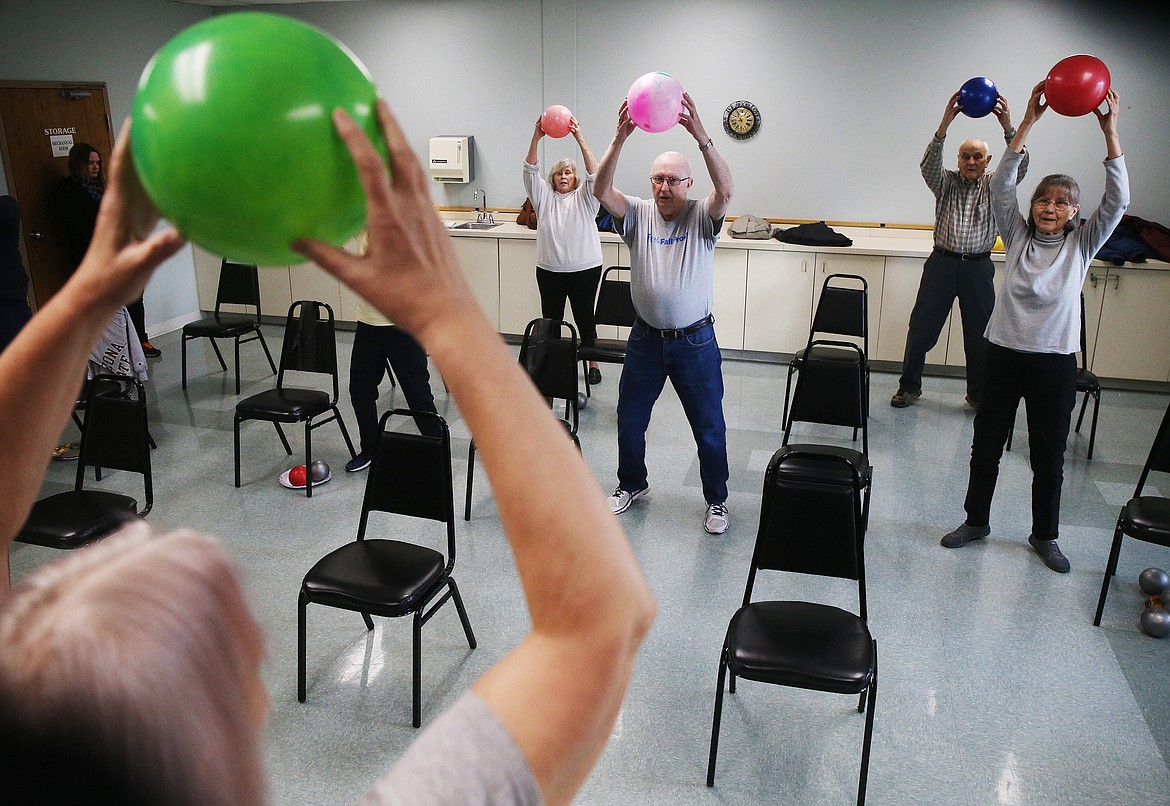
LOREN BENOIT/Press Fit and Fall Proof program attendees lift soft touch medicine balls to strengthen their core and upper body muscles during a workout Thursday morning at Lake City Center.
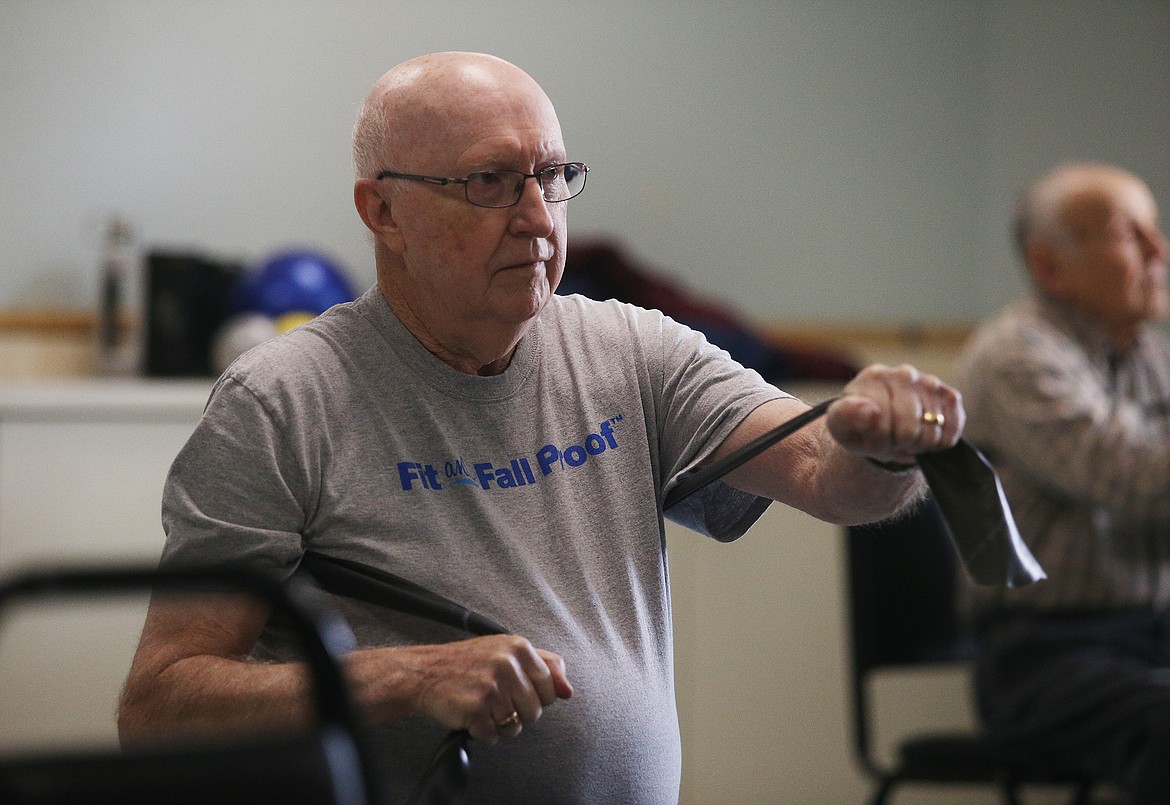
Art Flagan extends his arms forward using a resistance band during a Fit and Fall Proof class Thursday morning at Lake City Senior Center. (LOREN BENOIT/Press)
All it takes is one snagged rug, one patch of ice or one well-meaning little dog underfoot to send a senior citizen crashing to the ground.
"One slip and fall can change somebody’s whole life," said Wendy Ferguson, Kootenai Health injury prevention coordinator, registered nurse and certified emergency nurse. "That's why prevention is so important."
According to the Centers for Disease Control, the fall death rate for adults 65 and older is on the rise. It increased 30 percent from 2007 to 2016, and if these rates continue, seven fall deaths are anticipated to happen every hour by 2030.
"That’s really disconcerting, but that’s nationwide," Ferguson said. "That’s not just here."
The majority of these cases are ground-level falls, which are one foot or less from the ground. Information from Kootenai Health's trauma services reflects this dangerous trend; 291 of the 394 geriatric trauma patients treated from January through Oct. 31 of this year were brought in because of ground-level falls.
That only includes those who were admitted for observation or had to undergo surgery, not patients who suffered minor fall injuries and were released after a brief visit.
Ferguson said even though those numbers are staggering, they're still better than other locations.
"Talking to other injury prevention coordinators nationwide, you're looking at places that are 64 (percent)," she said. "There was a place outside of Detroit, Mich., they were close to 82. And this is Detroit.
"No. 1 is always ground-level falls."
Tripping hazards, poor eyesight and other factors are involved in the increase of fatal senior falls. The University of Washington is conducting a study to see if de-prescribing certain medications — benzodiazepines, for insomnia and anxiety, and opioids, for pain — would help reverse this trend.
Ferguson said she and anesthesiologist colleagues are looking forward to the results of this study because of the link between these medications and how they can suppress the nervous system and impede the ability to catch oneself during a fall. Many older adults are on several medications for multiple health issues, and “when you stack a lot of those up, sometimes, that can lead to falls," she said, adding that the key in this case is maintaining communication with health care providers.
"The take-home from all of that is that people do maintain their routine follow-ups and they do follow up with their doctors and they keep that conversation going and open about their medications," Ferguson said. "It's more important than ever that people follow up with their doctors and nurse practitioners."
A condition known as "orthostatic hypotension," when a person stands up quickly and blood can't pump to the brain fast enough, is also a culprit in elderly falls. Ferguson encourages people to take their time and change position slowly to allow the body to regulate before standing.
"It’s OK if you miss that phone call. It’s OK if you don’t get the door,” she said. “People say, ‘The phone rang and I jumped up,’ and then they break their hip and we meet in surgery."
Physical obstructions are always a concern when it comes to safety. Ferguson encourages proper footwear for going outside, removing scatter rugs from pathways and salting and throwing cat litter on icy areas to provide traction.
"Especially this time of year when we start getting this freezing ice," she said. "I can’t tell you how many conversations I’ve had with people in the recovery room, and they’re like, ‘I was just going to check my mail,’ or ‘I remembered it was trash day and I was just going to take out the trash.'"
The CDC National Center for Injury Prevention and Control reports that more than 3 million older people are treated in emergency departments for fall injuries each year. One out of five falls causes a serious injury such as broken bones or a head injury and in 2015, medical costs for falls totaled more than $50 billion, 75 percent of which Medicare and Medicaid covered.
Ferguson has been in the medical field about 15 years and recognizes that the rise in the fatal senior fall statistic is related to a populous generation getting older.
"The trend overall nationwide is increasing because our baby boomers are aging," she said. "We see it a lot here in this area because we have such an aging population here, as well as people moving in to retire."
Ferguson and Alicia Keller of Panhandle Health District work closely to help protect North Idaho's seniors by providing free educational workshops and fitness programs. Kootenai Health offers the 10-week Kootenai Balance and Fitness Exercise Class and PHD facilitates volunteer-led Fit and Fall Proof sessions multiple times a week at numerous locations. The classes focus on enhancing strength, balance, flexibility and mobility.
These hour-long sessions were developed by the Idaho Department of Health and Human Services. They include a variety of stretches, marching in place, shoulder-rolling, knee bends, ankle and wrist rotations and other movements to reduce injuries in case of a fall.
"Every muscle and joint gets worked on, and so it keeps us going from day to day,” said Marjaana Ylitalo, 72, of Coeur d’Alene, who attends the Fit and Fall Proof class at Lake City Center.
Ylitalo started going to these classes after she broke her arm in a fall more than a year ago. She said she has noticed an improvement in her strength and mobility in the past year. Her significant other, George Barnhart, 82, also participates.
"It makes me more flexible, and aware, too," he said.
Jill Hilgendorf leads the Lake City Center sessions and said she volunteers her time because when she retired, she didn't want to sit at home all the time. She wanted to help other seniors "just keep moving."
"When we get older, for all of us, something goes wrong, and it might not be what you expect to go wrong," she said. "Exercise can help stave problems off. It can help you improve after you've had a health condition.
"Every single person who participates in this program, I see improvement," Hilgendorf said. "There is nothing better than that."
As Ferguson said, the injuries seniors sustain when they fall can have life-altering consequences. Physical therapy or caregiver assistance may be required after a fall. Independence could be stripped away in an instant if the injury is severe enough, such as a potentially deadly head trauma that causes bleeding in the brain or a pelvic fracture that causes massive blood loss.
"Broken hips, now, hips are a whole different game. These people are not going back home, and that’s probably the saddest thing about falls,” Ferguson said. "Here were people who were very independent and living on their own, they fall and break a hip, they’re not going back home. They’re going to end up going to a skilled nursing facility, some kind of long-term rehab. There’s also caretaker stress that’s affiliated with that, because often they’ll have adult children who are now going to have to care for their mother and father, and now they’re losing time from work because of having to (provide) care. It’s a big deal. It affects a lot of people.
"People that fall and break a hip are also at risk for aspiration pneumonia or just pneumonia because they're not moving as much, so now all that bacteria collects in their lungs," she continued. "It’s not just the broken bones, it’s everything that goes with it... People are bedridden for a long time and a lot of times, people just don’t recover as well. That is the saddest part, that these people don’t go back to the way of life they were, and depending on how severe that break or fracture is, it kind of leads to their demise."
Ferguson recommends older adults keep their phones charged and somewhere easily reached with contacts pre-programmed or written nearby in large print for emergency purposes. Make plans with neighbors in case of snow storms, have routine check-ups with health care providers and safeguard the house by turning on nightlights and tossing out rugs that snag.
"A little bit of short-term pain makes for long-term gain," she said.
Other balance and fitness classes Kootenai Health offers for older adults are: cardio-pulmonary rehab for $3 per hour (208-625-4690); classes in the McGrane Center Aquatic Pool for $3 to $6 per class (208-625-5313); Kroc Center sessions for $16 to $20 (208-667-1865); and classes at PEAK Fitness at varied prices (208-667-2582 Coeur d'Alene or 208-762-9014 Hayden).
Fit and Fall Proof info: 208-415-5242 or www.panhandlehealthdistrict.org/fitandfall
ARTICLES BY DEVIN WEEKS STAFF WRITER

Docuseries 'opens wounds' for some in North Idaho
RATHDRUM — Family and friends who lost loved ones to suicide have expressed concerns with the “Irreplaceable” docuseries being filmed in Lakeland schools this week.

Young welders showcase talents in SkillsUSA contest
RATHDRUM — Showers of orange sparks cascaded from workstations to the floor as student welders meticulously completed their projects Friday at the Parker Technical Education Center in Rathdrum.

North Idaho canines will appear on Animal Planet
The biggest sporting events of the year are happening this weekend: Dog Bowl III and Puppy Bowl XVI.