
Moose lovers warned of shrub responsible for deaths
Bonner County Daily Bee | UPDATED 7 years AGO
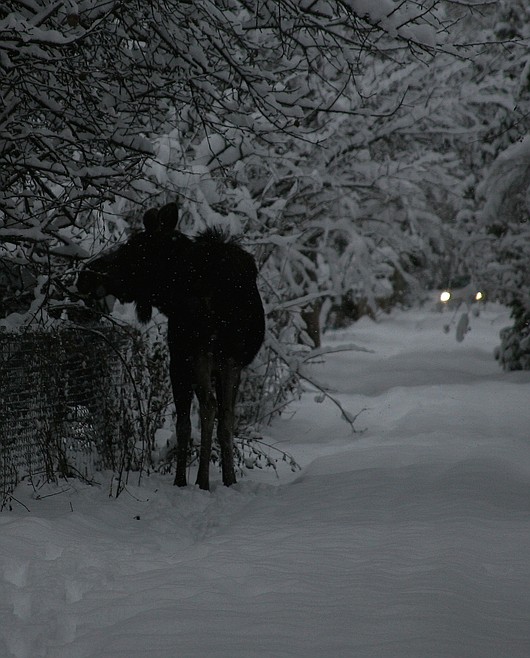
(Daily Bee file photo) A moose grazes in south Sandpoint in this 2015 [photo. Residents need to be careful with planting Japanese Yew (Taxus custidata) as the popular shrubs are toxic to all members of the deer family — as well as other browsing animals as well.
The current copy of Sandpoint Magazine — the excellent brain-child of Chris Bessler — set my alarm bells ringing with its focus on the ubiquitous moose that share our Sandpoint area homes. I mean that literally by the way, for as the photos showed, they feast on our trees and shrubs as they meander along.
The warning bell came from a column I wrote a year or so ago, and I urge anyone with any sort of landscaping to re-read it! I repeat it here edited somewhat so as to focus on the basics.
I received a phone call from a former co-worker at the Bee, Betty Johnson, who told me she had been watching a female moose browsing the shrubs in her yard and suddenly noticed that it had begun tossing its head about and shaking its head and ears — staggering around and then seemingly becoming angry and making hostile “charges” toward the house.
After a time, with no let-up in the creature’s actions, Betty called Matt Haag at IFG and explained the moose’s behavior to him and he immediately went to her house to observe. He watched as the moose lay down briefly, and ascertained that she was pregnant, and after checking the bushes she’d been eating, established that they were Japanese Yew (Taxus custidata).
Matt told Betty that the popular shrubs were toxic to all members of the deer family — as well as other browsing animals as well, and were responsible for the deaths of both deer and moose locally and elsewhere across the state, including an entire herd of 20-30 elk! He said if the moose at hand was poisoned its calf would die, too.
He said Idaho Department of Fish & Game had been trying to get the word out about the situation but hadn’t made much headway. Betty said “how about calling Valle?” He agreed with that and gave her his number for me to call. Meanwhile, the sick moose had gotten up and wandered next door to a huge snow-pile and began eating the snow in great gulps. It seemed to revive it a bit, and it’s hoped that the moose will recover.*
My following conversation with Matt provided the alarming statistics furnished earlier, and he stressed the fact that while the imported Japanese Yew is deadly, its soft-needled branches and bright red berries are pretty and appealing. He pointed out that little children might covet those pretty but poisonous berries and their seeds — which incidentally are toxic to many other creatures.
The native Pacific Yew (Taxus brevifolia) is perfectly safe for use (a call to native plant wizard Bob Wilson** of Cedar Mt. Perennials provided me with the Latin name) and it should be used to replace the seemingly popular Japanese Yew. Matt is hopeful that people with the dangerous plants will remove them — or at least cover them with burlap to discourage foragers. For further information, readers should call the Department of Fish and Game at Coeur d’Alene, 208-769-1414. Nursery owners reading this should consider returning or disposing of their stock, and notify suppliers of the problem.
Fortunately, other possibilities abound as substitutes, particularly the afore-mentioned Pacific Yew.
In addition, the attractiveness and practicality of our native Pachistma — variously known as Oregon box or Mountain Lover — boasts year-round bright/dark green, shiny, toothed leaves and is a sure bet for best all-around shrub. It is what I call a “sifter” plant; with tangled branches and the supple, leathery leaves, it allows winter snowfall entry to its base rather than collecting atop and crushing it.
Too, consider Mugho and other dwarf Pines, and many members of the Juniper family. Native Rocky Mountain Juniper for its loose-limbed, cedar-like foliage and dusky blue berries is a standout.
Hybrids, such as the Procumbens group, spread out from a mounded form with an almost moss-like foliage that is green in spring and summer but becomes tinged with purple during winter.
Tsuga Canadensis — hemlock — is another great creeper, hardy to Zone 2. T “Jeddaloah”, a dwarf conifer, cascades arching branches down embankments, over rocks and across the lawn if you let it. T. Cole’s Prostrate” spreads out dark green branches into a literal ground-cover that grows only a few inches high.
Small weeping evergreens like Norway Spruce are winners as well; my beautiful specimen bends double over itself and spreads it’s curved branches along the ground like some grand lady’s skirts.
Cotoneaster, with its deep green red berry-covered boughs is a prolific grower here, with several varieties available. The branches can grow in an attractive “fan” or trail to the ground, depending on which one you choose.
Like Pachystima, it is a great sifter, providing its own protective support. This wonderful plant would also be the perfect shrub for an embankment — as would many others herein mentioned.
* Unfortunately, neither I nor Bee Editor Caroline Lobsinger could find a closeup picture of the toxic Yew, but simply insisting on the native Taxus brevifolia should work, since all purchased shrubs have ID labels attached. If you are in doubt about your yew — if any — take a sprig to the Extension office at the Bonner County Fairgrounds just off Schweitzer Road and ask for identification. If it’s the “bad guy’ please replace it with a safe alternative.
** Bob Wilson may have an idea of native sources.