
SCRC links volunteers, providers to folks in need
Bonner County Daily Bee | UPDATED 7 years, 11 months AGO
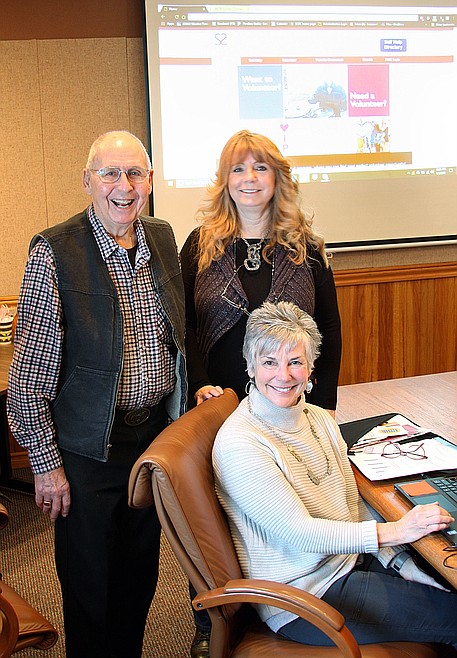
(Photo by DAVID GUNTER) Members of the Sandpoint Community Resource Center are, clockwise from left: President Rich Crettol; administrative assistant Bonnie Pafundi; and board member/volunteer Becca Orchard. The organization recently upgraded its website to provide one-stop shopping for people seeking assistance, as well as local groups that provide it.
By DAVID GUNTER
Feature correspondent
SANDPOINT — Two men and a cell phone. Sounds like a movie comedy title, though it’s really the genesis of the Sandpoint Community Resource Center.
Back in about 2011, Rich Crettol and Dave Pietz were looking for a way to help a fellow church congregation member in need, only to be met by a disorienting maze of providers. Some of the groups they called had closed their doors, others advised them that they didn’t offer the services they sought and weren’t sure where else to look.
It wasn’t so much that there was a lack of available help, it was more a matter of having no network in place to match people with places that could give them a hand.
“Dave and I found ourselves caught up in the provider runaround,” said Crettol. “We decided there was a better way to run a railroad.”
Where once Pietz and Crettol worked on a catch as catch can basis with their trusty cell phone and a legal pad scrawled with ever-changing contact names and numbers, using a “virtual office” format that operated from wherever the phone and pad happened to be at the moment, SCRC now has digs in the Columbia Bank Plaza building next to Farmin Park.
With one staff member, administrative assistant Bonnie Pafundi, a team of volunteers and a working board of directors, the organization has upped its game and managed to weave a fabric made up of the provider groups serving Bonner and Boundary counties.
By 2012, SCRC had hosted its first meeting, attended by more than 100 people, to discuss the prospect of turning a labyrinthine process into a one-stop shop, where those in need and those available to assist them could connect easily. The following year was a growth period for the center, with new ideas and skill sets adding to the mix.
Board member and volunteer Becca Orchard came on board to lead the process of organizational development, training and strategic planning. One of her first goals was to steer the group away from its heartfelt-but-helter-skelter roots and toward “a more sustainable way to help people.”
As we enter 2018, one answer appears to be helping people help themselves — or, at least, help themselves to the rich storehouse of information SCRC has gathered on their behalves. The vehicle is a revved-up website that interconnects a public interface with data management and reporting capabilities to give the organization an ongoing ability to codify its provider network.
“That has been the biggest game-changer for us,” said Orchard, adding that the site now gets about 6,000 hits, many of which click through the site’s self-help directory found at the top of every page. “When we tracked the growth year-over-year, it was off the charts. We had a 2,000 percent increase in hits to the self-help directory — that’s telling.”
As part of the process, SCRC also uses its site to follow up and make sure people found the services they needed and request feedback on how things could improve.
Based on the spike in web traffic — as opposed to anecdotal evidence — SCRC has learned that the level of need in the two northern counties is real.
“We have over 1,000 families — unique families, not repeats — who have contacted us,” Orchard said, pointing out that that the much-ballyhooed abuse of “the system” is almost non-existent. “The number of people who are repeat clients — those who contact us time after time for help — is maybe 1 percent.”
Families with dependants make up 57 percent of the client list, with almost half of the clients seeking assistance being over age 50. Flying in the face of stereotypes, only about 10 percent are homeless. In fact, close to 20 percent of the clients own their home and nearly 45 percent are renters.
Far and away, the availability of affordable housing is the main concern for area residents looking for help, coming in at No. 1 on the SCRC Top 10 list of needs.
“If you look at housing costs versus wages, that’s where that comes in,” Pafundi said.
It might come as a surprise to many to learn that the local poverty level would be seen as a living wage in other parts of the country. According to Crettol, a Sandpoint household earning $39,000 a year falls into that category. Based on that wage, he said, little is left to pay bills and buy groceries after housing costs are met.
Rounding out the list of needs are utility payments, financial and rent assistance, transportation, food, employment, legal and medical costs.
Needs, however, make up only one tier of what SCRC is all about these days. The advent of the upgraded website has meant that providers, too, have more connectivity and access to information.
“If we’re getting 6,000 hits, we can use this vehicle to help providers reach an audience,” Orchard said.
Along with that technology, SCRC led the formation of the Service Provider Information Network. That consortium held its first annual symposium last spring — an initial step toward building collaboration between service providers. The result of SPIN’s collaboration can be found on the SCRC website, where users have immediate access to resources that range from utility payment assistance to health care and free meal schedules in the community.
Also listed is the community food pantry offered by 7B Culinary Connections — a new service for people in need that might have flown under the radar, but for the networking of providers and the sharing of information.
“This is a perfect example of what we do,” said Pafundi. “Otherwise, how would anybody know they existed? We help people who are in need meet up with those who can assist them.”
Growth in those seeking assistance and a more robust line of communication to match them with providers has created a different sort of need — a need for more community volunteers. Thankfully, there is a pool of people looking to fill those shoes and, once again, SCRC is playing matchmaker to the community.
Going by the name V.I.P. — Volunteer Idaho Panhandle — the project works to bridge the gap between the need for volunteers and those wishing to put their talents to work in that capacity. Orchard referred to it as one of the “three tiers,” made up of SCRC, SPIN and V.I.P.
Higher visibility among users has done much to increase awareness of how those tiers can create crosstalk between service providers, people in need and volunteers.
And while SCRC has become a lot more than two men and a cell phone over the past seven years or so, and despite its rapid expansion in web traffic, the organization still is doing the heavy lifting of letting the community know this service exists.
“Our biggest challenge is to get people to know about us,” Orchard said.
“That’s the branding part of all this,” said Crettol. “To let people know we’re here.”
To learn more about SCRC, its events and services, or how to donate and volunteer, visit online at: www.sandpointcommunityresource.com or call 208-920-1840.