
Hells Gate State Park
Christian Ryan Correspondent | Hagadone News Network | UPDATED 7 years, 9 months AGO
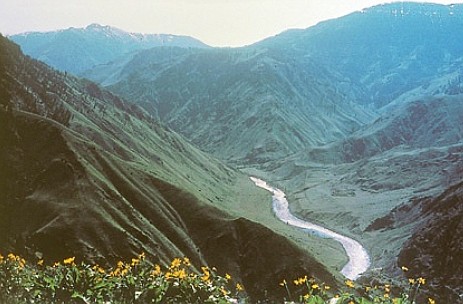


This week, our June-July journey through eight of the state parks of Idaho takes us to Hells Gate State Park. Not to be confused with Hell’s Gate National Park in Kenya, this Idahoan beauty lies in western Idaho 123.8 miles down U.S. 95 south.
My first impression of this park? How could they have come up with such a horrid name? This state park is beautiful beyond description, especially if you are into geology. Wind and water erosion over the millennia has been the primary agent in making the park look the way it does today, revealing stunning rock formations. Hells Gate State Park is often seen as the gateway into Hells Canyon, the deepest canyon in all of North America. With a depth of 7,993 feet, Hells Canyon easily dwarfs even the Grand Canyon’s depth at a mere 6,093 feet.
Hells Gate State Park sits on top of an arc of volcanoes that were pushed up and out of what would later become the Pacific Ocean; since then, those volcanoes have become inactive, and after thousands and thousands of feet of sedimentary (water-deposited) rock were piled on top of it, newer volcanoes formed and belched out enough basalt lava to cover the entire region in the form of a massive plateau. How did Hells Canyon form with all this volcanic activity happening? Well, eventually the lava plateau cooled and flowing water started carving through it. However, the canyon as we know it didn’t truly form until near the end of the Ice Age when Utah’s Lake Bonneville breached its borders, sending a massive outburst flood through Idaho and Oregon before finally flowing out into the Pacific Ocean and leaving modern day Snake River in Hells Canyon in its wake.
Adequate plant and animal life and habitable climate conditions have attracted Native American tribes to the Hells Gate State Park region for thousands of years, one of the most prominent inhabitants being the Nez Percé Tribe. In fact, if you go to the park today you can see depressions where they once built some of their pit houses. Among the first European settlers to see the region were none other than the Lewis and Clark expedition in 1806, but it wasn’t until the Wilson Price Hunt expedition of 1811 when it was actually explored.
Unlike the other state parks we’ve gone through so far, Hells Gate State Park is best described as a scrubland, and it’s home to sagebrush, bunchgrasses, prickly pear cactus, poison ivy, Douglas fir, ponderosa pine and other deciduous bushes and trees. As far as fish are concerned, smallmouth bass, catfish, trout, sturgeon and steelhead call the waterways of Hells Gate State Park home. In turn, they attract a whole host of fish-eating animals, like waterfowl, herons, otters and even pelicans. Bighorn sheep and deer are often seen in the park, so be on the lookout for them as well!
While plentiful food and drinking water draws animal life to the park, people are drawn to the park by the stunning geology, and the prospect of camping, hiking, mountain biking, horseback riding, swimming, wildlife viewing and especially rafting down Hells Canyon’s Snake River. Also be sure to stop by the Lewis and Clark Discovery Center where you can learn more about those famous explorers and the Nez Percé Tribe. Hells Gate State Park is by far one of the most geologically-enriching places in all of Idaho!
HELLS GATE STATE PARK SCAVENGER HUNT
As you explore Hells Gate State Park, see if you can find all of the items on this list. You may want to ask a ranger or park employee if you need help identifying one or more of the items on this list. Be sure to check them off as you go!
[ ] A park sign
[ ] Snake River
[ ] Igneous (volcanic) rock
[ ] Sedimentary rock
[ ] An animal that eats fish
[ ] A prickly pear
[ ] A bird that spends much of its time in the water
[ ] A Douglas fir tree
[ ] Poison ivy (OBSERVE FROM A SAFE DISTANCE!)
[ ] Something you didn’t expect to see
ARTICLES BY CHRISTIAN RYAN CORRESPONDENT

Critters of North Idaho: American Coot
If you see this bird swimming across the water’s surface from a distance, chances are you will mistake it for a duck.

Critters of North Idaho: Northern pike
When we talk about human disturbance of the environment, we usually think of the overharvesting of trees, overhunting and littering. But we can also disrupt the natural balance by introducing species of animals and plants into non-native habitats. This is what happened in the case of the northern pike.

Critters of North Idaho: Ye ol' vole
If you see a little rodent scurrying about in the thicket or under the snow, you may think it’s a mouse. And it may be a mouse, but at first glance it is very difficult to tell a mouse apart from another little rodent, the vole. So difficult, in fact, that voles are often mistakenly referred to as “field mice.” What makes these little scurriers so different from each other? For starters, they belong to different families.