
CFHS students showcase mastery education
Mary Malone Staff Writer | Hagadone News Network | UPDATED 8 years, 1 month AGO
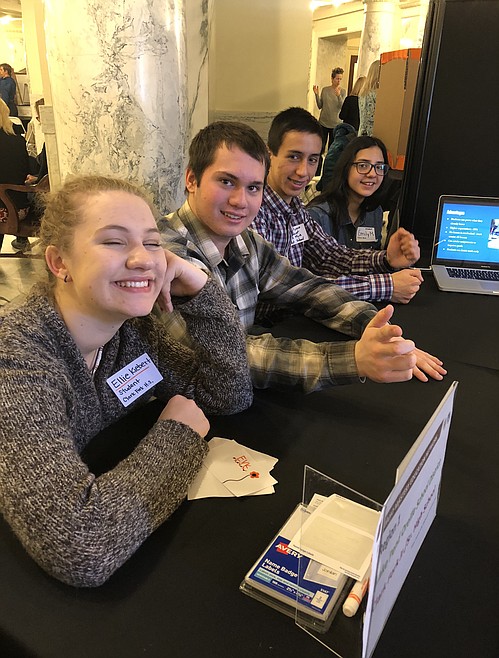
(Photo by MARY MALONE) Four Clark Fork Junior/Senior High students made their way to Boise last week to represent their school in the Idaho Mastery Education Legislative Showcase, held in the Capitol Rotunda. Pictured from left are sophomores Ellie Kiebert and Kobi Dooley, CFHS junior Michael Myers and seventh-grader Emily Myers.
CLARK FORK — Clark Fork Junior/Senior High School moved toward a mastery-based education model four years ago, and according to CFHS instructor Mike Turnlund, it is a "smashing success."
"It was an amazing outcome," said Turnlund, who was the first CFHS instructor to implement mastery-based education in the spring of 2014. "Everyone was successful and I knew I was on to something special."
The Idaho Mastery Education Network is now a cohort of 18 school districts and charter schools that are pioneering mastery-based education at a total of 32 school sites. Teachers, students and administrators from across Idaho gathered in the Capitol Rotunda on Feb. 23 to demonstrate the approach to education that measures student learning by mastery of content.
As Clark Fork is the only school in the Lake Pend Oreille School District engaged in mastery-based education at this time, four CFHS students made their way to Boise last week to represent their school in the Idaho Mastery Education Showcase. Those students, accompanied by Principal Phil Kemink, were sophomores Elaina Kiebert and Kobi Dooley, CFHS junior Michael Myers and seventh-grader Emily Myers.
"During the showcase, we allowed students to do what they do best and shine," Kemink said in an email to the Daily Bee, adding that business was kind of slow during the "science fair" type presentation. "Those who took the chance to speak to our four students were thoroughly impressed with the mature and engaging responses that were provided. I was approached by several afterward that were very excited by what they heard and were eager to share their experience. In their words, 'You have some great kids.' I’m very proud of them and to be part of our school community."
Dooley said there were booths set up for each of the schools in the Capitol Rotunda, and people would stop by to ask questions. They didn't know who many of the people were, but some of the state legislators stopped by to inquire about the CFHS program.
"It was really cool to see all the different schools and what they do with the program," Kiebert said.
Teachers and school administrators took the opportunity to see what others were doing throughout the state as well.
"It was a good time for everybody to see what everybody else was doing and get ideas from them," Dooley said. "There was a very wide variety — there was a school where they didn't have any traditional classrooms and they had to find people in the community to help. So depending on what they did, they would get a credit for the community service they did. It was interesting for sure."
They were told they didn't need a poster board set up, Dooley said, but all the other schools that participated had one anyway. So Kiebert said they felt a bit unprepared in comparison. They did present a slideshow on the computer and, as Kemink said, they nonetheless impressed those who stopped by. Kiebert said they also got to tour the Capitol Building and a couple of the teens watched a legislative session in progress.
As junior high and high school students are engaged in mastery at Clark Fork, Emily Myers represented the junior high students and said she enjoys mastery.
"Mastery is really nice because you can move ahead and work ahead," she said.
Dooley said it gives students a way to prioritize classes as well. If, for example, a high school student is taking a health class, they have the option of working ahead to finish it, and then using the extra time to focus on dual credit courses, he said.
"By moving ahead, you could finish high school early and by senior year, you can just be working on all college classes, dual credit classes, and get a lot of that knocked out in high school," Michael Myers said. "The dual credit, a lot of that gets paid for by the state, so it is a lot less expensive doing dual credit your senior year than doing that year in college."
Moving Idaho to a mastery-based K-12 education system was the number-one recommendation of the Task Force for Improving Education, according to a statement from the State Department of Education. While Turnlund began experimenting with it in 2014, Idaho lawmakers approved the model in 2015 and the initial cohort of participants was selected, forming the Idaho Mastery Education Network as a mastery incubator. Network participants completed a year of planning and design for their mastery models in 2016-17 and are implementing those models this year.
“This is an opportunity for us to personalize learning for each student so they’re successful in their own way, at a flexible pace,” Superintendent of Public Instruction Sherri Ybarra said in the statement. “Mastery-based education is the wave of the future, and this network puts Idaho at the forefront.”
Participants include rural and urban schools, alternative schools and specialized schools from varied parts of the state. Response from educators, students and parents has been very positive, said Kelly Brady, mastery education coordinator for the State Department of Education in the statement.
“They love it,” Brady said, noting reports of increased student engagement and fewer behavioral issues. “We now have 40 to 45 districts that want to move in this direction.”
The mastery-based system is tailored by each participating district and school to meet local needs, she said, and network members work collaboratively, sharing ideas and experiences. Last year, she said, members of the cohort met together once a month; this year they gather for two days during every quarter.
Although serving students’ individual needs is the goal of all Idaho educators, mastery-based education makes it easier to match educational goals with individual students and encourages students to communicate their needs and help determine how they learn, Brady said.
Turnlund said, normally, a semester's work is driven by the calendar. Everyone is required to work at the same pace, so the kids who are capable of going faster get bored, and the kids who can’t keep up fall further and further behind. With mastery, they do the same amount of work, but the students are not driven by the calendar. They don’t have to wait for the rest of the class.
"The teacher will lecture and do what teachers do, but if a student is able to go on ahead, and as long as they maintain As and Bs, they can get done with the course as quick as they want," Turnlund said.
The teacher is able to differentiate, he said, checking in with the students who are breezing through the work and spend the majority of their time with the students who need help to keep from falling behind. Also with mastery, he said, there is no C, D or F. Instead, the student gets "approaching mastery" and is required to retake the class. The school's grade point average is up because the kids are required to work more, he said. They also can work in ways that they prefer, because students have different learning styles, as do adults, Turnlund said.
"(The students) like it and our grades are up, our scores are up, our attitudes are up," Turnlund said. "There is no downside to mastery."
Mary Malone can be reached by email at [email protected] and follow her on Twitter @MaryDailyBee.
ARTICLES BY MARY MALONE STAFF WRITER

Shotgun and drugs lead to arrests
BONNERS FERRY — Two individuals were arrested after a shotgun and drugs were found following an alleged incident at Bonners Ferry High School.

Drones take off at Priest River Elementary
PRIEST RIVER — Wearing their flight crew colors, the fifth-grade students walked side by side across the gymnasium to ensure the flight deck was clear of debris.

Mentoring foster kids & the art of fly fishing
SANDPOINT — Giving foster kids the opportunity to get out into nature and learn the art of fly fishing is a powerful therapeutic tool, allowing the youngsters to leave behind some of the stress while also building their confidence and self-esteem.