
Aviation students get look at C-17
CHERYL SCHWEIZER | Hagadone News Network | UPDATED 7 years, 9 months AGO
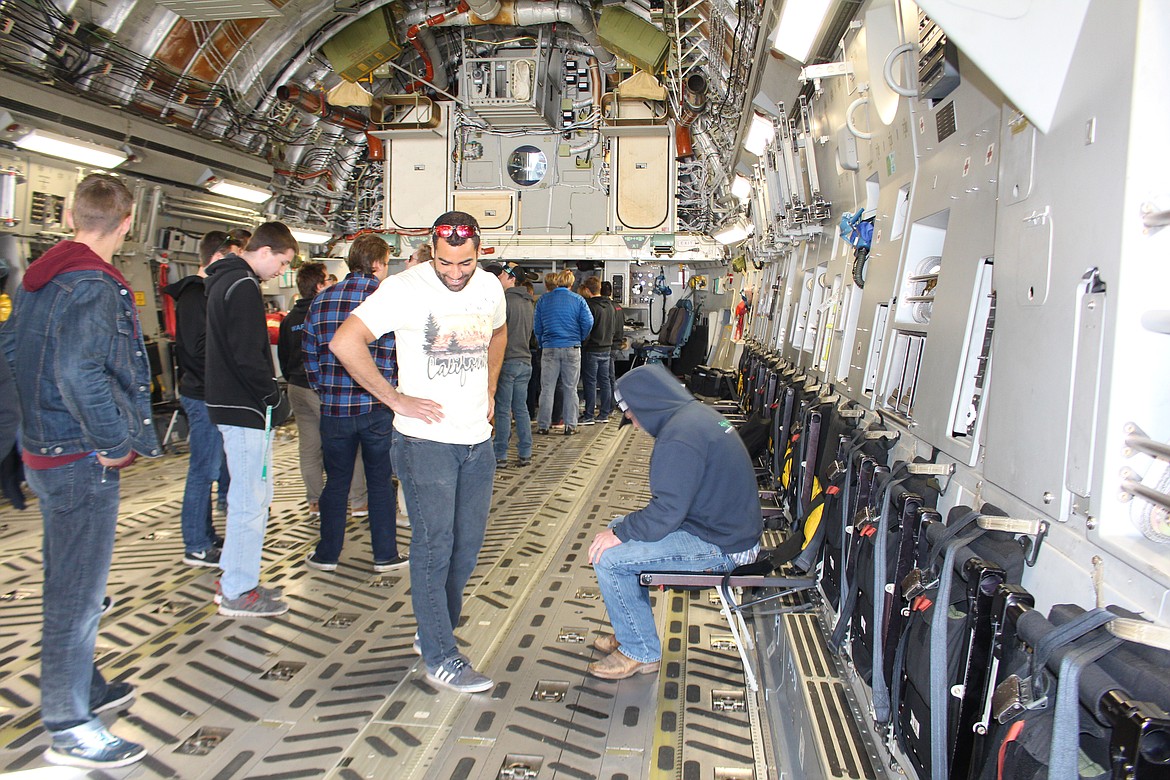
Cheryl Schweizer/Columbia Basin Herald Big Bend Community College aviation students got a chance to tour the cavernous hold of a C-17 Friday during a visit of the aircraft from Joint Base McChord.
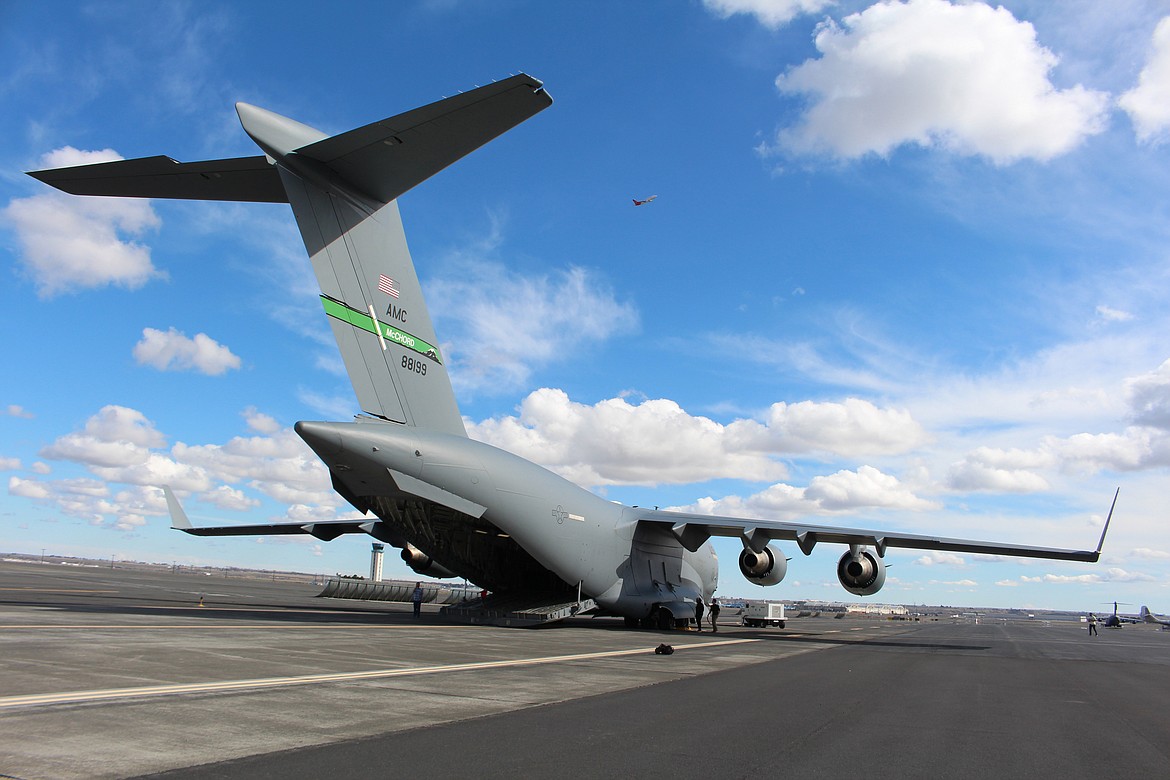
Cheryl Schweizer/Columbia Basin Herald Big Bend Community College students got a close look at a C-17 from Joint Base McChord Friday.
Senior Reporter Cheryl Schweizer is a journalist with more than 30 years of experience serving small communities in the Pacific Northwest. She began her post-high-school education at Treasure Valley Community College and enerned her journalism degree at Oregon State University. After working for multiple publications, she has settled down at the Columbia Basin Herald and has been a staple of the newsroom for more than a decade. Schweizer’s dedication to her communities and profession has earned her the nickname “The Baroness of Bylines.” She covers a variety of beats including health, business and various municipalities. | March 19, 2018 3:00 AM
MOSES LAKE — It is one of the truisms of aviation that there are no minor collisions at altitude.
There would seem to be less opportunity for two planes to run into each other – plenty of blue sky – but at any given moment there’s a lot of traffic up there, some of it headed for the same airspace. Pilots have to pay careful attention to where they are and where everybody else is, and make sure other pilots and the control tower know where they are. That was the message from U.S. Air Force Captain C.J. Tetrick in a presentation to Big Bend Community College pilot training students Friday.
Tetrick also brought along her ride, a C-17 transport, all 174 feet of it. With a 170-foot wingspan. As a reference, loadmaster Hugh Banueloc said the plane has transported tanks and helicopters, among other cargo.
Tetrick’s unit is based at Joint Base McChord near Tacoma, and a lot of training is performed in the area of the Grant County Airport. The airport, of course, also is used by commercial jets for testing and training, and by BBCC students in pilot training. While there’s a lot of sky out there, that’s a lot of traffic. There have been 15 – “one-five,” Tetrick said – near-midair collisions at the Grant County Airport in the last five years. Technology has improved, and “they still happen, with our technology.”
Making flight operations more complicated is the fact air force, BBCC and commercial pilot training continues at night, in some cases all night. And the airport control tower closes at 10 p.m. “We’ll still be there, after the sun sets,” she said.
Tetrick emphasized the importance of communication – but not too much communication. Too much talk crowds out crucial radio traffic, she said.
A 2009 graduate of the Air Force Academy, Tetrick said she has about 3,000 hours flying experience. But she has done very little general aviation flying, she said, which made obtaining a general aviation license a challenging experience. “That was more terrifying than any C-17 flying,” she said.
Her career has taken her around the world; C-17s fly into combat zones, of course, but they also perform humanitarian and supply missions. Antarctica is among the regular stops on the supply mission route.
Big Bend aviation students walked the cavernous cargo hold, and climbed the ladder – very few aircraft have a second floor – to the cockpit. Banueloc said the trick to loading a C-17 is balancing the load, which means it's important to get everything in the right place. Once it's there it's just as important to tie it down, so it stays in place, he said.
ARTICLES BY CHERYL SCHWEIZER

Port of Moses Lake to build electrical generation, transmission lines
MOSES LAKE — The Port of Moses Lake will start construction of electrical transmission lines between port property and Rocky Ford to the north and the port and Connell to the south. Port officials also are working to build electrical generation facilities on port property.
Audit findings follow sentencing of former GCFD 4 chief
WARDEN — Grant County Fire District 4 is instituting new policies for credit card use and use of its petty cash accounts. Fire district officials also have written new policies governing the purchase of equipment following the two audits by the Washington State Auditor’s Office, released Monday.
Mattawa to work on sewer, water projects in 2026
MATTAWA — The city of Mattawa has budgeted to spend about $200,000 more in its current expense (general) fund in 2026 than it is projected to receive in revenue. Expenses for all departments are projected to be slightly higher than revenues, and as a result Mattawa is projected to have slightly less money in at the end of 2026 than it does at the beginning of the year.