
CRITTERS OF NORTH IDAHO: Trumpeter Swan
Christian Ryan Correspondent | Hagadone News Network | UPDATED 7 years, 6 months AGO
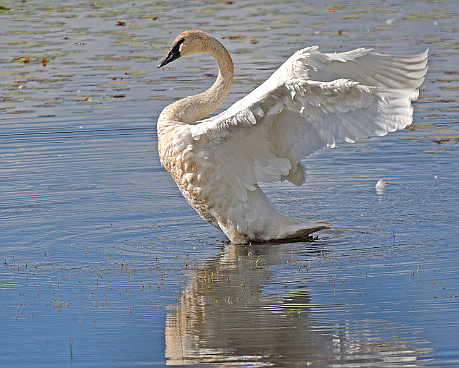


Of all migratory birds, Canada geese probably get the most attention due to their distinctive appearance and widespread distribution. However, there is another bird on the move this time of year (September-October), this one flying south to escape the harsh, blistering cold winters of Alaska and Canada: the trumpeter swan (Cygnus buccinator).
These birds aren’t called trumpeter swans for nothing! You’ll know you’re watching a flock of migrating trumpeter swans when you hear the distinctive “oh-OH” trumpeting call that gives them their name. At 30 pounds in weight and a maximum wingspan of 10 feet, the trumpeter swan is the largest species of waterfowl, as well as North America’s heaviest flying bird. Other than the fact that males are larger than females, the species is largely non-sexually dimorphic. This means that there are few external differences between male and female trumpeter swans, as both genders are entirely white, with a black bill, face and legs and carry a long, straight neck. Juvenile trumpeter swans, called cygnets, are mostly white, but may have darker gray or grayish brown feathers and grayish pink legs.
If you live in the North Idaho area, you’re probably only going to see these birds as they migrate south in a v-formation. Their Canadian cousins are well-known for doing this as well, but why? One of the main reasons is to conserve energy. In flying in v-formation, each swan flies a little higher than the bird in front of him, reducing the amount of wind resistance. Each bird takes turns flying in front, only falling back when they get too tired. By doing this, the birds are able to fly for a very long time before stopping for a rest.
Two-thirds of all trumpeter swans that spend the winter in the lower 48 states migrate to Idaho’s own Harriman State Park. Here, they’ll find their desired habitat: clean, freshwater ponds, lakes, and marshes. Other trumpeters will migrate even farther, as far south as Arkansas, Oklahoma or even Texas. After the long flight south, one of the first things on a trumpeter swan’s agenda is getting some grub. Like other swans, trumpeters like to dine on leaves, stems, roots and tubers of emergent vegetation and water plants, with a side dish of small fish and fish eggs. Yum, yum!
The trumpeter swans will stay in their overwintering grounds until February or March, when they make the trip thousands of miles back north to mate and lay their eggs. If you hear a distinctive “oh-OH!” sound coming from above this autumn, look up! You might spy a flock of these majestic birds on their way south for a winter in a trumpeter swan’s paradise.
•••
Contact Christian at: [email protected]
HOMESCHOOL PROJECT
TRUMPETER SWANS’ MIGRATION
Migration patterns of the trumpeter swans are complex and are usually done in short segments with long layovers. Let’s check out some of the spots where these swans stop along the way south. The list is not necessarily in the order that they travel.
Download and print the map from the link provided. Mark the locations on your map as you find the trumpeter swans migrating points. You can turn this into a lapbook project.
https://commons.m.wikimedia.org/wiki/File:BlankMap-USA-states-Canada-provinces,_HI_closer.svg
Prince William Sound - Alaska, Copper River Delta - Alaska, Tanana River - Alaska, Puget Sound - Washington, Columbia River Delta - United States and Canada, Vancouver Island - British Columbia, Canada, Red Rock Lakes - Montana, Pagosa Springs - Colorado, Magness Lake - Heber Springs, Arkansas and French Broad River - Asheville, N.C.
Project provided by Angel Dominiq
ARTICLES BY CHRISTIAN RYAN CORRESPONDENT

Critters of North Idaho: American Coot
If you see this bird swimming across the water’s surface from a distance, chances are you will mistake it for a duck.

Critters of North Idaho: Northern pike
When we talk about human disturbance of the environment, we usually think of the overharvesting of trees, overhunting and littering. But we can also disrupt the natural balance by introducing species of animals and plants into non-native habitats. This is what happened in the case of the northern pike.

Critters of North Idaho: Ye ol' vole
If you see a little rodent scurrying about in the thicket or under the snow, you may think it’s a mouse. And it may be a mouse, but at first glance it is very difficult to tell a mouse apart from another little rodent, the vole. So difficult, in fact, that voles are often mistakenly referred to as “field mice.” What makes these little scurriers so different from each other? For starters, they belong to different families.