
CRITTERS OF NORTH IDAHO: Grizzly Bear
Christian Ryan Correspondent | Hagadone News Network | UPDATED 7 years, 5 months AGO
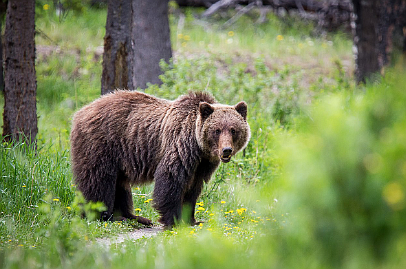


People have feared and revered bears for thousands of years. According to some archaeologists, they were even worshipped by some cultures (though this is a controversial theory).
The Native Americans have long seen the bear as the physical manifestation of rebirth because of the bear’s tendency to hibernate over the course of a winter and re-emerge in the spring.
There are eight species of bears living on four of the seven continents. The panda bear, sun bear, sloth bear and Asiatic black bear live in Asia and the spectacled bear makes its home in Central and South America.
Three bears call North America their domain: the American black bear, the polar bear (which also inhabits high northern Eurasia) and arguably one of the most well-known bears — the brown bear (Ursus arctos)!
Two subspecies of brown bear can be found in North America: the Kodiak brown bear of Alaska and Canada, and the grizzly bear.
Grizzlies get their name from the long guard hairs on their backs and shoulders that give them a “grizzled” appearance.
These animals were once a common site throughout much of western and central North America, from as far north as Alaska to as far south as Mexico. Unfortunately, over-hunting and habitat loss has severely reduced their historic range.
Today, grizzly bears are found in the forests of Alaska, Canada and largely isolated regions of the northern United States (especially Wyoming’s Yellowstone National Park and Idaho).
Their range doesn’t usually extend quite into the Coeur d’Alene area, but a young grizzly bear was recently found roaming the area surrounding Athol in August.
As the Coeur d’Alene Press reported back in August, the bear was captured and released elsewhere, where it could continue to live out its life and not be of danger to humans.
Grizzly bears are the largest carnivorous animal to roam the lower 48 states, measuring 5-8 feet long, standing 3-3 ½ feet tall at the shoulder and weighing 200-450 pounds in the female variant, and 300-850 pounds in males.
The brown bear’s habitat often overlaps with the American black bear’s, and some people have a difficult time telling them apart. This is because, while most brown bears are brown in color with darker brown legs and blond-tipped fur on the flank and back, their coloration can be anywhere between blond to nearly black.
Brown bears, however, are much larger than black bears and have a characteristic hump on their shoulders that is packed with muscles. It’s this muscle that enables a grizzly to rip open a log or dislodge a human’s head off with one swipe.
Grizzly bears have sharp canine teeth, claws the size of crayons (2-4 inches long!), a bite force of 1,200 pounds per square inch and a top running speed of 30 miles per hour, so you could be forgiven for thinking this creature was a 100 percent carnivore.
Indeed, grizzlies can be aggressive predators, often chasing down deer, rodents, elk, moose, caribou or snatching fish out of the water. However, most of a grizzly bear’s diet actually consists of carrion, insects and plants!
Just like a cow, grizzlies are often observed munching away on grass, and they also love to eat leaves, seeds, berries, roots and fungi.
Despite being fiercely territorial, grizzlies can congregate in large numbers without fighting if enough food is available to them.
Every autumn before their winter hibernation that can sometimes last up to seven months, grizzly bears gather in and around rivers to hunt for salmon that are migrating upstream to spawn.
An omnivorous animal weighing 200-850 pounds is a force to be reckoned with!
In the past, people thought the best way to deal with grizzly bears was to kill them whenever they crossed paths with us. But these animals are not man-eating monsters of Hollywood creation: they’re animals, and they should be treated as such.
Grizzly bears are far more afraid of us than we are of them. When left undisturbed in their natural habitat, they have no desire to persecute humans.
If we give grizzly bears the space they need to survive, they’ll keep their distance from us as well, living at large in the wilderness they call home.
•••
Contact Christian at [email protected]
HOMESCHOOL PROJECT
AIR-DRY CLAY GRIZZLY BEAR
INGREDIENTS
1 cup cornstarch
4 oz. white glue, non toxic
1 tbl. lemon juice
2 tbl. oil
HOW TO MAKE
1. Put the cornstarch in a bowl.
2. Add the glue.
3. Mix them together until it has a smooth consistency like icing.
4. Add the oil and the lemon juice and mix quickly.
5. Place the bowl in the microwave for 30 seconds then take it out and mix quickly. Put it back in the microwave for another 30 seconds.
6. Take a wooden spoon and stir it until it has dough-like consistency.
7. Remove the clay from the bowl and place on parchment paper. Gently knead it with cornstarch until the stickiness is gone. It should have smooth creamy texture and form a tear drop when you pull it apart.
Now your clay is ready to use. It can used like dough or shaped into an animal like a grizzly bear. If you shape it into an animal, let it dry then paint it with a non-toxic acrylic paint.
Since our article is about the grizzly bear, you can make bear ornaments using a cookie cutter. Don’t forget to put a little hole in the top of the ornament so you can put the string through it to be hung.
When the clay is not in use store it in a ziplock bag with a little oil.
Disclaimer: This clay IS NOT edible.
Project provided by Angel Dominiq
ARTICLES BY CHRISTIAN RYAN CORRESPONDENT

Critters of North Idaho: American Coot
If you see this bird swimming across the water’s surface from a distance, chances are you will mistake it for a duck.

Critters of North Idaho: Northern pike
When we talk about human disturbance of the environment, we usually think of the overharvesting of trees, overhunting and littering. But we can also disrupt the natural balance by introducing species of animals and plants into non-native habitats. This is what happened in the case of the northern pike.

Critters of North Idaho: Ye ol' vole
If you see a little rodent scurrying about in the thicket or under the snow, you may think it’s a mouse. And it may be a mouse, but at first glance it is very difficult to tell a mouse apart from another little rodent, the vole. So difficult, in fact, that voles are often mistakenly referred to as “field mice.” What makes these little scurriers so different from each other? For starters, they belong to different families.