
Trip to India serves up inspiration for teachers
Mary Malone Staff Writer | Hagadone News Network | UPDATED 7 years, 6 months AGO
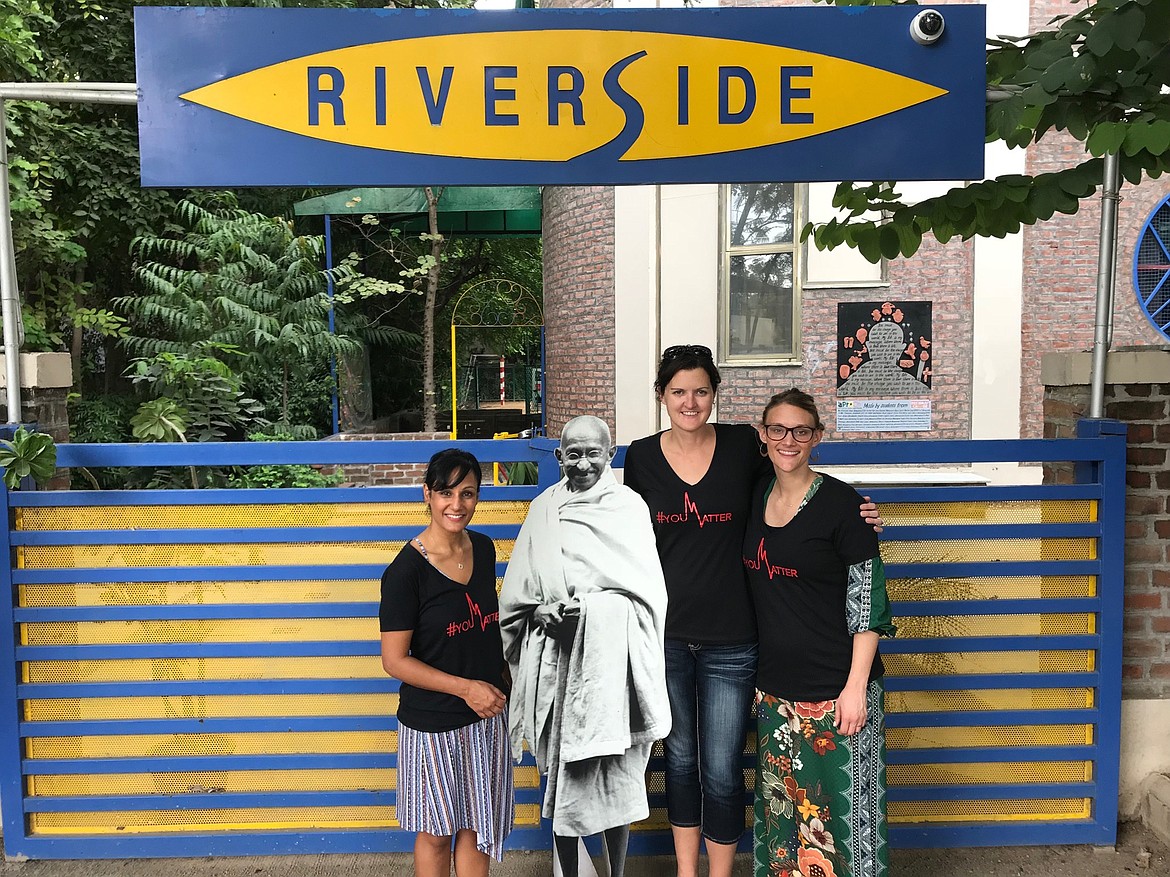
(Courtesy photo) Sanjli Gidwaney, director of DFC USA, Ann Dickinson, and Tara Seibel, co-director of DFC USA, pose for a photograph outside Riverside School. The trio were all sporting the #youmatter gear designed by Dickson’s sixth-grade DFC class last year.
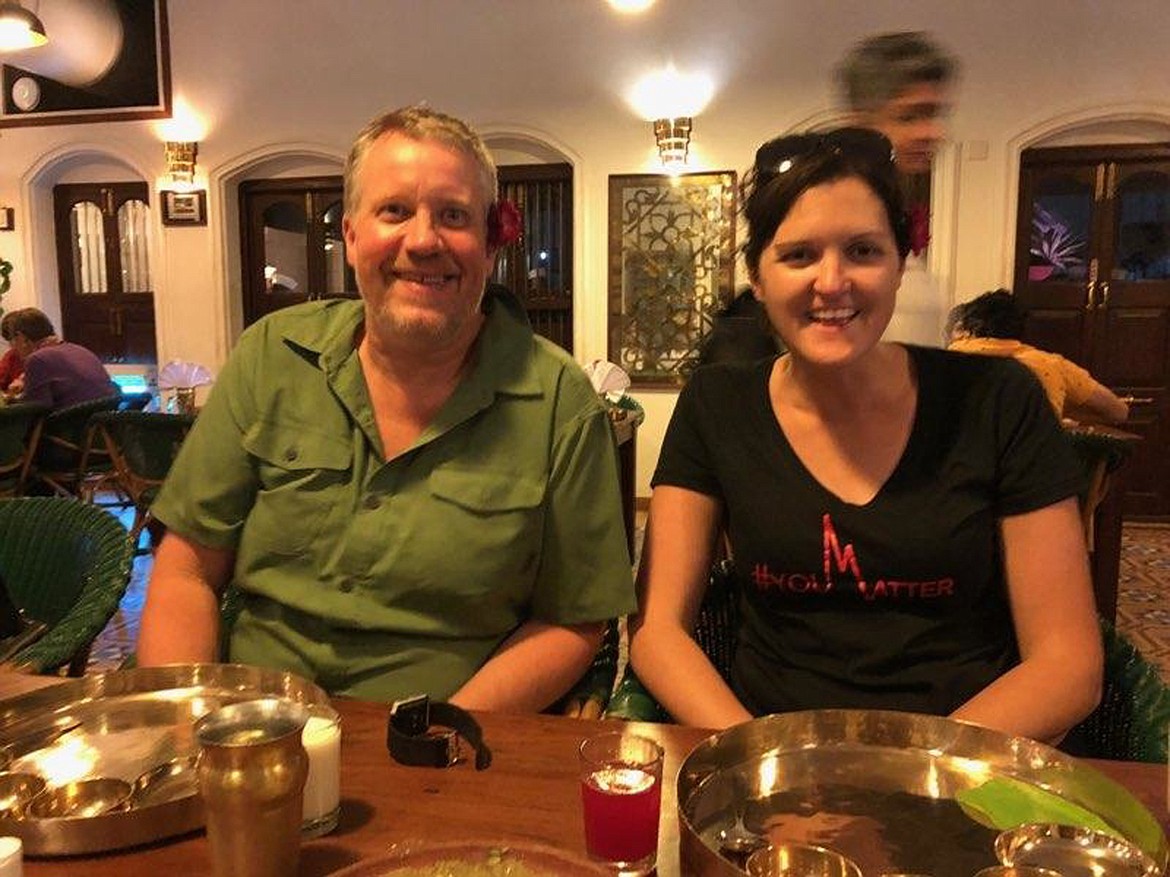
(Courtesy photo) Geoff Penrose and Ann Dickinson at a restaurant in India where they tried betel leaves.

SANDPOINT — Over the past couple years, Washington Elementary students have successfully designed change, from suicide awareness and prevention both locally and abroad, as well as intersection safety changes at their school.
Design for Change is a world-wide program that sixth-grade teacher Ann Dickinson implemented at Washington Elementary. As the program grows within Washington Elementary, it is also expanding to other schools in the Lake Pend Oreille School District. As such, Dickinson and Geoff Penrose, the principal of Lake Pend Oreille High School, recently returned to Sandpoint after being invited to attend a four-day training session at the Riverside School in India.
The Riverside School was founded by Kiran Sethi, who is also the founder of Design for Change. Riverside has been designated an I CAN school, as it embeds the Design for Change process — feel, imagine, do and share — throughout the school, pre-K through grade 12.
"I am so excited because Design For Change USA wants Washington Elementary and Lake Pend Oreille High School to be the first I CAN schools in the nation," Dickinson told the Daily Bee shortly before heading to India.
When they returned, she described it as "amazing," "eye opening," and a "great experience from top to bottom." Penrose said he was still processing it as the trip was "quite overwhelming" and a "truly profound" experience.
"It was hugely inspirational on the one hand, in that you have a school full of students who are engaged, socially conscious, and generally happy, persistent learners," Penrose said. "And on the other hand, I was really, in many ways, reaffirmed in that their big 'ah ha' is basically to treat each student as if they are a human of great value. That's the basis of everything they do, and I think a lot of what we do here, too. Their big secret is incredibly valuable for any school."
The FIDS process is not only used during projects, as the typical Design for change process goes, it is incorporated in the social-emotional piece as well, Dickinson said. This includes the children using FIDS to gain empathy toward each other, or to come to resolution in any minor or major conflicts that occur.
"What I saw at the school is, when they are younger, they have a huge emphasis on building the culture between the kids and the staff of respect and rapport and empathy," Dickinson said. "So the younger kids really emphasized that, the FIDS model ... in that relationship building and just that social-emotional piece."
It was "interesting" to watch the progression through the grades, she said, because as they get older, they begin doing "passion projects," exploring things they are interested in, among other things. When the kids go off to college, Dickinson said, they know what they want to do. In talking with some of the school's alumni, she said none of them were unhappy with their career choices.
Riverside School is now trying to spread the I CAN model to schools across the world.
For Dickinson, the plan is to continue to grow the Design for Change program at Washington Elementary, expanding it to more grade levels. It started with her sixth-grade elective and, last year, was implemented in Charlene Hitchcock's second-grade class. Both age groups have had great success with their projects. This year, the sixth-graders will still do a Design for Change project in Dickinson's elective, but there will also be a combined project between the fourth-, fifth- and sixth-graders. The second-graders are doing a project again as well.
Dickinson said she will also implement FIDS more fully with her sixth-graders this year in all projects and other areas of learning where it fits.
"We are able to enhance some of the stuff we are doing already by using that framework," Dickinson said. "Then as we go, if more teachers are interested in it, then we will have a model that they can actually come and see how we are implementing it."
At LPOHS, David Suswal and Luke Childers have implemented Design for Change into their advisory classes. They are still in the "feel" stage and will be doing some projects this year as they progress through the FIDS process.
"I feel that the trip prepared me much better to support them as they start that journey," Penrose said, adding that Design for Change fits neatly with the school's five-year vision to become a full experiential learning school.
"We have talked a lot as a staff about what that actually means, and we generally come back around to we don't want to lose that service-learning piece. We really enjoy seeing our students out in the community making a positive change ... We see (Design for Change) as one strand that is going to feed into our five -year vision to make this the best school in the state, alternative or otherwise."
Mary Malone can be reached by email at [email protected] and follow her on Twitter @MaryDailyBee.
ARTICLES BY MARY MALONE STAFF WRITER

Shotgun and drugs lead to arrests
BONNERS FERRY — Two individuals were arrested after a shotgun and drugs were found following an alleged incident at Bonners Ferry High School.

Drones take off at Priest River Elementary
PRIEST RIVER — Wearing their flight crew colors, the fifth-grade students walked side by side across the gymnasium to ensure the flight deck was clear of debris.

Mentoring foster kids & the art of fly fishing
SANDPOINT — Giving foster kids the opportunity to get out into nature and learn the art of fly fishing is a powerful therapeutic tool, allowing the youngsters to leave behind some of the stress while also building their confidence and self-esteem.