
Questions raised about Cruzane forest-thinning project
Maggie Dresser Mineral Independent | Hagadone News Network | UPDATED 6 years, 7 months AGO

The Lolo National Forest and FWP are working together to maintain elk habitat while continuing with forest management. (Photo courtesy of FWP)
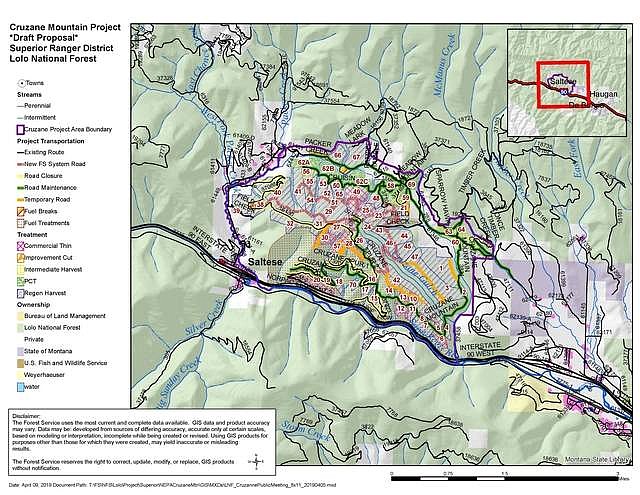
THE CRUZANE Mountain Project draft proposal. The project will manage Lolo National Forest’s wildfire hazards on Cruzane Mountain near Saltese to be implemented in 2024 after a finalized decision. (Graphic courtesy of U.S. Forest Service)
A forest thinning proposal intended to reduce wildfire potential is raising questions about its effect on elk calving due to its prime habitat area, which lies on Cruzane Mountain near Saltese.
Montana Fish, Wildlife and Parks wildlife biologist Liz Bradley says Cruzane Mountain is an important summer range for elk and it’s where they raise their calves.
The fuel thinning project would remove a significant portion of the forest, which acts as a cover during the warm summer months. Bradley says the herds would likely be displaced following the thinning.
But the Lolo National Forest and FWP are working together to ensure that both the elk habitat is not disturbed, and forest management remains in place.
“We’ll have a plan that meets the needs for elk security,” Bradley says. “It’s just finding that balance that achieves both goals.”
The Lolo National Forest is brainstorming ways to minimize those impacts and find that balance.
Winter logging emerged from the conversation but is only an idea at this point. But this could impact loggers and the snowmobile community.
Superior District Ranger Carole Johnson says maintaining elk habitat is the only concern they received from scoping comments and it’s a widely supported project.
The Cruzane Mountain project is scheduled for implementation in 2024 and its goal is to reduce fuels with forest thinning where substantial wildfire potential exists.
The U.S. Forest Service hosted an open house in April to address proposed techniques for the project, including fires and fuels, vegetation and reforestation, and roads and transportation.
FIRES AND FUELS
At the open house, Superior District Fuels Technician Josh Stroot discussed the prescribed burn proposals, a hazard reduction burn used to for forest management, that would be initiated on Cruzane Mountain.
Stroot said teams would start at the top of Cruzane Mountain and gradually burn downward. Crews would burn the understory and slash to remove the fuels for a potential wildfire disaster.
“It’ll be a lot prettier to do it now,” Stroot said.
Stroot said crews will use a feathering technique when burning, which creates a more aesthetically pleasing look instead of clearcutting.
VEGETATION
Silviculturist Andy Kies discussed the forest health and reforestation following the prescribed burns.
If the budget allows, the Forest Service will plant larch and white pine trees on the north face of Cruzane and larch and ponderosas on the south face. The Forest Service is required by law to reforest the burned area within five years. The area will also rely on natural regeneration.
Kies says the general tree species composition consists of lodgepole, ponderosa, Douglass fir and larch trees.
Historically, less Douglas fir trees existed in the area but following wildfires in the early 1900s, the species began to populate the area more. The Douglas fir is a common host to pathogens and spreads diseases like root rot, a fungus that kills tree roots.
ROADS AND TRANSPORTATION
Timber Management Assistant Mike Mueller discussed the road construction and reconstruction that will occur once the project begins. Crews will reconstruct Cruzane road and there will be proposed roads for firelines on the backside.
While the project is still developing, agencies are working together to find common ground and to bring in experts.
“They’re all doing some great work out there,” Bradley said. “I think we can do some work that’s positive for both forest health and wildlife.”
The U.S. Forest Service hopes to finalize a decision in summer 2020.
ARTICLES BY MAGGIE DRESSER MINERAL INDEPENDENT
Sheriff's office loses important asset
After serving with the Mineral County Sherriff’s Office for 25 years, Superior Mayor Roni Phillips announced her retirement from the Jail Administrator and 911-Dispatcher positions in early April. Phillips will remain Superior’s mayor, and will continue working as an EMT on Superior’s ambulance.

Wolf count in Region 2 is up, but mostly stable
Following Montana Fish, Wildlife and Parks 2017 Annual Report release this spring, officials estimate 633 gray wolves reside in Montana, more than the previous five years.

Sheriff's budget may lose some overtime
At the Sheriff’s Office final budget hearing in Superior on Friday, Aug. 16, county officials decided the only area they could make financial cuts were in overtime.