
Groups file suit to stop electric bikes in national parks
CHRIS PETERSON | Hagadone News Network | UPDATED 6 years, 9 months AGO
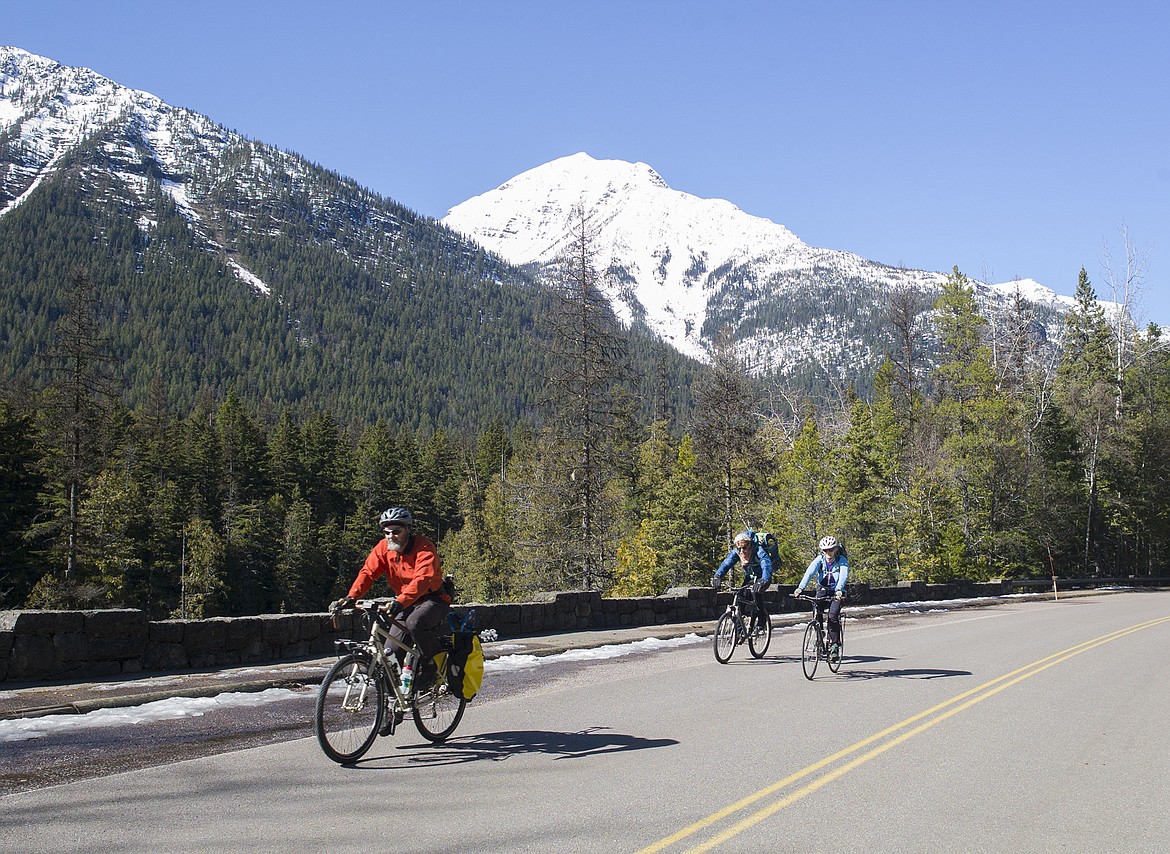
Cyclists head down the Sun Road in this file photo.
Chris Peterson is the editor of the Hungry Horse News. He covers Columbia Falls, the Canyon, Glacier National Park and the Bob Marshall Wilderness. All told, about 4 million acres of the best parts of the planet. He can be reached at [email protected] or 406-892-2151. | December 5, 2019 2:33 PM
Several groups want to put the brakes on e-bikes in national parks and have filed suit in federal court.
“The use of e-bikes on non-motorized trails puts plaintiffs at risk of higher-speed and more dangerous collisions, thus it causes them to avoid or reduce their use of National Park trails that defendants have newly-opened to e-bike use. E-bikes also pose other significant environmental impacts that harm plaintiffs’ enjoyment and use of National Parks including, but not necessarily limited to, disturbance of wildlife and trail damage,” the complaint, in part, claims in a suit filed Dec. 4 in federal court.
It’s filed by Public Employees for Environmental Responsibility, Wilderness Watch, Environmental Action Committee of West Marin, Marin Conservation League, Save our Seashore and individuals Amy Meyer of California and couple Phyllis Koenig and David Perel of New Jersey.
E-bikes use small electric motors to either assist riders in pedaling the bikes, or they completely power the bikes. A directive by Secretary of Interior David Bernhardt in August ordered park superintendents to allow bikes in national parks where traditional human-powered bikes were already allowed.
In Glacier National Park, that meant e-bikes would now be allowed on the Going-to-the-Sun Road when it wasn’t snow covered, as well as other roads.
Nearly all of the backcountry trails in Glacier don’t allow biking, save for the bike paths in the Apgar and Fish Creek areas and the Flathead Ranger Station Trail.
But Park Service-wide, the directive opened many areas to e-bikes.
“Overcrowding is a serious problem for wild places with an increasing demand for easier, quicker access into remote landscapes. The Park Service’s order, issued without the public input required by law, exacerbated the problem by instantly converting a massive network of non-motorized trails into electric bike lanes,” claimed Dana Johnson, staff attorney for Wilderness Watch.
Bernhardt’s directive did not have any environmental review — it was simply a letter sent to park superintendents, though it did allow them to close areas to e-bikes if they could justify it.
In the Flathead Valley, several bike shops sell or rent the bikes.
Some businesses said the directive was good for them — biking the Going-to-the-Sun Road is one of the most popular activities in Glacier Park during the spring and interest in e-bikes has been robust.
Using an e-bike would certainly make biking in Glacier easier. A person on an e-bike can get uphill much faster an easier than a traditional bike and the Sun Road is all uphill.
But the lawsuit maintains that the Park Service ignored the National Environmental Policy Act, The Organic Act and several other federal laws. It also ignored its own rule-making, said George Nickas of Wilderness Watch, a wilderness advocacy group in Missoula.
He said in essence, the directive allows motorbikes in the backcountry. If it had been gas-powered motorcycles, there would have been an outcry, but because they’re electric, there hasn’t been as much. But he said the speed and effectiveness of today’s technology is only going to get better, and bikes in the future will be able to go farther and faster. He predicted in 10 years, nearly all bikes will be e-bikes, as people look to keep up with their peers.
“We’ll have a backcountry filled with motorbikes,” he claimed. “When you think of what that means for wildlife, that’s not good.”
The suit seeks injunctive relief, which means they’re asking the court to stop the directive allowing e-bikes.
Nickas said bike push is pervasive. He pointed to legislation in Congress a few years ago that tried to allow bikes in designated wilderness. If that had passed, e-bikes could have been allowed in places like the Bob Marshall.
“The push is on to allow bikes everywhere,” he said.
ARTICLES BY CHRIS PETERSON

Columbia Falls City Council OKs municipal budget
The Columbia Falls City Council Sept. 8 approved the final fiscal 2026-27 year budget and added a few items along the way.
Water plan calls for dam on Glacier National Park's St. Mary Lake and lower St. Mary Lake
As climate change gets worse, water woes emerge
A study released earlier this summer suggests that inflatable dams on St. Mary and Lower St. Mary Lake could help in relieving future water use conflicts on the St. Mary and Milk River systems.
Ruis starts work on Teakettle Heights subdivision, nixes apartments close to neighbors
Developer Mick Ruis said last week that he’s changed the housing layout of Teakettle Heights at the north end of Columbia Falls, noting that single story homes will now be adjacent to the Aluminum City neighborhood, as opposed to tall apartment buildings as it was first designed.