
Students win when they sleep in
Devin Weeks Staff Writer | Hagadone News Network | UPDATED 6 years, 3 months AGO

School teachers and community leaders attend a meeting to review present data, impacts and recommendations for school start times during a meeting Thursday in the Midtown Meeting Center. (LOREN BENOIT/Press)
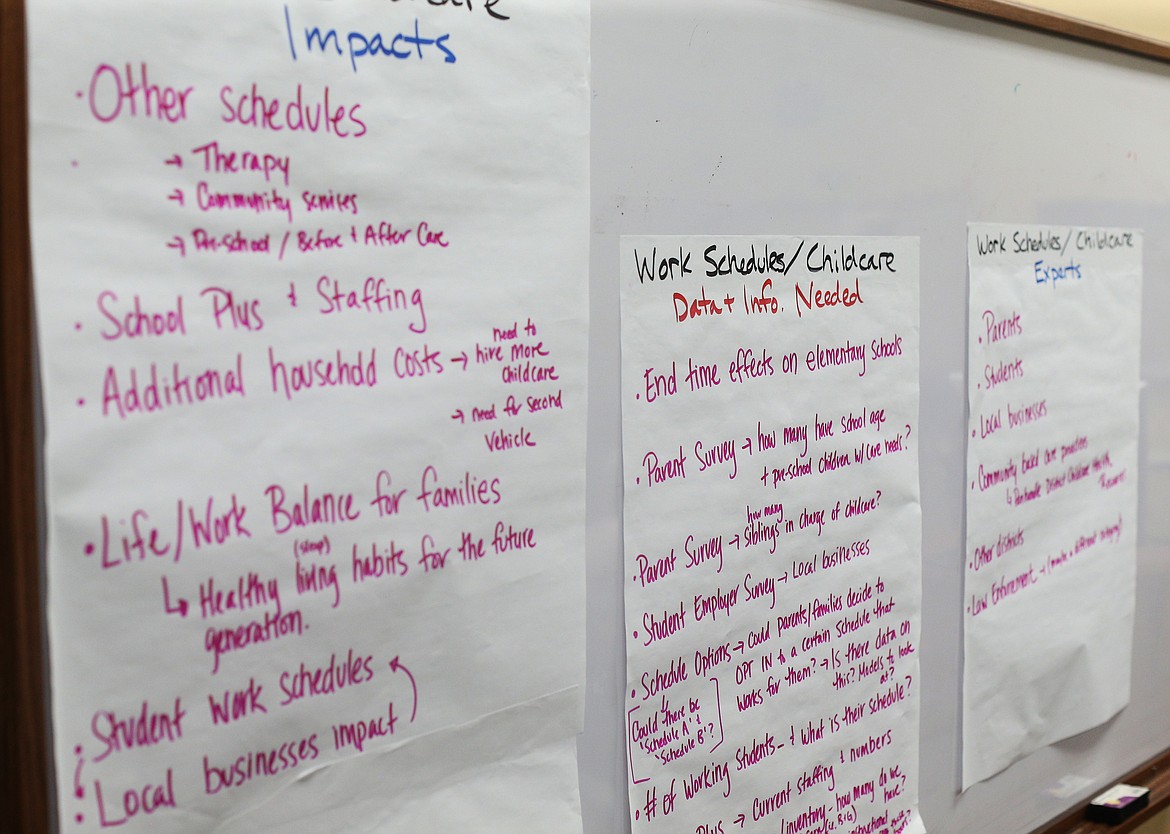
Ideas and suggestions on school start time impacts are written on sheets of paper hung on a whiteboard by members of the work schedules/child care subcommittee of the advisory committee on school start times during a meeting Thursday evening. (LOREN BENOIT/Press)

Teenagers are known for being night owls.
They stay up late and have trouble getting up early.
It may seem like bad behavior, but it's not necessarily their fault. It’s just part of who they are.
"This is pure and simple biology,” said Sara Morrow, a licensed Coeur d'Alene psychologist who specializes in child, teen and family mental health services. "The sleep wave cycle shifts across a lifespan. Babies sleep multiple times a day, toddlers need a nap, elementary kids tend to be easier to go to bed early and wake up earlier. But at puberty, a big thing happens in your endocrine system. We talk about kids being hormonal. It’s very much true."
Around age 11 is when a child's melatonin (the hormone that regulates the circadian rhythm) shifts toward a nocturnal late-sleep cycle, she said.
"Kids who could go to bed at, say, 9 o’clock and fall asleep, they’re really struggling now to be asleep before 11 o’clock at night," she said. "And it doesn’t matter if you force them to go to bed, they’re going to lie in bed awake, and that’s the struggle I see every day in my clinical practice.
"And they’re really not ready to wake up,” she continued. “They say the teenage brain stays in sleep mode until 8 a.m. — 11 p.m. to 8 a.m., those are the nine hours that most teenagers’ circadian rhythm functions on, and if we withdraw those two hours of sleep in the morning, the detrimental impacts are huge. That’s also where we have REM (rapid eye movement) sleep. That’s where the body does a lot of healing. It’s really detrimental to your health to lose those last couple hours of sleep."
This subject has been studied across the disciplines for more than 20 years, with recommendations from prominent health agencies like the American Health Association and the American Academy of Pediatrics to delay school start times for middle and high school to 8:30 a.m. or later. Right now, it is common for American high schools to start the school day between 7 and 8 a.m.
Sleep deprivation has been linked to athletic injuries, car crashes, depression, anxiety, anger, impulsivity, risk-taking behavior, drug use, delinquency issues and suicide. Morrow said the reason she started talking to school leaders last year about this issue is because “the suicide rate in our region is tragic; we have a tragically high suicide rate amongst the youth of our region.”
“There’s no debating this research," Morrow said. “We have 16 health agencies that really are pushing for this to be a national shift for the sake of public health and safety."
Morrow shared data about sleep and its impacts on kids and teens Thursday during the second meeting of the Coeur d'Alene School District's Advisory Committee on School Start Times.
The more than 30-person advisory committee, appointed by the board of trustees, has been tasked with taking this research and configuring how to execute a plan for the district to implement later school start times starting next school year.
"We have to kind of look at this not if we should do this change, but how," Morrow said. "We are going to have to really get broad community support to get this understood why we need to make this change."
Subcommittees within the advisory committee are looking at how later school start times will affect other facets of life for the whole family, including extracurricular activities, elementary students, transportation and busing, child care and employment.
The group is led by the district's technology director, Seth Denison, who invites community members and students in leadership to join in the conversation about shifting to later start times.
"Part of what we're looking at is if it's possible, logistically," he said. "If we can figure out how to mitigate some of these impacts, then yes, I do think it's possible."
Lake City High School ASB President Jacob Baker, 17, participated in this meeting to answer questions and provide a student voice.
"I think it's great that there is a student perspective because this whole change is surrounding students and how sleep is going to impact their testing scores, academic results, and then also, just the results afterschool," said Jacob, who worked with the jobs and extracurricular subcommittee.
"(Later start times) could be beneficial, it's just the feasibility that we need to figure out," he said. "Really, it is all about the mental health aspect. The suicide rates are very incredible right now. I just wrote a paper about it, and it's quite sad. It sucks. So having a chance to change that could be great."
The school start times advisory committee meets in the Midtown Meeting Center, 1505 N. Fifth St. The meetings are open to the public and will take place from 4:30 to 6 p.m. Jan. 15, Feb. 19 and March 11. A recommendation will be brought before the board March 18.
Email questions and comments to: [email protected]
ARTICLES BY DEVIN WEEKS STAFF WRITER

Docuseries 'opens wounds' for some in North Idaho
RATHDRUM — Family and friends who lost loved ones to suicide have expressed concerns with the “Irreplaceable” docuseries being filmed in Lakeland schools this week.

Young welders showcase talents in SkillsUSA contest
RATHDRUM — Showers of orange sparks cascaded from workstations to the floor as student welders meticulously completed their projects Friday at the Parker Technical Education Center in Rathdrum.

North Idaho canines will appear on Animal Planet
The biggest sporting events of the year are happening this weekend: Dog Bowl III and Puppy Bowl XVI.