
Elk hanging in there despite snowy February
Ralph Bartholdt Staff Writer | Hagadone News Network | UPDATED 7 years AGO
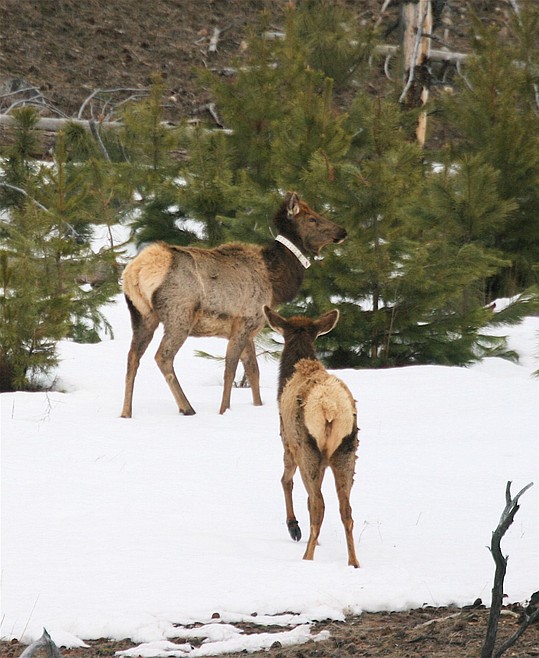
Courtesy of IDAHO DEPARTMENT OF FISH AND GAME North Idaho elk have fared well despite February’s heavy snow and recent cold temperatures.
COEUR d’ALENE — Despite a deluge of snow in North Idaho’s mountains and river valleys, elk calf mortality has been low, according to Idaho Fish and Game.
Only two collared elk calves died last month in the St. Joe River Valley. One of the animals was killed by wolves and the other’s cause of death wasn’t determined.
Biologists have seen up and down survival rates over the past several years, often depending on late season snow storms. The latest mortality numbers are lower than in previous big snow years, possibly because this season’s snow came later. That allowed elk to feed across their range until February, when the snow hit, wildlife biologist Laura Wolf said.
“In 2017 and 2018, we had a lot of snow that came earlier,” Wolf said. “The calf mortality was two to three times higher.”
The game department usually collars 60 elk in the Coeur d’Alene and St. Joe mountains. It monitors their movements in winter and early spring to gather data on survival, which is used to set game seasons.
This year, however, only 30 elk were collared in units 6 and 7 of the St. Joe.
The department also uses game cameras on winter range to get a better picture of total elk on the range. Herds are monitored from St. Maries to Avery in the St. Joe and south to Clarkia in the St. Maries River drainage. Beginning next year, cameras will also be placed from the Silver Valley to McGee in the Coeur d’Alenes.
“Those are used to get the actual abundance — that’s calves, cows and bulls,” she said.
When the 150 cameras in the St. Maries and St. Joe drainages are plucked up by biologists, likely in April, they will have weathered the most difficult month, because throughout Idaho, March is the litmus test for elk herds.
“Right now, deer and elk are just trying to hang on through spring green-up,” said Greg Painter, Fish and Game wildlife manager. “We see most of our mortality in March.”
So far this month, no collared elk have died in the Panhandle, but that could change, depending on how long the snow lasts and how quickly south-facing slopes green up.
“If they didn’t have enough fat stored they might not make it,” Wolf said.
Data shows that 80 percent of elk survived mild winters in 2015-2016, while just 45 percent of collared elk survived severe winters, such as the 2016-2017 winter.
On average, 62 percent of collared elk survived winters between 2015 and 2018. Causes of mortality on average include mountain lions, which killed 45 percent of the deceased elk; wolves killed almost 19 percent; and malnutrition, parasites and disease killed 21 percent. Cause of death couldn’t be determined by Fish and Game examiners in the other cases.
ARTICLES BY RALPH BARTHOLDT STAFF WRITER

Traffic fatalities on Super Bowl Sundays? Nope
Super Bowl Sunday may invoke images of tailgating and revelry that exceed the merriment of other annual sporting events, but local law enforcement aren’t kicking off special patrols to tackle errant — or intoxicated — drivers.

Isenberg: No plea at murder hearing
Her shackles jangling, Lori Isenberg walked in single file with other inmates into a downtown Coeur d’Alene courtroom Tuesday afternoon, wearing red, high-security jail pajamas and shower shoes.

Police: Man sought in assault case
The 53-year-old man who likely died during a standoff with police this week in Post Falls was wanted for failing to appear at his sentencing hearing after being convicted for assaulting a group of Jehovah’s Witnesses.