
CRITTERS OF NORTH IDAHO: Virginia Opossum
Christian Ryan Correspondent | Hagadone News Network | UPDATED 6 years, 10 months AGO
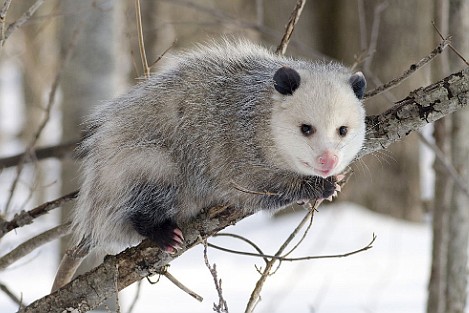


You may refer to it as a “possum,” but it is informal to refer to a Virginia opossum (Didelphis virginiana) in this way. Possums are actually a group of mammals native to Australia and its surrounding islands, and they more closely resemble large chinchillas. They also have long fluffy tails.
The Virginia opossum (Didelphis virginiana), on the other hand, lives in the forested swamps and woodlands of North America. They also inhabit cities and suburbs, as they are quite adaptable and have learned to live alongside humans. Opossums usually get between 12.9 and 21.7 inches from head to tail, and tips the scale at anywhere from 4 to 13.2 pounds. Past their white and heavily whiskered faces, their bodies are covered in a thick coat of dull grayish-brown fur. Their tails are long, furless and prehensile, meaning that it can grasp objects.
Contrary to popular belief, opossums do not sleep upside-down while hanging from their tails. Instead their tails are used as a fifth limb, grasping branches as the animal clambers through the trees.
What sets opossums apart from virtually every other animal on the North American continent is that they are marsupials. Marsupials are a group of mammals that give birth to undeveloped young and rear them in a pouch on the mother’s belly. Most marsupials, like the kangaroo and koala, are native to Australia, and the few that aren’t are possums that come from South America. How did we Americans end up with opossums?
Well, it turns out that opossums are not originally from North America either. Their ancestors lived in South America, which was an island continent until the Isthmus of Panama formed. At that time, tapirs, tree squirrels, foxes, deer, cougars and other North American animals migrated into South America, while opossums, toads, ground sloths, hummingbirds, armadillos (some the size of small cars) and other South American animals migrated into North America. This event is called the Great American Interchange.
Opossums are not particularly fast animals, and thus are commonly preyed upon by owls, eagles, foxes, bobcats, and even domestic cats and dogs. When faced with a predator, opossums flash their teeth, hissing and screeching at their attacker. But, if this does not deter the predator, opossums are well known for … well, “playing possum.”
The opossum almost enters a coma-like state, flopping over onto the ground with its tongue dangling from the mouth. It also produces a noxious odor. Predators are so confused and disturbed by the opossum’s act that they let the animal be. Despite appearing to enter a coma, the opossum is fully alert while “playing possum” and can spring back to life as soon as the threat has gone.
One reason opossums are so adaptable is because they can eat a wide range of foods. Grains, berries and other fruit are frequently consumed by these marsupials, but when they also eat earthworms, snails, birds, mice, insects and carrion. And thanks to their immunity to snake venom, they can even kill and eat venomous snakes!
•••
Contact Ryan: [email protected]
HOMESCHOOL PROJECT
HOW TO MAKE
A CARDBOARD TUBE OPOSSUM
I hope that you have enjoyed making the homeschool projects. This is the last project for the school season until August.
MATERIALS NEEDED:
Cardboard Tube
Gray Paint
Scissors
White Cardstock
Gray Cardstock
Glue
Pink Colored Pencil
Pink Mini Pom Pom (or White Pom Pom & Pink Chalk)
Googly Eyes
Pink Pipe Cleaner
Tape
INSTRUCTIONS:
1. Start by painting the cardboard tube gray.
2. While it is drying, cut a narrow, elongated heart from white cardstock.
3. When the paint is dry, glue the heart onto the end of the TUBE. A rubber band holds it in place while it’s drying.
4. Cut a pair of skinny arms and a pair of skinny legs from the grey cardstock.
5. Cut two rounded ears from the grey cardstock and use the colored pencil to add pink shading to the centers. Bend them up slightly.
6. Glue the arms, legs and ears in place.
7. Add the eyes and the pink pom pom nose.
8. Finally, bend the pipe cleaner to make a tail. Secure it inside the tube with tape or hot glue.
If you have been finding these projects helpful please let us know. We would love your feedback.
Project provided by Angel Dominiq
ARTICLES BY CHRISTIAN RYAN CORRESPONDENT

Critters of North Idaho: American Coot
If you see this bird swimming across the water’s surface from a distance, chances are you will mistake it for a duck.

Critters of North Idaho: Northern pike
When we talk about human disturbance of the environment, we usually think of the overharvesting of trees, overhunting and littering. But we can also disrupt the natural balance by introducing species of animals and plants into non-native habitats. This is what happened in the case of the northern pike.

Critters of North Idaho: Ye ol' vole
If you see a little rodent scurrying about in the thicket or under the snow, you may think it’s a mouse. And it may be a mouse, but at first glance it is very difficult to tell a mouse apart from another little rodent, the vole. So difficult, in fact, that voles are often mistakenly referred to as “field mice.” What makes these little scurriers so different from each other? For starters, they belong to different families.