
Do de-icing chemicals hurt trees? Experts say no
Craig Northrup Staff Writer | Hagadone News Network | UPDATED 6 years, 10 months AGO
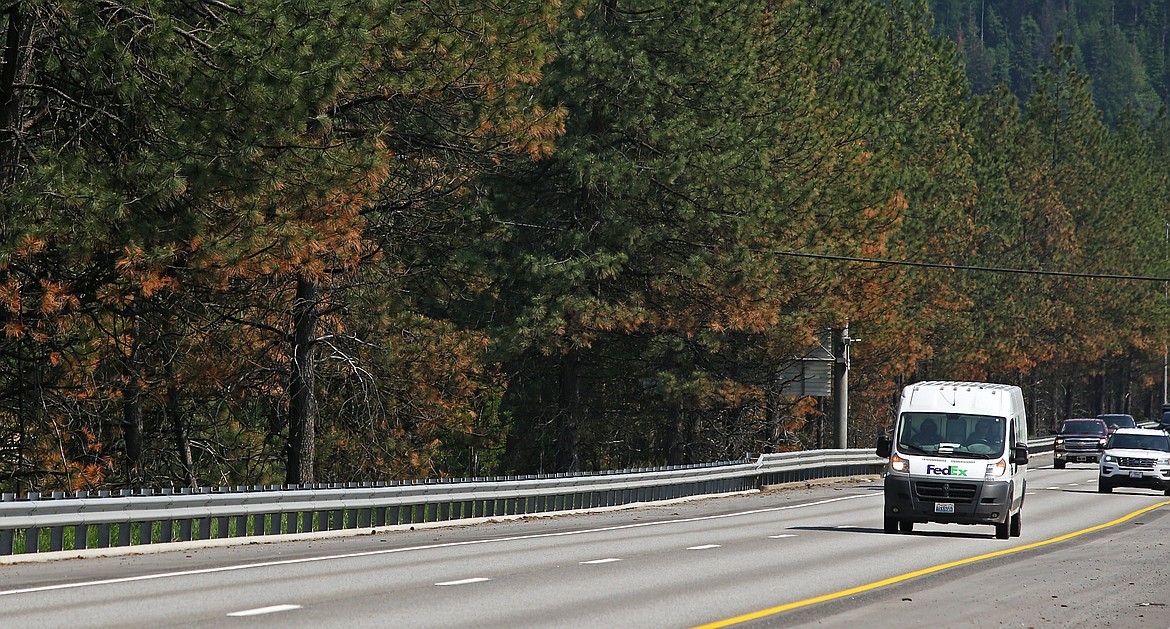
LOREN BENOIT/Press Motorists head west on Interstate 90 on Thursday. A woman posted on a local We The People Facebook page about her discomfort with trees, between exits 14 and 17, that may be affected by the use of de-icer.
A Facebook inquiry questioning the use of de-icer along Interstate 90 led us down a few roads to determine what danger, if any, chemicals used by the Idaho Transportation Department pose to trees.
Doris Hastings posted on a local Facebook group’s page that she was concerned de-icing chemicals were damaging trees adjacent to I-90, particularly between exits 14 and 17 east of Coeur d’Alene.
“I am bothered by the situation with the dead and dying trees,” Hastings posted Thursday. “I am fairly certain this has been caused by the chemicals used to treat the roads in the winter.”
It turns out the Idaho Transportation Department uses one chemical to de-ice I-90 during winter weather conditions, according to Mike Lenz, spokesman for ITD’s North Idaho Operations. While many chemical concoctions have been used in the past to clear snowy roads, Lenz said his department now employs only one chemical to our highways and freeways: Salt.
Salt is a natural stressor to virtually all vegetation, a notion familiar to arborists and most recently backed up by 2014 and 2015 studies by the University of Tennesee and Rutgers University, respectively. These studies reinforce the long-held understanding that salt is essentially the anti-plant. Prolonged contact damages vegetation.
“We try and use the least amount of salt possible while still keeping I-90 safe,” Lenz said. “We really try to put out the minimal amount of salt to protect the environment as best we can. We’re very conscious of our neighboring environment — and not just with trees, but with wildlife, rivers, fish. Our natural surroundings are what makes this area great, and it’s really important that everybody is consciencious of that.”
Conserving salt involves more than environmental concerns. It’s expensive: nearly $92 per ton.
Salt does not necessarily condemn trees to certain death, both university studies showed. Often, salt will merely damage the exterior of the tree or kill branches. While that’s unsightly, some species of trees — like the ponderosa pine, for example, which is one species living between exits 14 and 17 — will grow out of their salt-induced wounds. Damaged branches and dead needles eventually break away, allowing the tree to continue to flourish.
In an effort to keep salt from drifting off the roads and into neighboring vegetation, Lenz said ITD uses an additive to inhibit the proliferation of salt during particularly cold snaps.
“Whatever we can do to keep salt on the road,” Lenz said, “we’ll try it.”
Steve Clark is a scientist for Envirotech, the manufacturer of a product called Boost, an additive the transportation department uses to keep brine on the freeway during and after de-icing. He said the carbohydrate-based enhancer was one of their most successful products.
“Boost is really good at minimizing and inhibiting corrosion,” Clark said. “It helps salt stick to the road through a hygroscopic process that keeps the salt wet and on the ground once it’s activated.”
Use of the additive is not a fail-safe. While additives like Boost inhibit salt from affecting the nearby trees at the time of de-icing, the real danger to freeway-side vegetation comes with the push of the plows. Salt absorbs precipitation, which is then lifted with the snow as it is plowed off the road. This prolonged contact can damage — even kill — trees.
“We’re always trying to dial back our usage,” Lenz said. “We are always training our people the best we can to use the least amount of salt on the roadways. It’s all about finding that common ground to protect the environment and protect motorists.”
ARTICLES BY CRAIG NORTHRUP STAFF WRITER

Legislature gives Green the boot
John Green, in the midst of his first term representing Rathdrum, was expelled from the Idaho Legislature early Thursday afternoon.

No fast lane for grocery tax relief
This week saw an end to three bills devoted to helping residents pay for their groceries, dimming Gov. Brad Little’s hopes to shepherd relief to local shoppers.

Grocery credit bill stewing in Idaho House slow cooker
A bill that would increase the tax credit Idahoans receive to help offset the cost of groceries is tentatively scheduled for a vote in the state House today, but postponing that bill is becoming the norm, rather than the exception.