
Potential, not poverty
Devin Weeks Staff Writer | Hagadone News Network | UPDATED 6 years, 5 months AGO
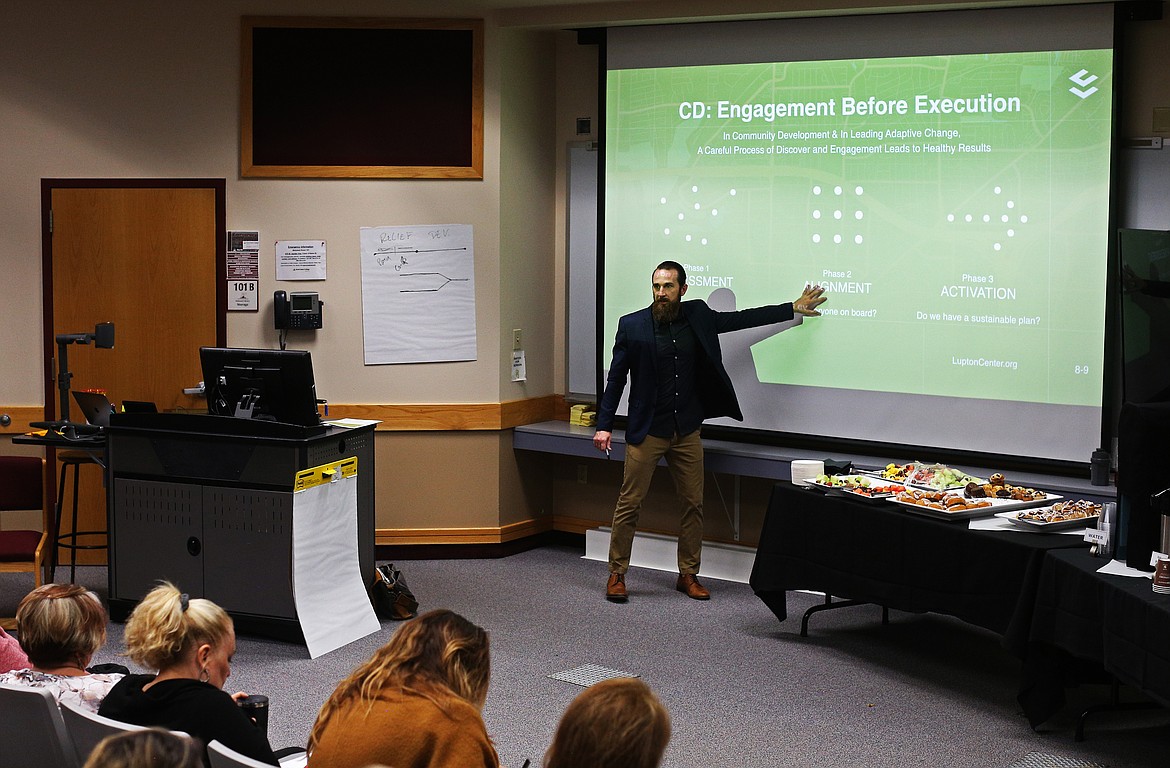
LOREN BENOIT/Press Shawn Duncan speaks to attendees at Charity Reimagined’s workshop about how to implement a plan to make lasting community change in the fight against poverty.
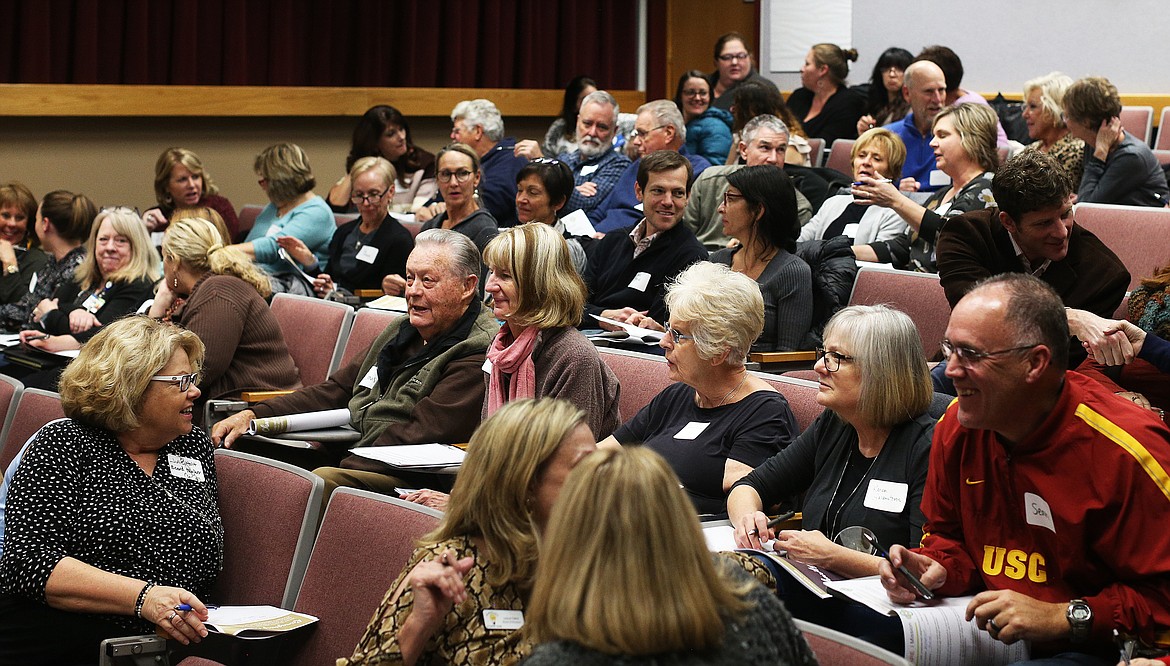
LOREN BENOIT/Press Guests at Charity Reimagined’s workshop spend time mingling and talking about the impact of non-profits and their role in the community to fight against homelessness and improve public wellness.
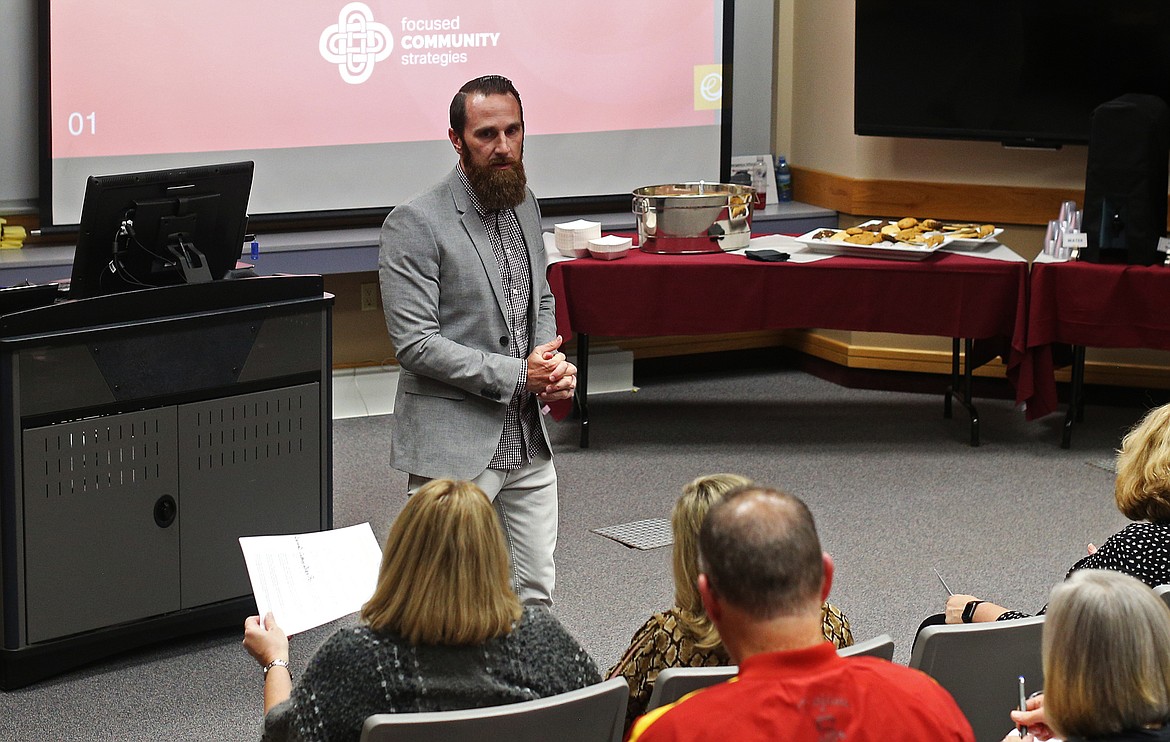
Lupton Center director Shawn Duncan speaks at a Charity Reimagined workshop Monday night at North Idaho College. Charity Reimagined focuses on helping nonprofits become more effective in aid they provide, which includes building trust and preserving dignity. (LOREN BENOIT/Press)

COEUR d’ALENE — Even the most experienced explorers don’t know what to expect when they travel into uncharted territory.
Meriwether Lewis and William Clark thought they’d be able to canoe on over to the Pacific Ocean, but instead they encountered a daunting mountain range — the Rockies. They had to go where no American explorers had ever been. They experienced trial and error and stumbled along the way.
But they persisted, and, after some time, they accomplished their mission.
That’s the same kind of path into the unknown that many North Idaho nonprofits, ministries and other charitable organizations can expect to take as they shift their thinking from one-way giving to transactional exchanges that mean more for the preservation of human dignity.
To re-imagine the way charity work is done requires a leap of faith, especially when it means crossing into new territory.
“What is in front of us is making maps, not following them,” Shawn Duncan, director of the Lupton Center in Atlanta, said Tuesday. “There are no paths. There’s not a visitor’s center with a sign out front."
Duncan visited Coeur d’Alene this week to enlighten and engage with community members at North Idaho College during a sold-out two-day workshop: Changing the Charity Paradigm.
During the workshop, the charity mindset was challenged. Results of well-intended giving were examined, bringing to light unintended consequences — resentment, dependence, blame, shame — that not a lot of people like to talk about.
The concept is encapsulated in the work of Lupton Center founder Robert Lupton, who wrote "Toxic Charity: How Churches and Charities Hurt Those They Help (and How to Reverse It)," on which the seminar was based. Toxic Charity gives many examples of failures in the system, from misuse of funds and unnecessary spending to how one-way giving, which requires no relationship investment between the giver and receiver, is damaging in the long run because it robs people of self worth and creates a cycle of helplessness.
According to Lupton, one-way giving follows this route: Give once, you receive appreciation; twice, anticipation; three times, expectation; four times, entitlement; five times, dependency.
Many believe the current system of giving is not as efficient or as fulfilling as it could be, so local consulting nonprofit Charity Reimagined invited Duncan to Coeur d'Alene to provide education and tools to help organizations be more effective — with the entire community as the big winner.
“These problems are really entrenched and there’s not a lot of solutions readily available. If there were, they’d probably already have been executed at this point,” Duncan said. “Most of the problems we’re encountering do not have clear need and definition yet as to what the problem actually is, right? The evidence of the problem is clear — what’s missing, what seems to be lacking, where hurt might be — but what the nature of the problem actually is or any solution forward is just not readily available."
One example Duncan provided was an animation called the "Cold Water Collective," where a woman with an overflowing bucket of water sees people in her community without water so she decides to give them some of hers. That soon catches the attention of her friends, who want to help fill everyone else's empty buckets.
After years and countless hours, the program had grown and the buckets of the givers were continually refilled. The buckets of those they thought they were helping, however, remained empty. It became apparent that the solution required much more than the "haves" simply filling the buckets of the "have-nots."
Those attending the two-day workshop commented that this parable lacked advocacy for the owners of the empty buckets, that perhaps something was wrong with their water supply, and that maybe the givers never even asked how they could help and simply assumed filling the buckets would solve their problems.
"It feels so good to share that water, but when we put the center on the neighborhood versus the organization, things change," Duncan said.
The Luptin Center at Focused Community Strategies has worked with five Atlanta neighborhoods over more than 40 years to identify the real causes of the symptoms of need and lift entire communities out of poverty. The effort required a paradigm shift in how assistance is provided, but it's one Charity Reimagined is already setting in motion in Kootenai County.
"This is pretty heavy stuff," said Charity Reimagined founder Maggie Lyons. "All of you are here because you are ready to engage in the conversation on a county level about how we can do charity better."
Info: www.charityreimagined.org
- • •
The Oath for Compassionate Helpers
From the Lupton Center:
I will never do for others what they have the capacity to do for themselves.
I will limit one-way giving to crises and seek always to find ways for legitimate exchange.
I will seek ways to empower by hiring, lending and investing and offer gifts as incentives to celebrate achievements.
I will put the interests of those experiencing poverty above my own even when it means setting aside my own agenda or the agenda of my organization.
I will listen carefully, even to not what is being said knowing that unspoken feelings may contain essential clues to healthy engagement.
And, above all, to the best of my ability, I WILL DO NO HARM.
ARTICLES BY DEVIN WEEKS STAFF WRITER

Docuseries 'opens wounds' for some in North Idaho
RATHDRUM — Family and friends who lost loved ones to suicide have expressed concerns with the “Irreplaceable” docuseries being filmed in Lakeland schools this week.

Young welders showcase talents in SkillsUSA contest
RATHDRUM — Showers of orange sparks cascaded from workstations to the floor as student welders meticulously completed their projects Friday at the Parker Technical Education Center in Rathdrum.

North Idaho canines will appear on Animal Planet
The biggest sporting events of the year are happening this weekend: Dog Bowl III and Puppy Bowl XVI.