
As deadline nears, Sun Road plan draws sharp criticism
CHRIS PETERSON | Hagadone News Network | UPDATED 6 years, 10 months AGO
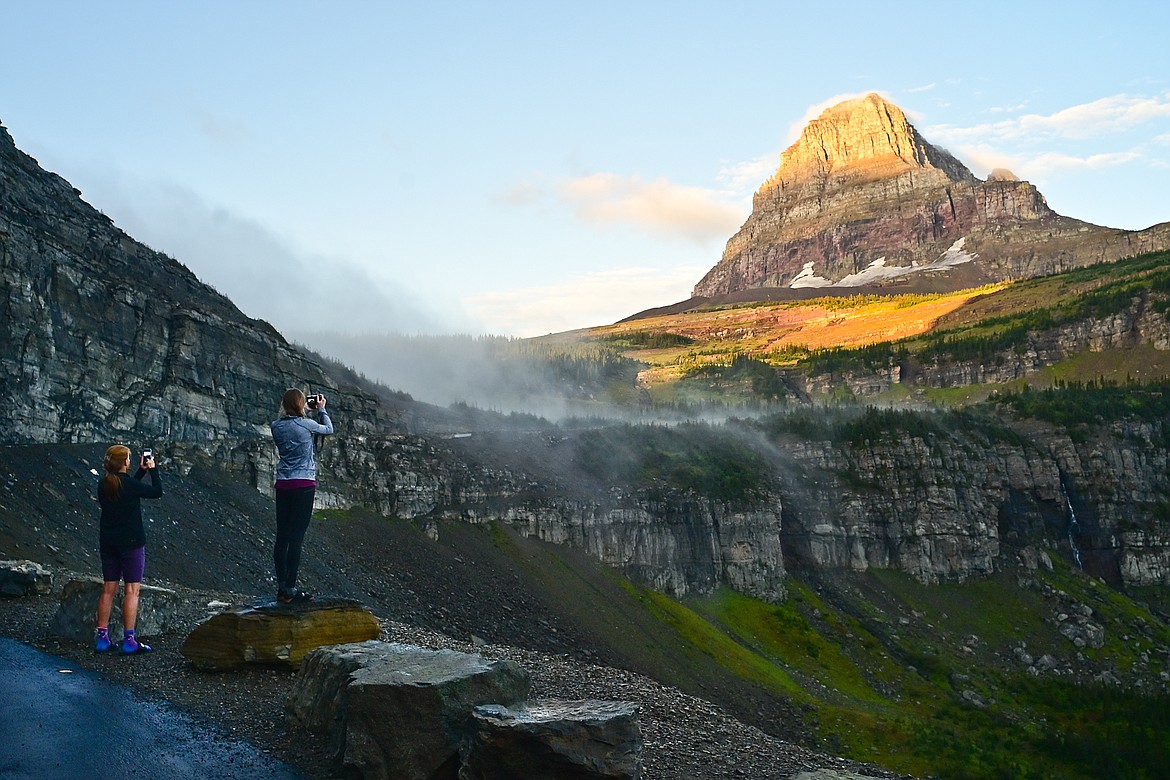
Tourists take photos along the Going-the-Sun Road in this file photo.
Chris Peterson is the editor of the Hungry Horse News. He covers Columbia Falls, the Canyon, Glacier National Park and the Bob Marshall Wilderness. All told, about 4 million acres of the best parts of the planet. He can be reached at [email protected] or 406-892-2151. | October 30, 2019 8:15 AM
Glacier National Park’s Going-to-the-Sun Road corridor management plan is drawing some sharp criticism as the comment period deadline nears next week.
Headwaters Montana, a local conservation group, has a multitude of concerns about the plan, said director Dave Hadden.
“It’s kind of unconscionable how many people we’re putting through that park,” Hadden said in a recent interview.
He charges that the Sun Road is already overcrowded. A person can’t hike the Highline Trail in the summer without hiking with other people.
“You’re not out of sight or sound of another person the entire way,” he said. The backcountry in Glacier is supposed to be managed as wilderness, he noted. About 90 percent of Glacier is recommended wilderness.
But this plan, which calls for more trails and more parking will just make things worse, he claimed.
“They (The Park Service) need to stop what they’re doing and do an EIS,” Hadden said.
An environmental impact statement is a more thorough review of a plan, typically with more alternatives. The current plan is an environmental assessment, with a take-it-or-leave-it plan.
Jack Potter, a retired chief of science and management at Glacier, also has concerns about this plan.
One of Potter’s main concerns is the plan doesn’t have a comprehensive carrying capacity plan for the Park. It simply tries to deal with crowds piecemeal, by adding more parking and some questionable trails that could have impacts on grizzly bears and other wildlife.
He suggests the Park “get ahold of the problem,” figure out desired limits and then work to solve the problem.
“We can’t solve it until there’s a comprehensive plan,” he said.
While the plan itself is an environmental assessment, Potter said that parts of it, in his view, would require and environmental impact statement in their own right, because they would impact sensitive habitat for a host of species.
Potter notes that other parks in the Park Service system set limits on visitation. Wonder Lake, in Denali, for example, has a limit on the number of visitors. Other parks like Acadia in Maine have places that can only be accessed by a shuttle system.
Hadden said he’s visited Zion National Park in Utah, which uses a shuttle system and doesn’t allow private vehicles in the main canyon, and it was a pleasant experience.
In a long and reasoned recent letter in the Daily Inter Lake, Joe Raudabaugh of Whitefish claims the Park Service needs to use the data it gathered in recent studies done by Carnegie Mellon University and incorporate it into the plan. At the very least, make it public.
“I am personally an advocate of limiting visitation levels to ensure we preserve and protect our beloved park and ensure the safety of our visitors. But, regardless of the level of visitation that is allowed, visitors who spend their precious dollars and vacation hours to get to the gates of our park should be able to write the grandest of Glacier memories and not have them ruined by congestion and the rumblings that unhappy crowding creates,” Raudabaugh writes.
For Hadden, he said it’s imperative that locals who remember the enjoyment of a Glacier that wasn’t once so crowded.
“It’s important for folks to say enough is enough,” he said. “(This plan) sucks.”
The comment period closes Nov. 6. The full document is available at https://parkplanning.nps.gov/projectHome.cfm?projectID=47660.
For a recap of the plan, see the story on page B1.
ARTICLES BY CHRIS PETERSON
Water plan calls for dam on Glacier National Park's St. Mary Lake and lower St. Mary Lake
As climate change gets worse, water woes emerge
A study released earlier this summer suggests that inflatable dams on St. Mary and Lower St. Mary Lake could help in relieving future water use conflicts on the St. Mary and Milk River systems.
Ruis starts work on Teakettle Heights subdivision, nixes apartments close to neighbors
Developer Mick Ruis said last week that he’s changed the housing layout of Teakettle Heights at the north end of Columbia Falls, noting that single story homes will now be adjacent to the Aluminum City neighborhood, as opposed to tall apartment buildings as it was first designed.

Couple hikes 1,000 miles on CDT, paints along the way, show Saturday in Columbia Falls
Hiking the entire length of the Continental Divide Trail in Montana is hard enough. Jaden and Genevieve (DeLorme) Attard, both 25, added another degree of difficulty, because after a long day of hiking, they broke out their canvasses, paints and brushes and would knock out a plein air painting or two on most days.