
INL nuclear energy drives state's economic engine
Craig Northrup Staff Writer | Hagadone News Network | UPDATED 6 years, 6 months AGO
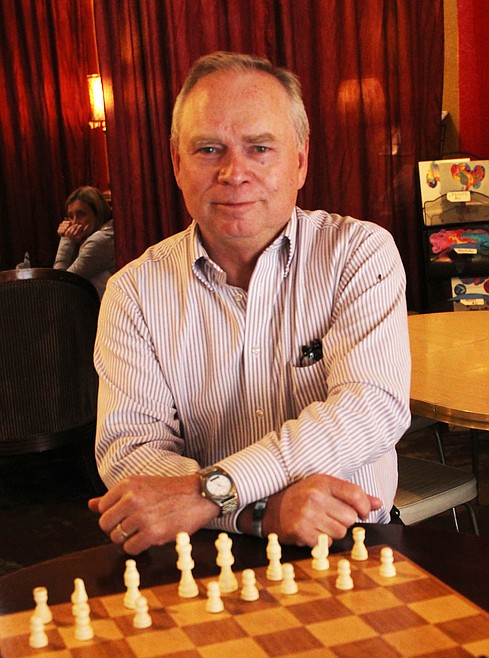
CRAIG NORTHRUP/Press David Shropshire came to Coeur d’Alene to represent Idaho National Laboratory during this week’s Think Big technology symposium.
COEUR d’ALENE — Down the street from Think Big’s block party in Coeur d’Alene Friday afternoon, David Shropshire sat in Calypso’s with a look of hopeful optimism in his eyes.
“It’s really an exciting time to be in this industry,” Shropshire said before manning his booth at the technological event that evening. “Particularly in the U.S., we’re doing things we didn’t think would have existed 20 or 30 years ago. The innovation we’re seeing in this industry is really game-changing.”
The industry Shropshire referred to — the industry in which he has invested the bulk of his adult life — is taking on new technological life. As a nuclear economist at Idaho National Laboratory, the born-and-raised Idahoan sees his field entering the early stages of a Renaissance, with INL at the heart of nuclear energy’s economic growth.
“What’s happening at INL is really quite exciting,” he said. “When I left to work in Europe in 2010, many of the labs were mainly empty. There weren’t too many projects. Now, it’s fully utilized. It looks pretty vital. It’s becoming more of a campus environment.”
That campus is expanding its reach beyond its Idaho Falls property. With more than 4,200 employees and $150 million-plus in contracts, INL’s $2 billion economic impact can be felt along every stretch of land from Bonners Ferry to Malad. And its tangible results aren’t far behind.
“In Coeur d’Alene, for example,” he said, “the work we’re doing will help you maintain your clean and beautiful environment, because you won’t be releasing as many carbon emissions into the atmosphere through fossil fuels. Keeping the air clean and your environment thriving is a real benefit nuclear energy can provide.”
Specifically, Shropshire is focusing on INL’s work with a burgoening technology: micro-reactors. Unlike larger reactors with less efficient grids such as those in Hanford or Three Mile Island, these smaller, portable reactors provide concentrated energy with a fraction of capital and construction costs. This technology opens the door for new and potentially groundbreaking ways to power communities. Shropshire, who spent the last nine years overseas working for the International Atomic Energy Agency and the Nuclear Energy Agency, said micro-reactors represent a technology that is almost exclusively American.
“It was something that kind of surprised me,” he said. “At the IAEA, we worked with 30 countries that all used nuclear energy. When I came back to the INL earlier this year, I saw all this work being done on micro-reactors, and I thought, ‘This is unusual.’ The work I had done while I was gone was all on larger reactors.”
After further investigation, Shropshire discovered INL was ahead of the technological curve.
“I was talking to experts from all over the world,” he said, “and they weren’t really working on micro-reactors. They were working on small and medium reactors or large reactors. The U.S. is putting a lot of resources into micro-reactors. It’s pretty unique to the U.S. It’s just not happening in Europe.”
Micro-reactors — small enough to be transported by semi — can be easily installed with little to no removable waste, according to designs and prototypes Shropshire has seen. Its portability makes for useful solutions to today’s real-world problems.
“With portability, that’s the whole idea,” he said. “They need to be transportable so they can be put into places where they use diesel power. That’s the main thing it was envisioned [to solve]: remote villages in Alaska, mining companies, different industries that use that amount of power. Hospitals. Neighborhoods. Communities.”
One such scenario lies in the Caribbean, where Hurricane Maria obliterated Puerto Rico in 2017, knocking out its power for 11 months. The American territory is currently debating the installation of micro-reactors to bury underground, securing the island’s energy needs from another hurricane.
Shropshire believes Hurricane Maria is just one sign Mother Nature is holding cheering on INL’s research.
“A new wave of younger people are gravitating toward us,” Shropshire said. “The appeal toward nuclear [power] is getting more visible. That could be for multiple reasons, but I think the younger generation appreciates climate change is a real issue. Those that are more technology-savvy understand nuclear energy doesn’t produce carbon emissions like fossil energy does. I think there’s a recognition that nuclear needs to be part of the solution.”
Shropshire credited the Idaho State Legislature and the state’s Congressional representatives for championing the labs. In a Sept. 12 speech at Boise State University, for example, U.S. Sen. Jim Risch told a room full of Idaho constituents the need for the INL was never higher.
“Make no mistake,” Risch said, “consistent, reliable energy is just as viable to our national security as our roads, military and economy. Our state and nation is blessed with the Idaho National Laboratory, the birthplace of nuclear energy in the universe. They are now becoming not only the flagship on nuclear energy, but on cybersecurity.”
Contrary to popular Idaho belief, nuclear energy is not the sole focus at INL. Computer scientists and coders are breaking new ground at the Collaborative Computing Center, which focuses on simulating complex models, and at the Cybercore Integration Center, which focuses on cybersecurity and national infrastructure protection. The nuclear economist said that because the fields of study are growing so rapidly, the labs are pushing to attract an ever-expanding workforce.
“INL is doing a really good job recruiting people,” he said. “They’re in hiring mode like crazy. They accept new hires every two weeks. When I came back to the INL [in April] there were 30 people in my class. That’s just one Monday.”
Shropshire added the availability isn’t the main perk of working at the Idaho Falls facilities.
“For young people,” he charged, “for students interested in STEM, there are opportunities for them to participate in INL sponsorships, internship opportunities and jobs ... If young people want to stay in Idaho, here’s a job that’s drivable in a day, where you can get a high-paying job with great benefits.”
Shropshire added the state’s investment in INL is paying big dividends in a future that’s about to go nuclear.
“Now is the time to think big about small reactors,” he said. “My advice to Idahoans: Be open to the idea of nuclear power. Don’t close your mind to it, because there’s no limit to what it can do.”
ARTICLES BY CRAIG NORTHRUP STAFF WRITER

Legislature gives Green the boot
John Green, in the midst of his first term representing Rathdrum, was expelled from the Idaho Legislature early Thursday afternoon.

No fast lane for grocery tax relief
This week saw an end to three bills devoted to helping residents pay for their groceries, dimming Gov. Brad Little’s hopes to shepherd relief to local shoppers.

Grocery credit bill stewing in Idaho House slow cooker
A bill that would increase the tax credit Idahoans receive to help offset the cost of groceries is tentatively scheduled for a vote in the state House today, but postponing that bill is becoming the norm, rather than the exception.