
Beyond the COVID-19 test
RACHAL PINKERTON | Hagadone News Network | UPDATED 5 years, 12 months AGO
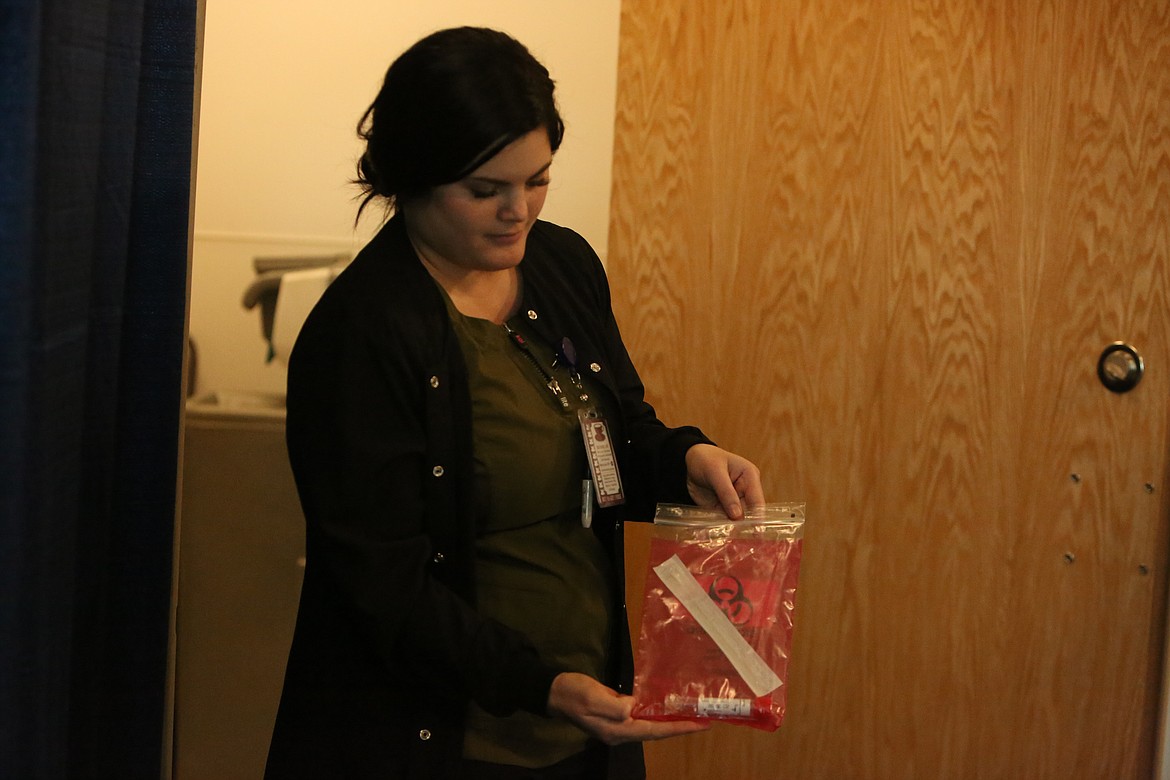
Emry Dinman/Sun Tribune Medical Assistant Sabrina Weber holds up an unused coronavirus test kit, the main component of which is essentially an oversized cotton swab that gets inserted far up a patient’s nose.
MOSES LAKE — A person with COVID-19-like symptoms gets tested for the virus. Then what? Does he or she go into isolation? How long will it take to get the test results? How is the patient notified of the results? How will the community at-large be notified?
With the number of COVID-19 patients rising each day, these questions are more frequently asked. Theresa Adkinson, administrator of the Grant County Health District, has had to answer these common questions too.
When someone goes to a clinic with COVID-19-like symptoms, Adkinson said they are typically tested first for influenza. The health care provider will decide if a COVID-19 test is needed.
Once a COVID-19 test sample is taken, it is sent to a lab. When the COVID-19 virus first hit Washington state, there was only one lab, operated by the state, that could process tests. Now there are multiple labs that tests can be sent to. But even with the added labs, it can still take three to 10 days to get results back. Adkinson said that some commercial labs are backlogged as more people in Washington state and across the country are being tested.
When someone is tested, they are sent home and told to avoid all contact with others, including the people they live with, while they await the results of their test. Until the result comes back, health care providers cannot be 100 percent sure what kind of illness the patient has. Isolation prevents other people from being exposed to the coronavirus.
Typically, the health district knows when tests are sent out and receives demographic information about the patient. Test results are sent to the patient’s health care provider, who reports the information to the health district. On weekends, the health district staff also receives the test information and counts the results prior to clinics reporting them on Monday.
Adkinson said that the health district sees more test results come back on Thursday through Sunday than other days.
If a test is negative, the patient is informed and life can go on as normal. When a positive result comes back, health clinics give the information for the patient. The patient has to stay in isolation for 72 hours after their fever has disappeared.
While most people who get a positive result have some symptoms, there are some that exhibit no symptoms. Those people must wait at least 14 days before they can come out of isolation. As more is learned about COVID-19, the length of time may change.
When a test sent to a commercial lab comes back positive, the test is sent to the state lab for confirmation. Positives are counted when they are returned from the commercial lab, and an investigation begins. An investigation involves getting the information on all the people that have been around the patient in the past 14 days. Close contacts are then alerted and told to go into quarantine. A close contact is someone who has been within six feet of the infected person, talked to them or given them a hug. In contrast, a casual contact is someone who has been in the same grocery store at the same time as the infected person or went to the same showing of a play or movie.
As positives are recorded, the health district monitors community spread. As of now, Adkinson doesn’t believe that the Quincy and Mattawa cases are connected.
When someone exhibiting symptoms has had contact with a known COVID-19 case, they are reported as a probable case on the health district website. Once the test result comes back, they are listed as positive or negative.
The health district is very cautious about the information it shares regarding patients with COVID-19 tests.
“A lot of people want us to put the address out,” Adkinson said. “We can’t do that. We have to be careful with the information we are providing. The staff in the building do not know who all the cases are. They’re following up and don’t know the patient.”
A few community leaders have expressed frustration with how the health district has or hasn’t communicated with them regarding the cases in their community. One city official pointed out that mayors are the ones who make emergency proclamations and help direct decisions regarding the closure of city parks and should therefore have access to critical information.
“I sympathize with them,” Adkinson said. “I’m hearing worry in their voices. I’ve gotten to relive it over and over with each community. We can’t get into the weeds on cases. We try to be as transparent as we can. We are committed to keeping the website updated each day.”
The biggest thing that Adkinson emphasized to help keep the number of positive cases low is for everyone to stay home. Unless there is a reason for people to be out, such as a trip to a grocery store, everyone should stay put.
“And not the whole family going to the grocery store,” Adkinson said. “Send one.”
Rachal Pinkerton may be reached via email at [email protected].
ARTICLES BY RACHAL PINKERTON

Agriculture department fights gypsy moths in Cowlitz County
SILVER LAKE - The Washington State Department of Agriculture (WSDA) has begun treatments for the eradication of gypsy moth in the Silver Lake area of Cowlitz County. The treatments are being sprayed from the air on approximately 640 areas of land.
Potato news: Japanese tariffs down; Potato U announced
JAPAN - Frozen fries will now be able to enter Japan tariff free. Japan announced at the beginning of April that it was eliminating the 2.1% tariff on frozen fries from the US, as part of the US-Japan Trade Agreement, according to the Washington State Potato Commission.
Mattawa residents express concerns: Fear of retaliation, hostility cited; administrative assistant resigns
A few community members expressed concerns about the City of Mattawa and mayor firing Police Chief Joe Harris at a city council meeting Thursday.