UI’s agriculture center keeps a focus on organic
Bonner County Daily Bee | UPDATED 5 years, 4 months AGO

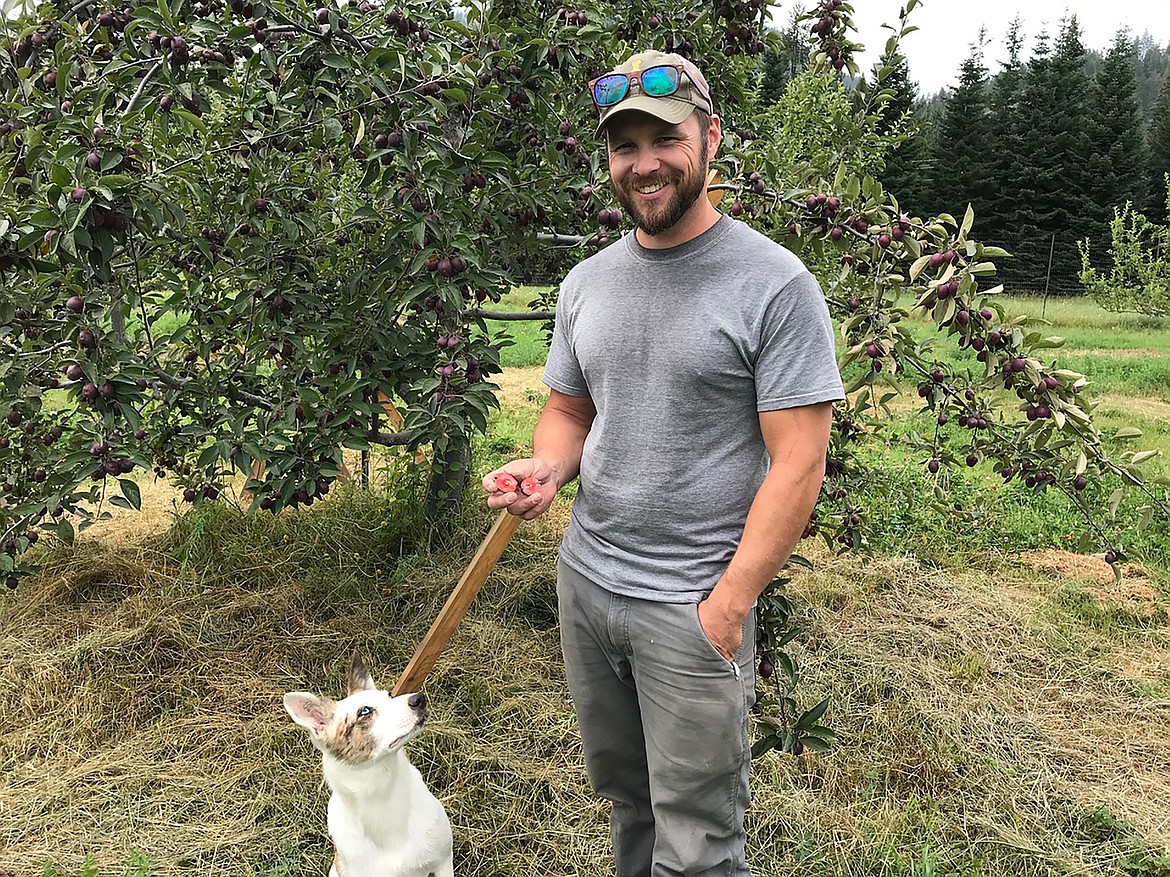
SANDPOINT — Walking through the orchard, Kyle Nagy stops, picks an apple from a Red Vein Crabapple tree and cuts it in half. The skin is deep cranberry, the inside is pinkish red all the way through. “These are good for cider,” he said.
Nagy is the superintendent and orchard operations manager at the Sandpoint Organic Agriculture Center on North Boyer, where research and recordkeeping is under way on the wide variety of organic heirloom apples — whose origin can be traced back 50 to 100 years — growing there.
There’s a lot of excitement at the University of Idaho about what’s occurred in the past two years since Dennis and Karen Pence donated the 66 acres and buildings to the University of Idaho. The orchard has grown from 270 apple trees to 640 apple trees and 1,000 feet of raspberry rows. (The u-pick raspberries section for the public is now closed.)
And now, a new project, headed by Dr. Jodi Johnson-Maynard, department head of Soil and Water Systems at the U of I was just funded to do research on soil health in organic management systems. “We are very excited!” he said.
The overall goal of the center, Nagy said, is to become a hub for organic agriculture research. Grants from the Department of Agriculture for organic work require a certified organic farm. The orchard near Sandpoint is the only organic site owned by the university, so it creates research opportunities for faculty and graduate students at the U of I.
Certified organic bareroot planting stock is purchased from various growers —Trees of Antiquity in California and Raintree Nursery in Washington.
“We have just begun working with Bonners Ferry Nursery to begin propagating some of our best performing varieties so they can be made available locally; however, they won’t be available for several years as they grow out,” he said.
Nagy said some of the favorite apples at the orchard include Baldwin (Massachusetts 1784), Spigold (New York 1962), and Holstein (Germany 1918). Nagy recommends Freedom (New York 1983) to home orchardists because it came out of a breeding program for disease resistance, it requires little maintenance, and produces great apples. One variety that has shown great promise is Duchess of Oldenberg, an apple tree that is ready for harvest in August. Some cultivars don’t produce until as late as October.
The center grows apple cultivars for many different uses — fresh eating, cider, baking, sauce, and long-term storage. “We’d like for people to know there are many good apples besides honey crisp!” he said.
Interestingly, the center does not allow the trees to produce fruit until their fifth year in the ground. “When they put on fruit in the spring, it is removed while we are thinning the fruit on the older trees. The reason for this? It’s important to send all of that energy to the roots and shoots of the young tree so that it can develop a healthy root system and canopy.”
Nagy advises home orchardists to resist the urge to leave a big crop on a young tree — just a few for tasting!”
Most of the compost at the center is used on the raspberry patch and vegetable garden; there is not enough for all the trees. Nagy explained that all the inputs, which include fertilizers, pesticides, and soil amendments, etc.) must be certified for organic production.
Organic fertilizers that often include poultry manure, bone meal, blood meal, and kelp meal are used. When it comes to organic pest controls, they use neem oil as a dormant spray and sulfur to control apple scab (fungus) in the spring.
“We use a technique called mating disruption for codling moth, which is one of the worst pests for apples. We spread fake female pheromones throughout the orchard to confuse the male moths looking to mate,” Nagy said. And the barn kittens imported to their own shed in the orchard help out with rodent control.
Much of Nagy’s work is record-keeping. He must record all daily activities in the orchard, as well as any inputs or tractor implements used. They save receipts and organic certificates of all inputs for verification, as well as records of harvest and sales. “Lots of paperwork goes into maintaining organic certification, but it is worth it!”
Several fulltime seasonal workers and up to 3 interns, all paid positions, are employed each summer.
For those interested in learning more about apple growing, Nagy will moderate a free monthly webinar series beginning 10 a.m., Wednesday, Aug. 19 with “Sleuthing for Lost Apples: Lessons from the Experts.” Spokane-based David Benscoter of the Lost Apple Project, and John Bunker of the Maine Heritage Orchard are the presenters. They will be live streamed through Zoom at 10 a.m., the third Wednesday of the month for the next 9 months, but will be recorded and posted to the website — https://www.uidaho.edu/cals/sandpoint-organic-agriculture-center — if you cannot “attend” the live webinars.
A master plan is in the works for the center.
“We plan to put together an advisory board this fall of local organic producers to help direct our research into areas that would be most valuable for North Idaho producers and residents.
“There is some interest in trials of high-density trellised apple trees at SOAC, implementing techniques that have been refined at the Parma Research and Extension station by Dr. Essie Fallahi in southern Idaho, to see how well the high-density planting would fair under organic production management,” he said.
Susan Drinkard writes features for the Daily Bee. She can be reached at [email protected].