
Bipartisan caucus seeks solutions for rural issues
Riley Haun Contributing Writer | Hagadone News Network | UPDATED 6 years, 1 month AGO
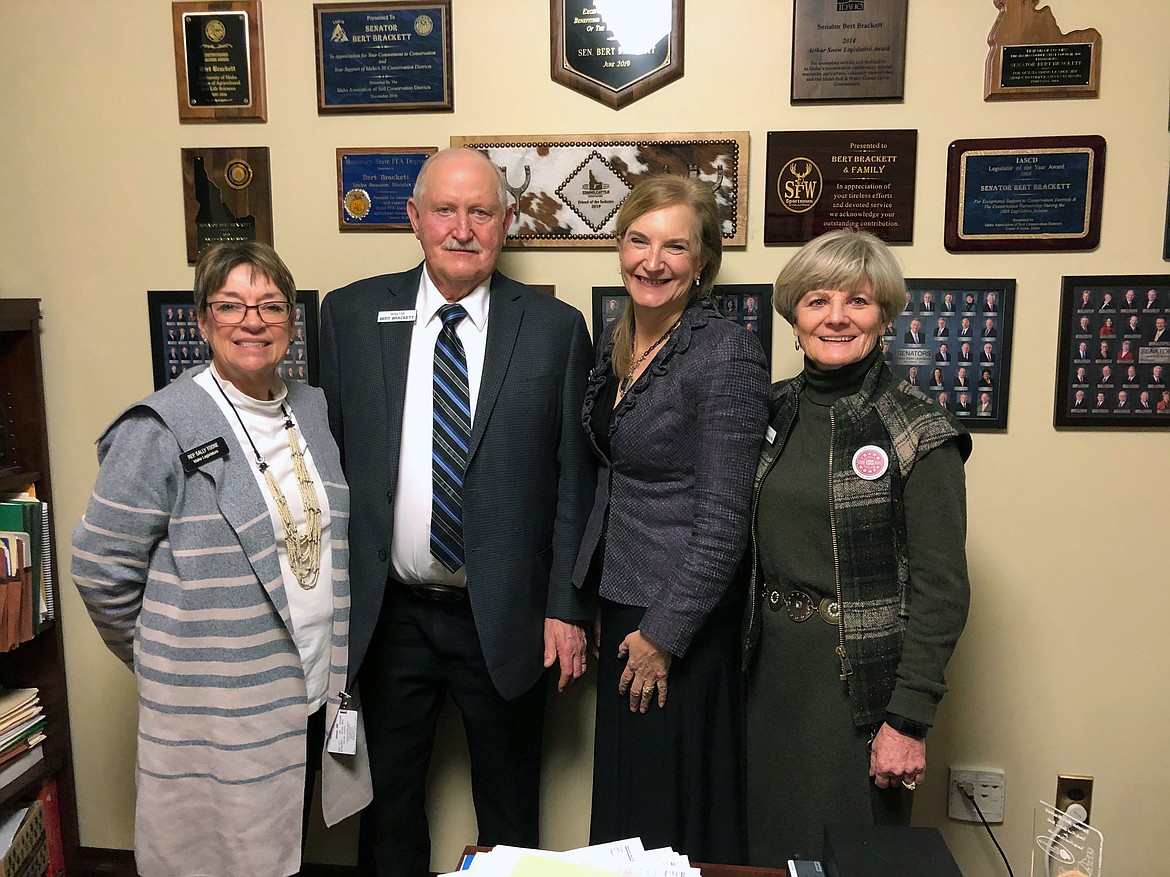
(Photo by RILEY HAUN) Founding members of the Farm, Ranch and Timber Issues Caucus, pictured from left, are Rep. Sally Toone, D-Gooding; Sen. Bert Brackett, R-Rogerson; Rep. Caroline Nilsson Troy, R-Genesee; and Sen. Janie Ward-Engelking, D-Boise.
There are a lot of definitions of “rural.”
The U.S. Census Bureau defines it simply as “any population, housing or territory not in an urban area.” On a map of Idaho, only a few small pockets in the south—and Lewiston in the north—are gray urban areas in the sea of green, rural expanse.
But the difference between issues for those green areas and their gray neighbors is often more noticeable than that map lets on. Though the problems on everyone’s minds are the same, the solutions are not one-size-fits-all across Idaho.
The sheer size of so many rural Idaho districts presents a challenge in itself. Rep. Caroline Nilsson Troy, R-Genesee, said that challenge was never more apparent than when talking to a legislative colleague from a Boise-area district.
“He was telling me ‘my district is a mile to the east, a mile to the west and a mile and a quarter to the north and south,’” Troy said. “My driveway is a mile long. The perspectives are just different.”
Troy and fellow House member Rep. Sally Toone (D-Gooding) are working to unite both rural and urban perspectives in the Statehouse through their Farm, Ranch and Timber Issues Caucus. The project aims to create a bipartisan, bicameral forum to educate legislators from cities and farms alike on the issues that matter to rural life and industry.
Partnering for the future
Though the word “caucus” conjures images of politicians squabbling over policy and strategy, Toone said she doesn’t want Farm, Ranch and Timber to be seen as political. Rather, she and Troy want it to be a forum for discussion and education to inform legislators’ decisions down the road.
The group’s name reflects this dual-sided approach. In its early stages, Troy and Toone referred to it as a rural caucus, but ultimately settled on Farm, Ranch and Timber to emphasize its inclusive nature.
“We don’t want to limit it to legislators from rural areas only,” Troy said. “We want it to be all-inclusive for anyone who wants to learn about issues that impact their country cousins.”
Other issues-focused, non-political caucuses have sprung up throughout the legislature’s history but are often short-lived. Currently, there’s a caucus focused on STEM in education, among a few little-known others. Troy has been tinkering with the idea of a rural-focused caucus since taking office in 2014. But historically, Troy said, caucuses have been discouraged in Idaho’s Statehouse because they’re seen as getting legislators “off track” from their main duties—and besides, legislators are so swamped with work that there’s rarely time to workshop new projects during the legislative session, Troy said.
Troy and Toone don’t see this project as a potential distraction. They envision the caucus not as a lobbying group but rather an opportunity to share information and perspectives between rural and urban legislators. And the prospect of a joint caucus between the House and Senate is rich with potential to Toone, who said in a statement that its uniqueness “can’t be overstated.”
Taking the long view
Toone said the caucus would remain open to partnering with legislators on specific bills, but the focus is on building awareness and brainstorming solutions over developing legislation.
“Oftentimes there’s not a legislative solution to these problems,” Troy said. “It’s a longer-term solution, maybe a local solution.”
The caucus will tackle problems shared by rural and urban areas, Troy said—for example, broadband expansion, roads, health care and education are weighing on nearly every legislator’s mind. But there will be a special focus on issues that strike close to the heart of rural Idaho.
Toone cited the example of colony collapse disorder, a common problem for beekeepers in her Southern Idaho district. Not much has been done in the legislature to address the issue, but Toone said she thinks the problem is lack of knowledge, not apathy.
“If we get our colleagues together and present information to help them understand these specifically rural issues a little better, we’re already plowing new ground,” Toone said.
The caucus will aim to expand the horizons of legislators who often get “stuck in their silos,” Troy said. With each legislator assigned to multiple committees, there’s not a lot of time to look outside of the topics at hand. Legislators from rural backgrounds aren’t always assigned to the committees addressing rural-specific issues, and the rural perspective is often underrepresented in discussions on broader issues like infrastructure and health care.
Ultimately, the hope is that legislators who participate in the Farm, Ranch and Timber Issues Caucus’s discussions will return to their committees with fresh perspective on how their decisions affect rural areas specifically. The caucus would also serve as a “contact point,” according to a statement released by the group’s founders, allowing concerns to be heard throughout the legislature and other state agencies.
Discussion among the caucus would also provide a chance for legislators to share experiences from diverse rural districts throughout Idaho and compare problems and solutions.
“Maybe my district has a problem that yours has already solved, and we could learn from that,” Troy said. “Or maybe what’s a problem in mine isn’t a problem in yours at all. We’re really just testing the waters across Idaho to see what’s being done.”
Gathering support
Two members of the Senate, Sens. Bert Brackett (R-Rogerson) and Janie Ward-Engelking (D-Boise), have joined Toone and Troy as founding members of the caucus. With support from both sides of the Capitol, the founders say they feel optimistic about the group’s ability to achieve their goals.
“Congress has its own rural caucus, but we don’t want it to be [political] like that—we want an Idaho approach,” Toone said. “We’re from rural areas—we were elected for who we are, and people trust that.”
Troy agreed, saying she thinks Idaho’s “kinder” approach to bipartisan issues is a good thing for productive discussion. Troy said she thinks a wide swath of legislators will be attracted to the caucus’s meetings, currently planned for once a week during the legislative session.
“If you eat, you’re in agriculture,” Troy said. “So I think that means we’ve got them all.”
Twenty to 30 legislators from the House and Senate attended the caucus’s inaugural meeting February 3, Troy said. The attendees developed a list of general issues to be discussed, including grazing rights and the Good Neighbor Authority partnership between the Forest Service and the Idaho Department of Lands. Department of Commerce director Tom Kealey shared updates on Governor Brad Little’s broadband task force.
Rep. Christy Zito (R-Hammett) said she was looking forward to discussing her largely rural Southwest Idaho district’s concerns through the caucus.
“To involve the House, Senate and all political parties is politics in its greatest moment,” Zito said. “Our state is so diverse… It will be an excellent opportunity for those of us in the Southwest to share the issues that are faced in our area, and to learn what issues are facing other regions of our state on a more intimate level.”
The initiative has received support from industry members as well. Food Producers of Idaho, a coalition of over 40 commodity and agricultural organizations, provided lunch for the caucus’s first meeting.
Rick Waitley, a lobbyist representing FPI, said the organization’s members voted to provide lunch as their “blessing” to the caucus, showing industry’s support for the group’s mission. Moving forward, Waitley said FPI will support the caucus by linking them with industry members and experts from the organization’s wide network when a speaker or information is needed.
“Getting discussion going and exchanging ideas will mean only good dividends,” Waitley said. “If I were a freshman [representative] from a rural district coming in, I’d find it very refreshing that there was this nucleus of like-minded people working on the issues I care about.”
Troy and Toone said they hope the caucus will grow in numbers and eventually help in providing information on the scope of Idaho agriculture to anyone who wants it.
“In five years, I may not still be here [in the Legislature],” Toone said. “But I think we’ll have provided a resource for this way of Idaho life.”
Riley Haun is an intern with the University of Idaho McClure Center for Public Policy Research and the UI JAMM News Service
ARTICLES BY RILEY HAUN CONTRIBUTING WRITER
ISDA proposes new program to keep farms in the family
The Idaho Department of Agriculture proposed a new program aimed at helping Idaho farmers keep their farms in the family during the department’s legislative budget hearing Wednesday.

Industrial hemp gets push from Legislature
A proposal to create a plan for regulating industrial hemp in Idaho will move to the full Senate floor for a vote after farmers turned out in support at a legislative committee meeting Feb. 20.
Panel OKs rules limiting tag sales in some cases
Members of the House Resources and Environment Committee passed rules allowing the Idaho Fish and Game Commission to limit the sale of hunting tags under certain circumstances Monday.