
Are school core standards dead? Educators weigh in on uncertainty
Craig Northrup Staff Writer | Hagadone News Network | UPDATED 6 years, 1 month AGO
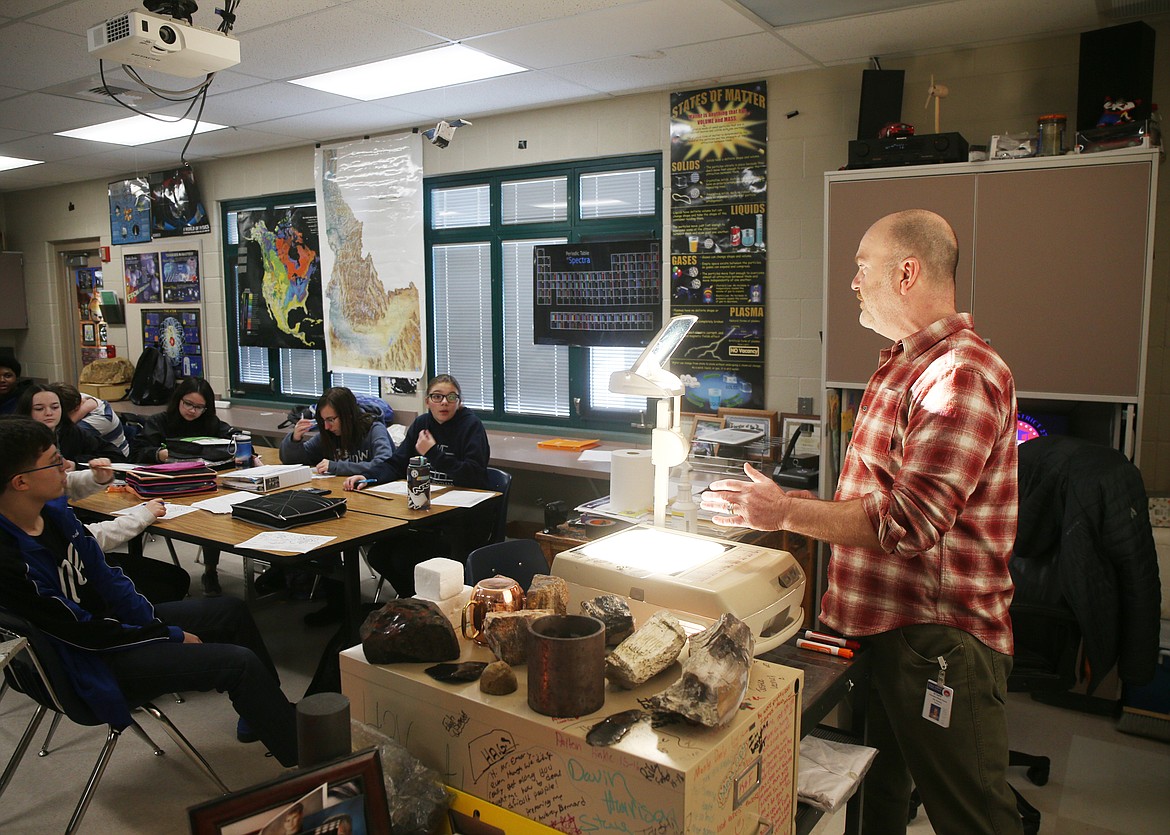
LOREN BENOIT/Press file Eighth-grade science teacher Michael Emory leads his class in a lesson on Yellowstone calderas at Woodland Middle School in this 2019 file photo. A recent move in the Idaho House would remove Idaho core standards from the required curriculum.
A legislative report at Saturday night’s conservative Lincoln Day Dinner drew one of the more enthusiastic rounds of applause after Rep. Ron Mendive made an announcement.
“The House Education Committee this last week: We actually voted by a vote of 10 to 5 to throw out Common Core,” Mendive said. “That’s a big win for us.”
Last week’s vote by the House Education Committee in Boise to eliminate Idaho’s English Language Arts, Math and Science standards has hit the radars of politicians and policy wonks alike. Some have championed its potential demise; others are holding out hope it will live to fight another day.
Educators have watched with more than passing curiosity as the events in Boise unfold.
“If it happens, we’ll do whatever we’ve got to do,” Post Falls Superintendent Jerry Keane said Monday. “Whether we build something new from within, or whether we take pieces of what we had before and put something together, we’ll have to do something. What matters is, we can’t leave any group of students behind.”
“If” being the operative word.
Idaho’s version of federal benchmark educational standards once known as Common Core have been in place since implemented by administrative rule in 2011. For the Feb. 5 rule to now remove the standards, the Senate Education Committee must agree to the change, line by line. The Senate’s sister committee could vote on the matter as early as this week.
The House Education Committee has made similar overtures in years past, most recently last year, when the House committee voted to toss the standards while the Senate committee disagreed. Regardless of what the Senate decides, local educators say the uncertainty is challenging.
“[The Legislature] wants to remove the standards,” Keane said, “but they’re not suggesting anything to replace it. There would be nothing — no replacement — to guide how we design our curriculum, and that’s obviously a problem. You can’t make a change like that without having something to put in its place.”
Scott Maben, director of communications for the Coeur d’Alene School District, agreed.
“Obviously, you need standards,” Maben said, “because standards are the basis of curriculum. It can take years to develop standards, to adopt standards and then write curriculum based on those standards. Your assessments can change based on the curriculum you teach … All of this is a process that can take years.”
The process doesn’t just exist on paper. Part of the curriculum process, Maben pointed out, involves a very real cost: textbooks.
“School districts spend a considerable amount of money on textbooks and instructional guides and software,” he said, “all of which is based on curriculae. We’ve spent hundreds of thousands of dollars in recent years, and we based the decisions to spend those dollars on the standards we have in place.”
Money spent on textbooks is only part of the equation. Originally designed in 2009 as a race between the states to split more than $4 billion in grant money, 46 states — Idaho included — adopted Common Core to qualify for those funds. Since 2009, 12 of those states have since repealed parts or all of the standardized testing program.
The loss of federal grant money is likely not enough to dissuade change as much as a disruption in already-invested dollars toward curriculae, Maben said.
“What position does [changing] put us in with adopting new standards?” Maben asked. “We would have just wasted a considerable amount of taxpayer dollars. I think those are questions that need to be [addressed] before a change is made.”
Keane echoed those sentiments, adding he’d be more receptive to change if a counterproposal was introduced and evaluated.
“We build our whole system around those standards to drive instruction and student achievement,” he said. “If they’re not there, then what? We’ve purchased curriculum based on those standards. You can’t replace the standards with nothing and expect it to work.”
Maben urged patience.
“It seems fairly preliminary to be reacting much to it,” he said. “Usually, the House will come out with something like this, and then the Senate will [intervene] or something will change. We’ve discovered every year that things can happen. We’re waiting to see what the Senate is going to do. I think we’ve got a long ways to go.”
Keane’s concern, however, was palpable.
“It would be quite a challenge to drop off a cliff like that,” he warned. “We can go back to what we had before, but it would be a pretty chaotic transition.”
ARTICLES BY CRAIG NORTHRUP STAFF WRITER

Legislature gives Green the boot
John Green, in the midst of his first term representing Rathdrum, was expelled from the Idaho Legislature early Thursday afternoon.

No fast lane for grocery tax relief
This week saw an end to three bills devoted to helping residents pay for their groceries, dimming Gov. Brad Little’s hopes to shepherd relief to local shoppers.

Grocery credit bill stewing in Idaho House slow cooker
A bill that would increase the tax credit Idahoans receive to help offset the cost of groceries is tentatively scheduled for a vote in the state House today, but postponing that bill is becoming the norm, rather than the exception.