
Rocket men
HEIDI DESCH | Hagadone News Network | UPDATED 6 years, 8 months AGO
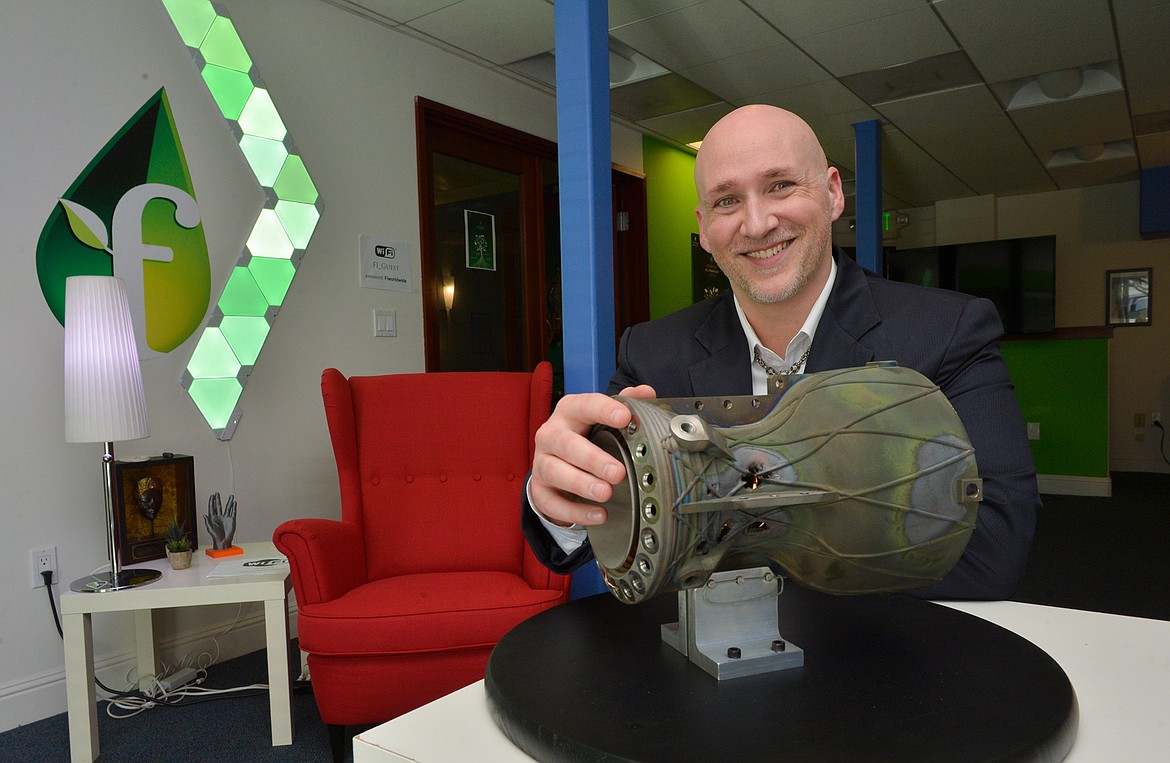
Aaron Davis, CEO and founder of Whitefish-based Mountain Aerospace Research Solutions shows off the first Fenris rocket engine, which he says will make getting into space cheaper and safer. The engine was created on a 3D metal printer, contains no moving parts and can be reusable. It was test fired on July 26, 2019, at a test facility in California's Mojave Desert. (Photo courtesy Doug Jorgensen, for Mountain Aerospace Research Solutions)
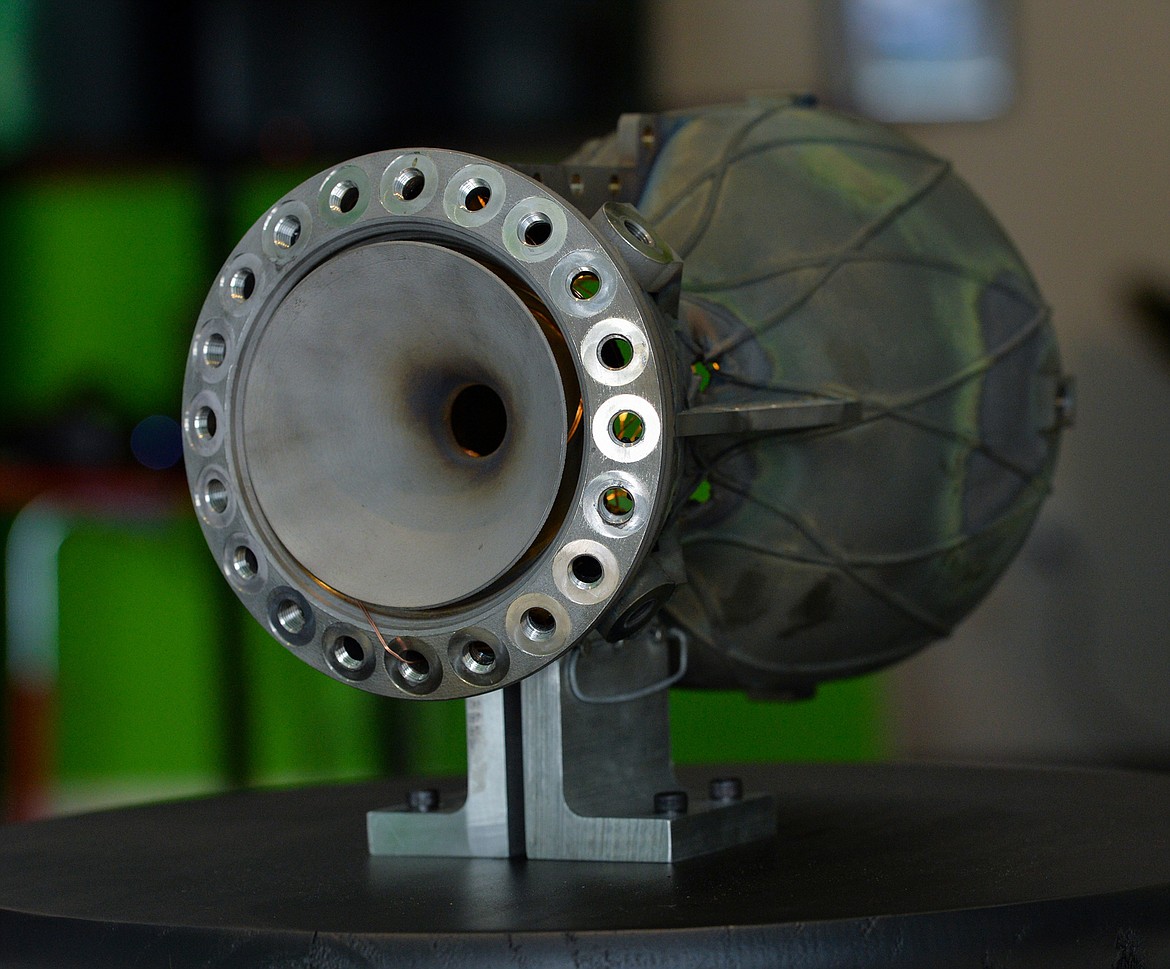
This prototype Fenris engine was test-fired on July 26, 2019, at the Mojave Air and Space Port in Mojave, California. The successful test demonstrated beyond a doubt that the engine pulled in plenty of oxygen from the surrounding air to sustain combustion. (Photo courtesy Doug Jorgensen for Mountain Aerospace Research Solutions)
DEPUTY EDITOR, FEATURES Heidi Desch is the Deputy Editor at the Daily Inter Lake, overseeing coverage of arts, culture, lifestyle, community, and business. Desch leads reporters in developing stories that highlight the people, traditions, and events shaping Northwest Montana, guiding content across print and digital platforms. With more than 20 years of journalism experience, including serving as managing editor of the Whitefish Pilot, Desch is a graduate of the University of Montana School of Journalism. She has received multiple Montana Newspaper Association awards, including part of the team leading the Daily Inter Lake to Best Daily Newspaper in Montana Award and the General Excellence Award in 2024 and 2025. IMPACT: Heidi’s work connects readers with stories that deepen the understanding of the community beyond daily news. | February 25, 2020 1:43 PM

Aaron Davis and Scott Stegman admit they wouldn't mind taking a trip to space, if the price were affordable.
They may have created a way to make that happen and allow almost anyone to be launched into orbit. They're the team behind the Fenris, an air-breathing, liquid-fueled rocket engine, that they say could radically change space travel, but also long distance flights around the world.
Davis say this technology gives everyone a chance to visit space and changes the equation on how to leave the planet.
“Space has been a part of my life and it's something I'm passionate about,” Davis said. “If I can help in anyway the species get to space that's something I want to chase as far as it could go.”
“For me it would be a dream come true,” adds Stegman. “The possibility that we could access other planets is huge for the path of humans and how we live.”
Davis is the founder and CEO of Mountain Aerospace Research Solutions based in Whitefish. He has a background in aviation through serving in the U.S. Marine Corps.
One of the biggest expenses for space travel is the cost of fuel necessary to push a rocket free of the Earth's atmosphere. Every rocket has to carry its own oxidizer to create enough thrust, and about 90% of a rocket's mass is tied up in propellant made of oxidizer and fuel, according to Davis.
So Davis began to wonder if he could change the way the rocket's engine works, by using the atmosphere as an asset. He connected online with Stegman, who has a background as an engineer working for aerospace companies, and felt the idea had merit.
They began working together and created the Fenris engine that takes oxygen from the atmosphere, compresses it and makes it available to use as a propellant. A rocket powered by a Feneris engine could carry bigger payloads and would make launches more affordable and safer because what previously was a controlled explosion becomes controlled propulsion, they say.
Stegman said the engine is a hybrid rocket motor and allows it to carry less oxidizer than on a regular rocket motor.
“The benefit is that the motor uses the air around it to be more efficient,” Stegman said.
Davis says allowing the engine to essentially carry its own fuel by feeding off the hydrogen and oxygen in the atmosphere changes everything.
“We expect it will be efficient enough to be used on long haul flights to anywhere in the world,” he said. “Those flights have to carry a heavy amount of fuel and it could cut down on that.”
They created the design for the rocket and then had the prototype metal 3D printed. The motor has no moving parts, can be manufactured anywhere and is 90% compatible with existing rocket technology, they say.
The first prototype of the Fenris engine was tested in July 2019 at the Mojave Air and Space Port in California. Davis and Stegman say the test was a success and gave them data to proceed with further testing planned for later this year.
A video of the test shows Davis pouring fuel into the engine and then calling for everyone to back away before a fire plume shoots out the back of the engine. The engine takes in the atmosphere, compresses the oxygen, and then burns it as propellant.
“I was super happy no body go hurt from my crazy idea,” Davis said with a laugh. “Then sort of after the fact I thought, ‘What do we do now?'”
“I was shocked that it worked,” Stegman said. “It's so different from conventional motors, I was surprised that it worked.”
The MARS team has now filed two patents on their design and are seeking investors and funding to keep their project moving forward. Davis was awarded NASA Fellowship at the Founder Institute in Palo Alto, California, that he hopes will help him make connections to assist with the engine.
“With funding, the target for suborbital launch testing is 2022 to 2023,” said Davis. “It's time to significantly reduce the cost of getting into space.”
For more information, visit https://www.marsengines.com
ARTICLES BY HEIDI DESCH

Whitefish wildfire protection plan up for City Council review
Fourteen areas of concern that are primed for mitigating wildlife risk are at the center of a draft Whitefish Community Wildfire Protection Plan.

Kalispell resident advocates for more women in the trades after being crowned Mrs. America
Standing on the stage in Las Vegas, wearing a white formal gown accented with feathers on one shoulder, Qadra Evans gripped hands with a fellow competitor.

Whitefish mulls updates to community growth plan
Whitefish City Council on Monday will consider updates to its community plan including language that looks to protect the historic character of its downtown amid state requirements allowing buildings up to 60 feet in height in certain zoning districts.