
What if WATER HURT?
Bill Buley Staff Writer | Hagadone News Network | UPDATED 5 years, 10 months AGO
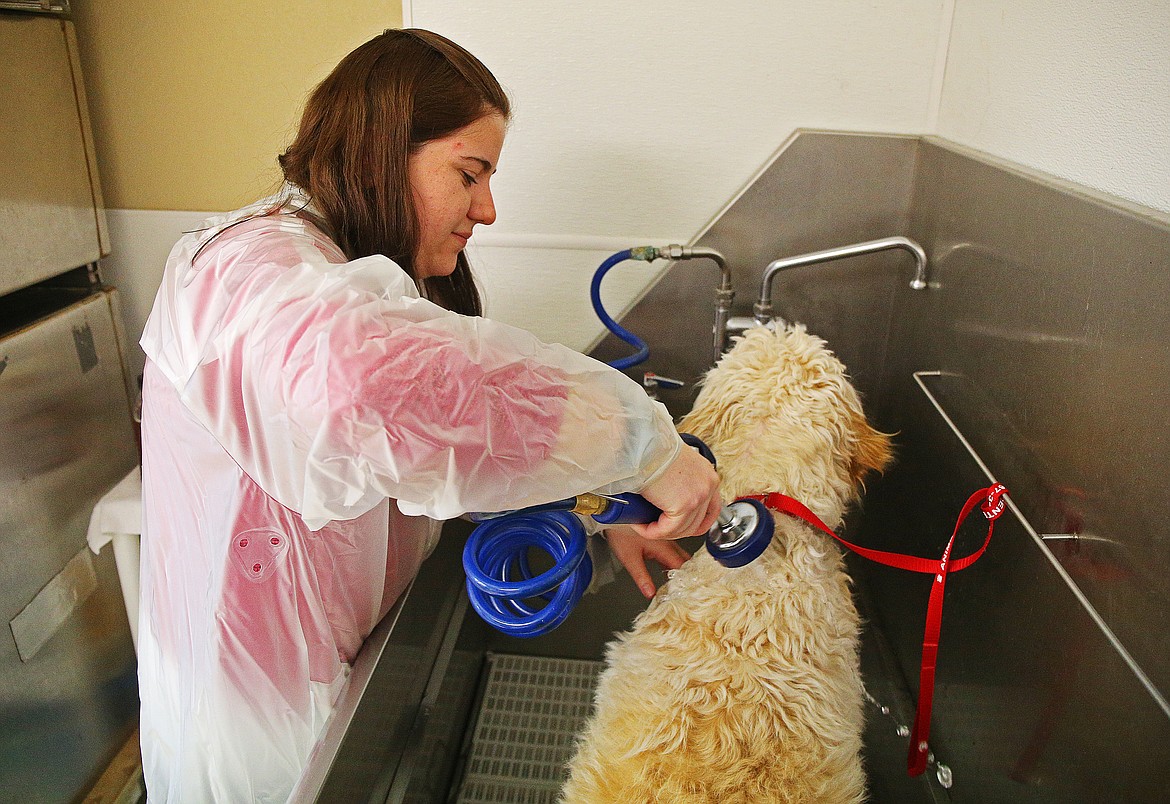
LOREN BENOIT/Press Rachael Fetter, a vet tech, has a rare disease known as aquagenic urticaria, which is an allergy to water. She works around the hurt while at work as she washes Deeks.
People need water to live.
Rachael Fetter avoids water to live pain-free.
“I stay as far away from water as I can,” the Rathdrum woman said Wednesday. “But water is a hard thing to avoid.”
Fetter has a rare disease known as aquagenic urticaria, which is an allergy to water. It is a type of hives that causes a rash to appear after water has any contact with the skin.
But it’s not just that it looks bad.
It hurts. Fetter said it itches “and feels like you’re being burned every time you get wet.”
“If I’m not careful, I’ll have blisters by the end of the day,” she said.
Try staying dry throughout the day. Not easy. Routines such as washing your hands and taking showers become exercises in anguish.
“Take a minute and think how hard it would be to avoid water on a daily basis,” the 23-year-old said.
When it rains, which it does often in North Idaho, Fetter stays inside. If she must go out, it’s a mad dash to the car or from the car to get back indoors, umbrellas at the ready.
And come summer, when many go for a swim in the lake or take a dip in the pool, Fetter can’t. Well, she could, but it would bring on the hurt.
It’s not just her personal life that is affected.
Fetter is a vet tech. So much of her job requires that everything be sterile, which means constant washing of hands and keeping work areas wiped down. She accepts that it won’t feel good, but it’s necessary — and it’s not going away.
“I like my job and everything I do,” she said. “So I work with it.”
Aquagenic urticaria is so rare that fewer than 100 cases have ever been reported as of 2011, according to healthline.com. Most people don’t realize a person can be allergic to water. Fetter has met doctors who have never heard of aquagenic urticaria.
She wants to change that.
Rare Disease Awareness Day is Saturday — #ShowYourRare is the social media campaign — and Fetter wants people to know there are others like her who face daily struggles with a rare disease.
The total number of Americans living with a rare disease is estimated at 25 million to 30 million, according to rarediseases.info.nih.gov/
In the United States, a rare disease is defined as a condition that affects fewer than 200,000 people.
“There are over 7,000 different rare diseases, so as it turns out, having a rare disease is not so rare after all. Building awareness is personal and important to me, because 1 in 20 people will live with a rare disease at some point in their life,” Fetter wrote. “I am part of that statistic.”
She said only 5% of rare diseases have an approved treatment plan by the FDA. Fetter doubts a cure is coming anytime soon, or ever, because so few people have aquagenic urticaria that there just aren’t enough case studies.
“We all talk about the more widely known diseases such as cancer and diabetes,” she said. “The list goes on and on. What we fail to discuss are the lesser-known diseases that can be some of the scariest and hardest to live with.”
A seminar to learn more about rare diseases is scheduled 11:30 a.m. to 1:30 p.m. Friday at the Washington State University Riverpoint campus in Spokane. It is free and open to the public. Info, tickets: bit.ly/2I2gp3e
Fetter faces another challenge.
Her legs are paralyzed from the knees down, which came on, without warning, about five years ago, and then gradually got worse.
First, her right leg stopped working below the knee. Then, the left.
“I’ve had no movement on my feet ever since,” she said.
It was three years ago Fetter began noticing hives after washing her hands. And the burning quickly caught her attention. She assumed it was nothing and would go away, whatever it was. But it didn’t. Instead, it got worse.
“I’d be in tears thinking I have to take a shower,” Fetter said. “And I’m still pretty close to that some days. I don’t want to get wet.”
At the doctor’s office, they ran tests like putting her arm in water to see how long it took for hives to form. They took skin biopsies. They had her put her foot in a pool of water to see how long it took for the skin to react: Five minutes.
Hives from this condition can be triggered from many water sources, including rain, snow, sweat and tears.
“Researchers are still working to determine the exact cause of aquagenic urticaria,” healthline.com says. “Some speculate it’s the chemical additives in water, like chlorine, that cause the reaction, rather than contact with water itself.”
In her research, Fetter found it just comes on. There’s no one reason why. It’s not known what triggers it.
She tried allergy injection shots that worked “great for one day.” Then, the hives and burning returned. While the hives remain visible for an hour, the burning sensation can last four or five hours.
At least, she said, the pain leveled off about six months ago and she has learned to manage it by taking antihistamines prior to getting wet. She takes medications to manage the pain, “so I can function and take showers.”
Fetter soldiers on.
She’s been to the Mayo Clinic twice. Her service dog, Deeks, is a good friend who helps her through everything. She plans her days carefully to steer clear of liquid.
Most days, she said, are pretty good.
But then — “some days just suck, because I know I’m going to get wet,” she said.
ARTICLES BY BILL BULEY STAFF WRITER

'We're going to be there'
COEUR d’ALENE — Hospice of North Idaho is very much about taking care of people.

Pastor Tim Remington: 'I didn't want it'
When Gov. Brad Little spoke to Cindy Remington on the phone Tuesday, he told her, “You’re going to be waking up beside a legislator.”

Mother Nature plays role in sled dog races
Dan Hanks will be in this weekend’s sled dog races at Priest Lake.