
District, residents seek Timothy Lane solutions
Craig Northrup Staff Writer | Hagadone News Network | UPDATED 6 years, 2 months AGO
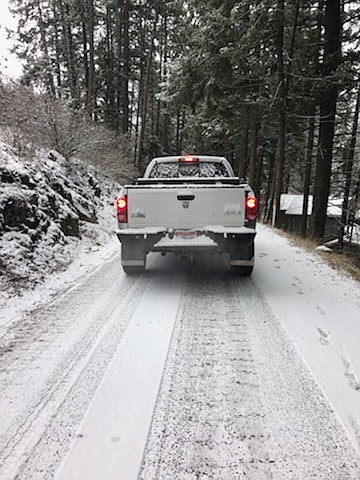
Courtesy of Lori Kae Baehr Drivers on Timothy Lane, a county road southeast of Coeur d’Alene, sometimes face only three choices after encountering oncoming semi trucks: backward, forward or over the edge. Residents on the rural road met with commissioners from the East Side Highway District Monday to brainstorm solutions.
A country road tucked away in the hills above Coeur d’Alene took centerstage at the East Side Highway District headquarters Monday, as locals met with commissioners to outline the challenges facing those who live and build on Timothy Lane.
“I don’t know if fixing the road is going to happen in our lifetime,” Lori Kae Baehr said after the meeting. “But as more people move in, it will get more traffic and more attention. [The meeting] was more of a re-explaining of our concerns, and I think they listened to us.”
Baehr joined a handful of concerned citizens in a series of interviews with the Coeur d’Alene Press, where they gathered to dissect the challenges of living on Timothy Lane, one that serves as a county road but, in places, doesn’t come within driving distance of meeting state code.
The dilemma was detailed in the Coeur d’Alene Press in December. As growth slowly reached past the southeastern corners of Coeur d’Alene over the past decade, new houses, new residents and new construction have overloaded the at-times one-lane incline of a forest road, turning it from a quaint and quiet traffic anomaly into a fingers-crossed dance with lumber-hauling semi trucks.
“Imagine trying to come up that road,” Baehr hypothesized for the Dec. 31 article. “Imagine you turn, come around the corner, and there’s a big truck at the bottom, heading down your way. [The other truck’s] not going to stop; he can’t. You’re going to have to stop and back all the way back down or find a place to pull over, and sometimes there isn’t a place. Sometimes you have to drive all the way back down ... It’s just one of many problems this road faces.”
The fact that the road is often iced over in the colder months causes some drivers concern, but the immediate problem isn’t actually putting in guard rails, widening the road, installing traffic lights or blasting nearby rock to expose potential turnarounds. The immediate problem is just paying for an engineer to perform the initial-but-necessary survey work.
“The commissioners agreed that it’s a problem,” Baehr said, “but the fix is always money. They went through the whole ‘Their budget is low’ thing, and I understand that. I wasn’t expecting anything different. It will cost money.”
“I think it went really well,” East Side Highway District supervisor John Pankratz told The Press. “It’s been brought to the board’s attention. It doesn’t change the funding availability that we’re limited with, but it’s in front of us, and that’s important.”
He added the process for changing a road begins before any survey work can be conducted.
“Before we can tell anybody how much this would cost or before we would want to spend any funds on engineering or geotechnical work, we’d want to get [the Idaho Transportation Department] involved, because part of Timothy Lane falls under federal jurisdiction,” he said.
Traffic from Interstate 90 hums over part of Timothy Lane. A since-grown-over end of the old road actually once connected to a pullover spot along the freeway, opening a potential avenue for an eventual fix.
“If that opened up onto I-90,” Baehr said, “that would probably solve a lot of problems.”
Pankratz cautioned restraint at that notion, however, as building an on-ramp is a bureaucratic traffic jam that could take decades to untangle, if it would happen at all.
Temporary strategies — some practical, others wishful — were discussed, including signage and a traffic signal. But those were just strategies, Pankratz urged, not solutions.
“It doesn’t solve anything,” he said. “It’s a way to manage the problem, sure. But it doesn’t fix the road.”
Part of Monday’s funding discussion centered on a Local Improvement District — having new and existing Timothy Lane residents share the costs. But that, Baehr said, shone an unanticipated revelation on residents currently enjoying a permit moratorium in the area.
“We realized that even if we agree, bite the bullet and do the LID, it just means they can start issuing new permits,” she said. “That means even more people will be moving up here.”
On the flip side, Baehr said doing nothing is not an option.
ARTICLES BY CRAIG NORTHRUP STAFF WRITER

Legislature gives Green the boot
John Green, in the midst of his first term representing Rathdrum, was expelled from the Idaho Legislature early Thursday afternoon.

No fast lane for grocery tax relief
This week saw an end to three bills devoted to helping residents pay for their groceries, dimming Gov. Brad Little’s hopes to shepherd relief to local shoppers.

Grocery credit bill stewing in Idaho House slow cooker
A bill that would increase the tax credit Idahoans receive to help offset the cost of groceries is tentatively scheduled for a vote in the state House today, but postponing that bill is becoming the norm, rather than the exception.