
Candidate takes issue with sign stipulation
Craig Northrup Staff Writer | Hagadone News Network | UPDATED 6 years, 2 months AGO
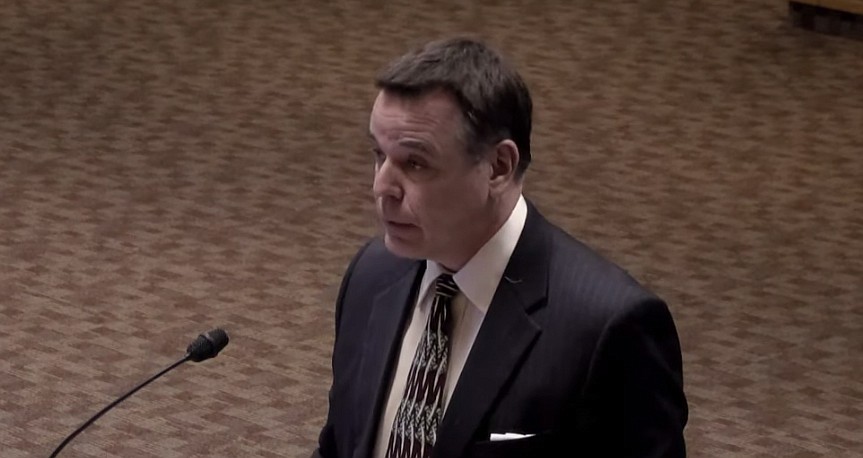
Grimm candidate for Kootenai County Sheriff, addressed the Coeur d’Alene City Council Tuesday night with his precedent-backed grievance that placing time restrictions on political signage is unconstitutional. (Courtesy City of Coeur d’Alene)
COEUR d’ALENE — When Mayor Steve Widmyer asked the small audience of onlookers Tuesday night if anyone wanted to step forward to address the council for public comments, John Grimm sprung to his feet.
“I’d like to talk to you tonight about your sign oridinance,” the candidate for Kootenai County sheriff told the City Council.
Grimm’s quick speech at the City Council meeting wasn’t the only message he was eager to express. Per Coeur d’Alene Code, Grimm has been keen to get his political message out.
For clarification, signs in Coeur d’Alene have to meet certain standards and follow certain rules, including:
- Rotating signs can’t exceed nine revolutions per minute.
- All signs have to be constructed with sound, durable materials.
- Any torn or damaged signs have to be fixed within a week.
- Signs can’t impede the travel or view of traffic.
- Signs may use changeable graphics to a maximum of 50 percent of the sign. The remaining area must be designed to use permanent graphics and/or lettering displaying the business name or purpose.
Kootenai County has a few rules regarding signage, as well. Signs that impede or confuse traffic, signs that aren’t structurally sound, roof signs, revolving signs or signs with moving parts, animated signs, signs with audio devices, flashing signs, signs advertising illegal activities and signs either obscene or indecent are all illegal, according to Kootenai County Code, as well as a few one-off prohibitions to boot. None, however, prohibit political signs.
The county does express its intent with a few topics that could impact political signage: “sign clutter” and temporary signage. County ordinances do state that temporary signs — which would include campaign-driven political signs — are often not built with the same structural integrity as permanent signs, therefore earning stricter scrutiny.
“Sign clutter” is exactly what it sounds like: an unseemly and disorganized display of signs that grow in both number and size for passing motorists. The county addressed its concern over “sign clutter” in its general purpose and findings without specifically targeting political signs.
On the flip side, the findings of Kootenai County’s signage ordinances and articles specifically champion First Amendment rights first and foremost, stating, “The purpose of this article is to set out regulations for the erection and maintenance of signs while preserving the right of free speech and expression … Because signs contain messages which may be protected by the first amendment to the United States Constitution and Article I, Section 9 of the Idaho Constitution, the board [finds] the adoption and enforcement of this article advances important, substantial, and compelling governmental interests.”
Political signs have to follow a few extra rules in Coeur d’Alene, however, one of which Grimm contends renders the whole ordinance illegal.
“The city of Coeur d’Alene has a sign oridnance that places additional restrictions on political signage,” he contended, “and the problem with that ordinance is that it’s been illegal since 2015.”
That ordinance — 15.24.270-C of the Coeur d’Alene City Code — states the following:
“Political signs may be erected for sixty (60) days prior to the decision in which such candidates or issues are to be decided upon. Such signs shall be removed not later than the fourth day following such election. Any such signs which have not been removed by the fifth day following such decision may be removed by the city’s building official.”
In other words, a candidate has a 60-day window before an election to post signs encouraging voters to choose him or her over another.
Grimm, however, sees that as a violation of property owners’ constitutional rights. And he said precedent — specifically the United States Supreme Court’s 2014 ruling in Reed v. the town of Gilbert, Ariz. — favors the candidate over the ordinance.
Reed v. Gilbert was a 2005 challenge to the Arizona town’s ordinance prohibiting, among other things, limitations on the length of time a sign could continue to promote a political candidate or cause. After rejections in lower courts, the Supreme Court finally ruled 10 years later that singling out and limiting a sign based on even its theme — politics, in this case — represented a form of censorship.
“In a nutshell,” Grimm argued to Council, “if your code enforcement officer needs to read the face of the sign to determine if a specific section of code applies to it, it is illegal. And it will not pass constitutional muster.”
Grimm said he had been in contact with City Attorney Michael Gridley, but to no avail.
“I’ve attempted to resolve this discreetly,” Grimm said, “... and we seem to be at some sort of impasse, I think.”
Gridley’s office did not respond to requests for comment. Widmyer, however, told both the Coeur d’Alene Press and Grimm that, considering this was the first time Council learned of the signage standoff, the city will have an answer no later than Friday.
“It was an issue that I was unaware of,” Widmyer said. “We have city legal staff reviewing it to see which direction we should take this.”
Grimm is running in the May 19 countywide sheriff’s race, which would start Coeur d’Alene’s 60-day signage window for candidates on March 20. This candidate, however, said those restrictions do not represent what the Founding Fathers had in mind.
“I can’t stand idly by as the First Amendment rights of the citizens of this county are being violated,” he said.
ARTICLES BY CRAIG NORTHRUP STAFF WRITER

Legislature gives Green the boot
John Green, in the midst of his first term representing Rathdrum, was expelled from the Idaho Legislature early Thursday afternoon.

No fast lane for grocery tax relief
This week saw an end to three bills devoted to helping residents pay for their groceries, dimming Gov. Brad Little’s hopes to shepherd relief to local shoppers.

Grocery credit bill stewing in Idaho House slow cooker
A bill that would increase the tax credit Idahoans receive to help offset the cost of groceries is tentatively scheduled for a vote in the state House today, but postponing that bill is becoming the norm, rather than the exception.